

Up to 5 billion people to be hit by rainfall changes this century if CO₂ emissions are not curbed, research shows
- Written by: Ralph Trancoso, Adjunct Associate Professor in Climate Change, The University of Queensland

Three to five billion people – or up to two-thirds of the world’s population – are set to be affected by projected rainfall changes by the end of the century unless the world rapidly ramps up emissions reduction efforts, according to new research by myself and colleagues.
To date, the effects of climate change on global rainfall has been uncertain. This has hampered our capacity to adapt to climate change and prepare for natural disasters.
Our method overcomes this uncertainty. We identified the regions where multiple climate models make similar projections about future rainfall impacts, and so reveal the global hot spots for drier and wetter conditions in future.
Our findings have deep implications for a large proportion of the world’s population – including millions of Australians.
Navigating the uncertainty of rain projections
Climate models are one of the main ways scientists understand how the climate behaved in the past and might change in future. They comprise millions of lines of computer code and use mathematical equations to represent how energy and materials move through the ocean, atmosphere and land. For future projections, climate models are driven by emissions scenarios representing various possible emissions trajectories.
Using climate models to simulate future rainfall patterns is a difficult task. Rain is influenced by complex factors, such as radiative balance (how much of the Sun’s energy is coming in versus how much is leaving), as well as climate drivers linked to specific sea surface temperature patterns, such as El Niño and La Niña. This means different climate models often produce different rainfall projections, especially at a regional level.
We wanted to investigate the extent to which climate models “agree”, or produce similar projections, about how CO₂ emissions may affect future rainfall around the globe.
There are several ways to do this. The usual method is to average out data collected over time – say, two decades. But this approach can eliminate important information and obscure vital insights into how rainfall will behave in future.
We used an innovative and more comprehensive approach based on “time-series” data, or data collected at regular intervals over time – comprising historical and future projections from 1980 to 2100. This approach accounts for continual changes over time, both in the recent past and out to the end of this century.
We analysed both the current and previous generations of climate models – 146 in all.
Read more: Yes, a few climate models give unexpected predictions – but the technology remains a powerful tool
The global hotspots
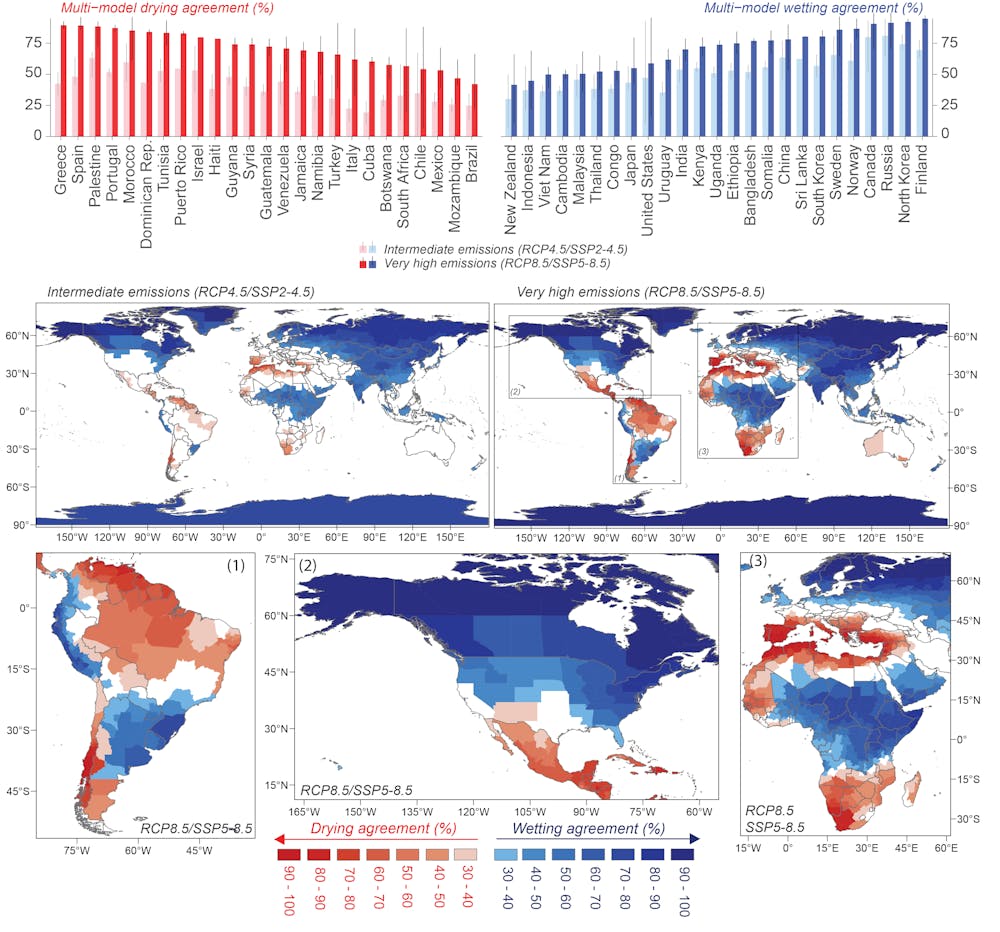
Our analysis showed several countries facing drier conditions in future. The top five most affected were Greece, Spain, Palestine, Portugal and Morocco, where at least 85% of models projected significantly reduced annual rainfall by the end of this century, under a worst-case scenario of very high emissions.
In contrast, for Finland, North Korea, Russia, Canada and Norway, more than 90% of models agreed on a trend towards increasing annual rainfall.
The picture was similar for most parts of the highly populated nations of China and India, which are together home to more than 2.7 billion people. In those nations, 70% of models agreed on projections for increasing rainfall.
Our analysis showed some European countries, including the United Kingdom, Germany and France, were generally projected to experience less rainfall in summer and more in winter. These increases and decreases offset each other, which means no change in total rainfall, but substantial changes in seasonal distributions over the year.
Using our approach, rainfall projections remained unclear for some parts of the world. These include most of Australia, as well as central Europe, southwest Asia and parts of the African west coast and South America.
All up, the regions getting wetter or drier under global warming cover a vast proportion of the globe. Under scenarios where emissions remain intermediate (where emissions decline to about half of 2050 levels by the end of the century), 38% of the current world’s population, or three billion people, would be affected by changes in rainfall.
If we experience very high emissions instead, 66% of the world’s population – or five billion people – would be affected. Many of these regions are already experiencing the wetting and drying effects of climate change.
A spotlight on Australia
Our analysis for Australia found climate models agree on a significant drying hotspot over the Indian Ocean, engulfing Australia’s southwestern and south coasts. Spring was the season with the greatest rainfall reduction over this region.
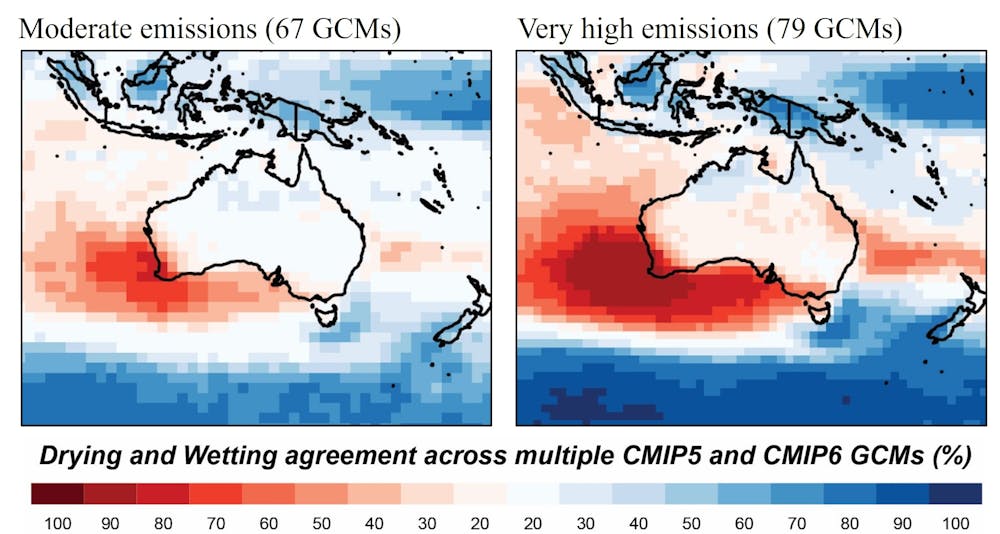 Red and blue regions show locations where drying and wetting was detected by multiple climate models
Author provided
Red and blue regions show locations where drying and wetting was detected by multiple climate models
Author provided
What about at a state level? Under a very high emissions scenario, half of models indicate future drier conditions for Victoria. This is driven by changes in winter and spring rainfall. Other states and territories with agreement for a drier future winter, also under a high emissions scenario, include the Australian Capital Territory and Western Australia. The models also project a reduction in spring rainfall in Tasmania.
Some 1.9 million Australians would be affected by these drying patterns, under an intermediate emissions scenario. They comprise those in southwest WA including Perth and the Wheatbelt region. Under very high emissions, as the impacted region expands fourfold towards western Victoria, around 8 million Australians could be affected.
Looking ahead
As climate change accelerates, it’s essential to understand the potential changes in global rainfall and the consequences on human populations.
My colleagues and I hope our findings reduce uncertainty about how rainfall patterns will shift around the world, and help governments and communities to design effective ways to adapt.
Authors: Ralph Trancoso, Adjunct Associate Professor in Climate Change, The University of Queensland


















