

Emily Wilson’s fluent new translation of the Iliad honours the epic poem’s power and beauty
- Written by: Chris Mackie, Emeritus Professor of Classics, La Trobe University
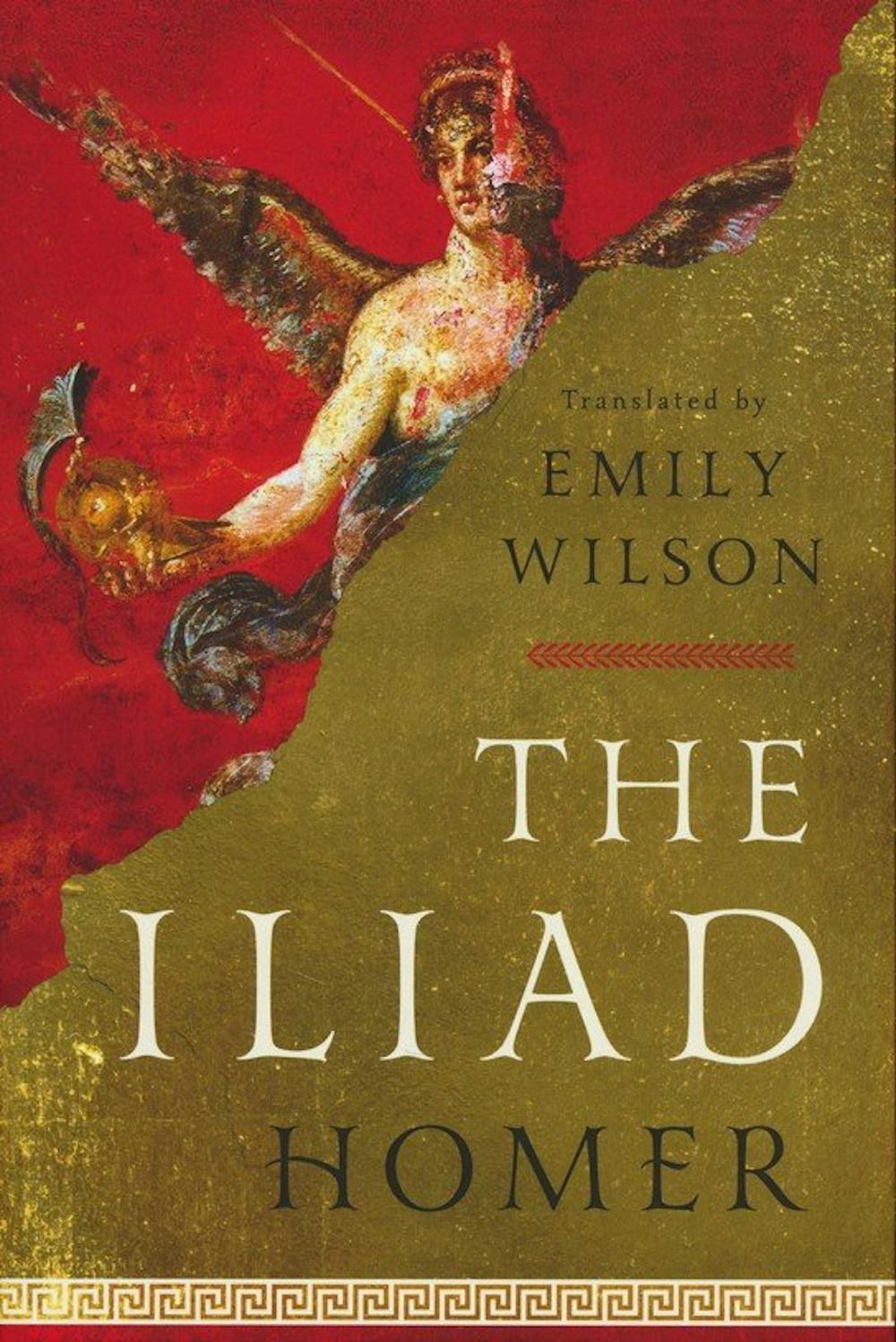
A new translation of the Iliad of Homer is cause for a general celebration, especially when the translator is Emily Wilson of the University of Pennsylvania.
Having turned her hand to translations of other Greek and Latin texts – notably Seneca, Euripides, Oedipus Tyrannos and Homer’s Odyssey – Wilson has moved on to the Iliad, joining an exclusive club of translators of this great work that includes Richmond Lattimore and Robert Fagles.
Review: The Iliad – Homer, translated by Emily Wilson (W.W. Norton)
This is an excellent publication where some bold decisions have been made to provide a sense of the sound and pace of the original text. As Wilson says in the translator’s note:
I wanted to honor the poem’s oral heritage with a regular and audible rhythm, and with language that would, like the original, invite reading out loud, and come to life in the mouth.
Thus, when reading Wilson’s Iliad one senses something of the chant of Homer’s verse, even through the written word.
Wilson’s book is much more than a translation. It contains a detailed introduction to the nature and dating of Homeric verse, the historical and archaeological issues of the Trojan war, the code of honour within which the Homeric heroes operate, and the broader mythical context of the war. The book could be a whole course in itself, if you wanted to make it one.
We are reminded, for instance, in a discrete section of the introduction, that the Iliad describes the destruction of Troy and the fate of its women, raped and abused by the conquering Greeks. Wilson writes that the “silencing, rape, subjugation, kidnapping and enslavement of women in war are essential instruments for the construction of male honor”.
The more one engages with the Iliad, the more one sees that it is not just a poem of immense power and beauty. It cast such a spell over antiquity that poets and artists after Homer spent much of their time engaging with it.
The Roman poet Vergil, for instance, whose epic poem the Aeneid (written about 700 years after the Iliad) was also focused on the Trojan war theme, may have known the Iliad off by heart. When we pick up Wilson’s translation we realise what a task that must have been.
Read more: Guide to the Classics: Virgil’s Aeneid
 The Wrath of Achilles – Louis Édouard Fournier (1881)
Public domain, via Wikimedia Commons
Devotees of Book 6 will also note how the text flows with remarkable ease:
When Hector finished speaking, Hecubawent in the house and shouted to her slavesto go through town and call the older women,and then she went inside her fragrant storeroom.In it, she kept her fine embroidered robes,Made by the women of SidoniaWhom godlike Paris Alexander broughtto Troy across the wide back of the sea,on that same journey when he brought back Helen,the daughter of the mightiest of fathers.
Book 6 is one of the more poignant books of the poem. The Trojan warrior Hector returns to the city from the fighting and talks with the women in his family: Hecuba, Andromache and Helen. It loses nothing in the Wilson translation. The reader might also note reference to Paris as “Paris Alexander” – a rather brilliant way of engaging with the fact that both names (i.e. “Paris” and “Alexander”) are used to describe him in the Iliad.
The Wrath of Achilles – Louis Édouard Fournier (1881)
Public domain, via Wikimedia Commons
Devotees of Book 6 will also note how the text flows with remarkable ease:
When Hector finished speaking, Hecubawent in the house and shouted to her slavesto go through town and call the older women,and then she went inside her fragrant storeroom.In it, she kept her fine embroidered robes,Made by the women of SidoniaWhom godlike Paris Alexander broughtto Troy across the wide back of the sea,on that same journey when he brought back Helen,the daughter of the mightiest of fathers.
Book 6 is one of the more poignant books of the poem. The Trojan warrior Hector returns to the city from the fighting and talks with the women in his family: Hecuba, Andromache and Helen. It loses nothing in the Wilson translation. The reader might also note reference to Paris as “Paris Alexander” – a rather brilliant way of engaging with the fact that both names (i.e. “Paris” and “Alexander”) are used to describe him in the Iliad.
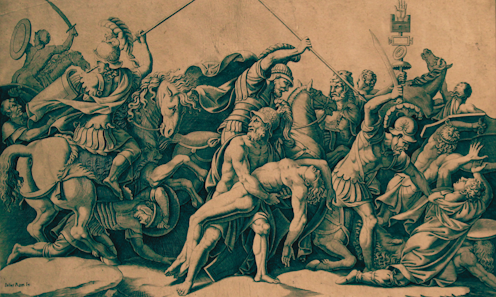
 Hector’s body dragged behind the chariot of Achilles – John Flaxman (1895).
Public domain, via Wikimedia Commons
Read more:
Guide to the classics: Homer's Iliad
So on the one hand Homeric purists should not be concerned about the disappearance of certain names or traditions from the Wilson translation. But this is not always the case.
The final book of the poem tells of the ransom mission undertaken by the Trojan king Priam and an old attendant to retrieve the body of Hector from Achilles, who has refused to give it over. The presence of Hermes is crucial in this particular book of the Iliad, because he is the god who oversees reciprocity and exchange. He acts as guide to the two old men.
But more often than not in Book 24 (and elsewhere in Homer) Hermes is called “Argeïphontês” (11 times), rather than “Hermes” (nine times). The name Argeïphontês seems to mean “Slayer of Argos”. It refers to a somewhat obscure narrative set in earlier times, in which Hermes killed a monster called Argos by first putting him to sleep and then striking him. The name Argeïphontês, it seems to me, is important in various ways, and it is something of a pity that it is dropped from the poem – although Wilson does maintain the monster-killing tradition by calling Hermes “the giant-slayer”.
Another surprising passage from Book 24 is Hermes’s arrival at Troy and his encounter with the two old Trojan men, Priam and Idaeus:
He reached the Hellespont and Troy. He touched down in a human guise.He looked like a young man, a magistrate,with beard first sprouting, the most handsome age.The humans drove beside the tomb of Ilus,then at the river made the mules and horseshalt for a drink. Dark night already coveredthe earth. Idaeus looked around and noticedHermes right next to them and said to Priam …
This passage, when I read it, seemed to me a strange translation, not the least for the references to a “magistrate” (i.e. a youthful Hermes) and “the humans” who drive past the tomb of Ilus. A “magistrate” in Homer’s Iliad? I don’t think so.
I don’t know what Wilson was thinking at this point, but she is alert to the danger of anachronism, which needs “to be balanced against an equally pressing danger: that archaism or unidiomatic English risks suggesting that the Iliad is more alien and more simplistic in its values than it really is”.
My two quibbles about Book 24 don’t add up to much in the context of this big work. I offer them as something to reflect upon. What is important about Wilson as a translator is that she has an unequivocal love for the text, which dictates almost all that she does:
I first began reading Homer in high school, early in the study of Ancient Greek. I liked the Odyssey, but I loved the Iliad with a passionate devotion. I have now lived with this poem for some 35 years.
We may be thankful for her love for the Iliad, and the longevity of it, and her generosity in offering it up to readers with very different backgrounds.
Authors: Chris Mackie, Emeritus Professor of Classics, La Trobe University
Hector’s body dragged behind the chariot of Achilles – John Flaxman (1895).
Public domain, via Wikimedia Commons
Read more:
Guide to the classics: Homer's Iliad
So on the one hand Homeric purists should not be concerned about the disappearance of certain names or traditions from the Wilson translation. But this is not always the case.
The final book of the poem tells of the ransom mission undertaken by the Trojan king Priam and an old attendant to retrieve the body of Hector from Achilles, who has refused to give it over. The presence of Hermes is crucial in this particular book of the Iliad, because he is the god who oversees reciprocity and exchange. He acts as guide to the two old men.
But more often than not in Book 24 (and elsewhere in Homer) Hermes is called “Argeïphontês” (11 times), rather than “Hermes” (nine times). The name Argeïphontês seems to mean “Slayer of Argos”. It refers to a somewhat obscure narrative set in earlier times, in which Hermes killed a monster called Argos by first putting him to sleep and then striking him. The name Argeïphontês, it seems to me, is important in various ways, and it is something of a pity that it is dropped from the poem – although Wilson does maintain the monster-killing tradition by calling Hermes “the giant-slayer”.
Another surprising passage from Book 24 is Hermes’s arrival at Troy and his encounter with the two old Trojan men, Priam and Idaeus:
He reached the Hellespont and Troy. He touched down in a human guise.He looked like a young man, a magistrate,with beard first sprouting, the most handsome age.The humans drove beside the tomb of Ilus,then at the river made the mules and horseshalt for a drink. Dark night already coveredthe earth. Idaeus looked around and noticedHermes right next to them and said to Priam …
This passage, when I read it, seemed to me a strange translation, not the least for the references to a “magistrate” (i.e. a youthful Hermes) and “the humans” who drive past the tomb of Ilus. A “magistrate” in Homer’s Iliad? I don’t think so.
I don’t know what Wilson was thinking at this point, but she is alert to the danger of anachronism, which needs “to be balanced against an equally pressing danger: that archaism or unidiomatic English risks suggesting that the Iliad is more alien and more simplistic in its values than it really is”.
My two quibbles about Book 24 don’t add up to much in the context of this big work. I offer them as something to reflect upon. What is important about Wilson as a translator is that she has an unequivocal love for the text, which dictates almost all that she does:
I first began reading Homer in high school, early in the study of Ancient Greek. I liked the Odyssey, but I loved the Iliad with a passionate devotion. I have now lived with this poem for some 35 years.
We may be thankful for her love for the Iliad, and the longevity of it, and her generosity in offering it up to readers with very different backgrounds.
Authors: Chris Mackie, Emeritus Professor of Classics, La Trobe University 



















