

Banksias are iconic Australian plants, but their ancestors actually came from North Africa
- Written by: Byron Lamont, Distinguished Professor Emeritus in Plant Ecology, Curtin University
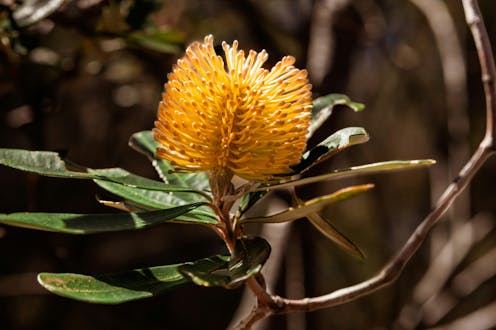
Few plants conjure up the Australian bush better than banksias, whose beautiful flowers are irresistible to honeyeater birds, small marsupials and nature lovers.
But our research, published in Perspectives in Plant Ecology, Evolution and Systematics, shows that the ancestors of banksias actually migrated here from North Africa.
From early fossil pollen studies, we already knew that the protea family (Proteaceae), which includes banksias, grevilleas, waratahs and macadamias in Australia, originated in northwest Africa 130 million years ago.
Our task was to track their migration to Australia, where they became the unique symbols of the Australian bush that we admire today. To give credit where it’s due, we need to know where our natural heritage originated. So, how did this iconic group of plants get here?
Looking at the entire family
Our study relied on two approaches. We used a DNA assessment of the entire protea family to create an evolutionary tree. Then we inserted key fossil pollen records of a known age into the tree, to serve as a “molecular clock”. This helped us work out the time of origin of all genera in this family.

We then searched the literature for records of ancient sedimentary deposits that contain fossil pollen with affinities to banksias in Africa, South America, Antarctica (which was covered in forest until 40 million years ago) and Australia.
This was made possible by the fact the hard walls of pollen grains allow them to be preserved for millions of years. Also, the pollen grains of plants in the protea family are quite distinctive from those of other families. We then compared the dates and locations of the fossil pollen against our family tree.
This showed that by 120 million years ago, the ancestors of banksias had begun crossing into northeast South America. The two continents remained joined at their tips until 100 million years ago.
The plants then migrated down the east side of South America – first reaching the Scotia Isthmus about 110 million years ago – and crossed onto the Antarctic Peninsula.
Read more: The coastal banksia has its roots in ancient Gondwana
Two routes into Australia
Here, the ancestors separated into two groups. One, the soft-leaved group, followed a cool-temperate rainforest pathway (dark for up to four months of the year) along the south side of Antarctica. They entered Australia via Tasmania from 105 million years ago.
The rainforest elements continued up the east coast, with some eventually reaching New Guinea; others entered New Caledonian rainforests directly from southern Antarctica. This route remained open until 45 million years ago, when Australia and Antarctica finally separated.
The other, hard-leaved group followed an open, fire-prone woodland pathway along the warmer, sunnier northern side of Antarctica. They entered Australia via the southwest tip that remained attached to Antarctica until about 70 million years ago.
The two points of entry were separated by a huge inland sea that occupied the Great Australian Bight during that period.
 Migratory pathway taken by the ancestors of banksias beginning 132 million years ago in north Africa. Note how the ancestors split into two groups on entering Antarctica from South America, banksia itself entering via southwest Australia and the rainforest species via Tasmania.
Modified from Lamont et al. (2024) Perspectives in Plant Ecology Evolution and Systematics
Migratory pathway taken by the ancestors of banksias beginning 132 million years ago in north Africa. Note how the ancestors split into two groups on entering Antarctica from South America, banksia itself entering via southwest Australia and the rainforest species via Tasmania.
Modified from Lamont et al. (2024) Perspectives in Plant Ecology Evolution and Systematics
A proliferation of banksias
Since banksia itself appears to have arisen 100 million years ago, the genus either evolved in northeast Antarctica or at the extreme corner of southwestern Australia. From there, they spread to the rest of Australia over the next 50 million years.
Banksias now consist of around 200 species, 90% of which are endemic to southwestern Australia. Ancestors of the bulk of the hard-leaved genera, such as grevilleas, hakeas, macadamias and waratahs, also entered Australia via the southwestern tip. They then migrated east along the margins of the Nullarbor Plain – thickly vegetated back then – to southeast Australia.
Until the results of our new study, it was believed the protea family arose in Australia and spread from here to Africa, South America, New Caledonia and Asia. Almost all migration would have needed to be over the oceans, as it was thought to have happened after the breakup of the Gondwanan supercontinent.
In fact, the journey was entirely overland as it occurred when Gondwana was largely intact, except for the early departure of Greater India.
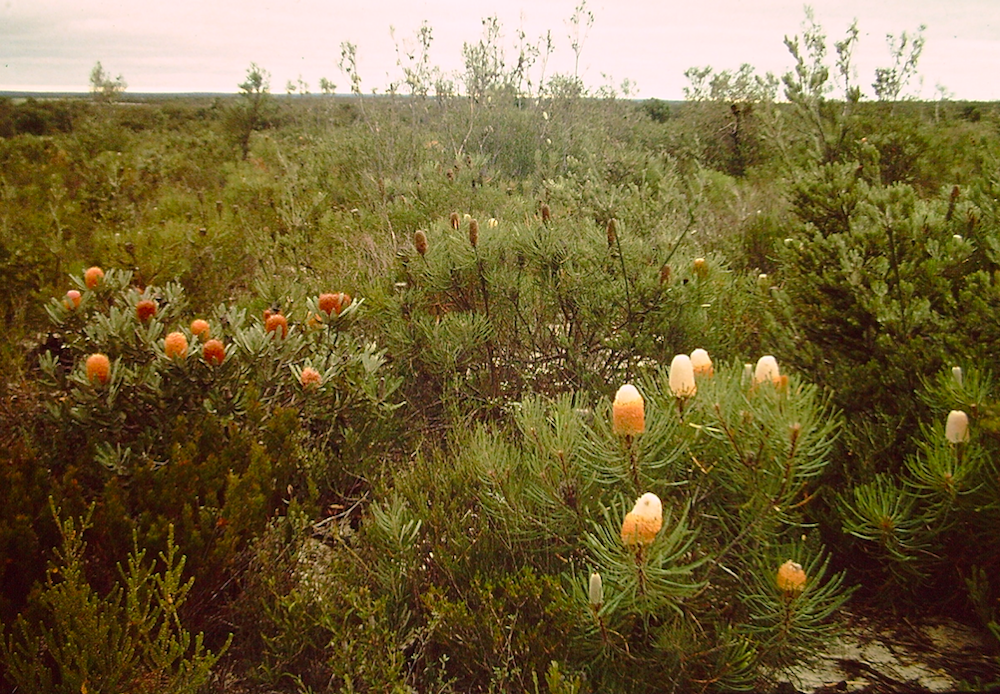 Banksia shrubland 300km north of Perth, Western Australia. Three species of banksia, about 1.5 metres tall, are present in this image as well as several other members of the protea family, such as Adenanthos and Xylomelum.
Byron Lamont
Banksia shrubland 300km north of Perth, Western Australia. Three species of banksia, about 1.5 metres tall, are present in this image as well as several other members of the protea family, such as Adenanthos and Xylomelum.
Byron Lamont
Plants out of Africa
Anthropologists are keen to point to the “out of Africa” hypothesis for the origin and migratory history of humans. It now appears such a hypothesis is equally applicable to some important groups of plants.
This is the first time the southwest corner of Australia has been recognised as a major migratory route for the protea family.
We now need to take seriously the Antarctic–southwest Australian link as a likely major entry route for many other hard-leaved plant groups into Australia. They could have originated in Antarctica and South America, and possibly even Africa.
This north Antarctic pathway might well also apply to eucalypts, whose oldest records are for southern South America, as well as currently endemic animals and microbes.
Authors: Byron Lamont, Distinguished Professor Emeritus in Plant Ecology, Curtin University


















