

Australia’s soils are notoriously poor. Here’s how scientists are working to improve them
- Written by: Ryan Borrett, Science Communications Coordinator, Murdoch University
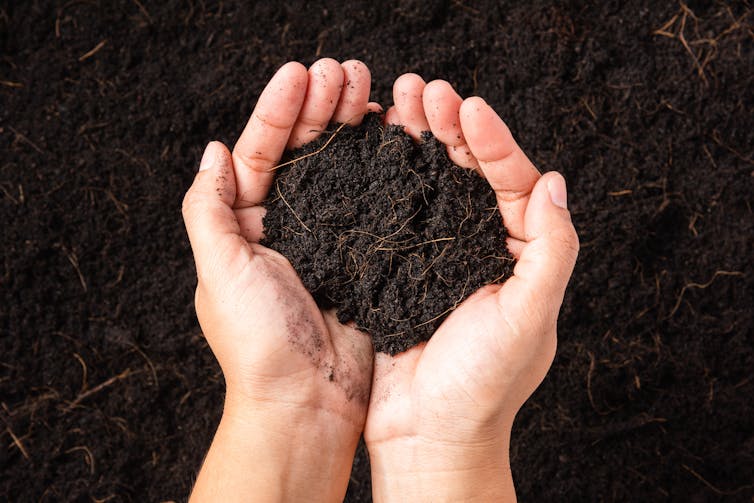
Most things you eat grew in soil or ate plants growing in soil. We don’t think much about it, but soil is essential to life.
During the last Ice Age, much of the northern hemisphere was covered in glaciers. As they moved, glaciers eroded away the top layer of rock and left a fresh layer of rock, ready to weather into soil.
But Australia didn’t have this renewal of soil from grinding ice – or from volcanoes, which dredge up minerals vital to plant life from deep below. As a result, our soils are famously very poor – heavily weathered, old, and short on nutrients. This is one reason why we have so much land devoted to grazing animals (crops need more nutrients than grass does), a heavy reliance on fertilisers and a detailed knowledge of fertile soils where they exist.
Unfortunately, our soils – valued at A$930 billion – are under threat. The latest State of the Environment report rated the health of our soils as “poor” and declining. Late last year, the government released a national plan to improve our soils.
Researchers are working on ways of improving Australian soils to make agriculture more sustainable and less reliant on fertilisers. Here are some examples.
From farm to food
You might wonder what the problem is. Aren’t we growing and exporting more food than ever? Farm productivity and incomes are at record highs and many farmers are adopting more efficient practices informed by research to help manage their soil amid new risks such as shifting rainfall and flash droughts.
But many of our soils are fundamentally vulnerable because they function in old and weathered landscapes. To keep the food coming, farmers have had to resort to clearing more land and increasing fertilisers, pesticides and herbicides. That works short term. But there are increasing concerns this intensive approach ends up making soil worse – more eroded, more saline and more acidic. All three of these are worsened by our changing climate.
Read more: 'Regenerative agriculture' is all the rage – but it's not going to fix our food system
What can be done?
Soil scientists have long worked on ways to get more out of our soils. The Green Revolution of the 1960s led to huge increases in yield – but required huge increases in application of fertilisers and other chemicals.
In Australia, farmers will likely have to rely on fertiliser for the foreseeable future as a way to correct soils which are naturally short on nutrients.
What we can do is learn to apply fertiliser only when it’s needed. That’s good for farmers – fertiliser is expensive – and good for the health of soil and nearby waterways.
Read more: What sub-Sahara can learn from India's 'Green revolution': the good and the bad
In southwest Western Australia, for example, soil scientists are working to understand how best to dose the soil with nitrogen, potassium and phosphorus – and how much to use.
In another project, scientists are working with farmers and land managers to sample and test their soil and interpret the data together. The goal is to pare back fertiliser use, which improves water quality in nearby waterways and estuaries, as unused fertiliser runs off and can trigger algal blooms.
Precision application of fertiliser is one method. But there are many other innovative soil projects across Australia.
For instance, fungi do vital work in cycling soil nutrients. And mycorrhizal fungi go one step further and live in symbiotic relationships with plants. What if we could use these fungi as a kind of living biofertiliser for grain crops? Scientists are exploring the potential for one such species, the ridge-stemmed bolete (Austroboletus occidentalis), to play this role.
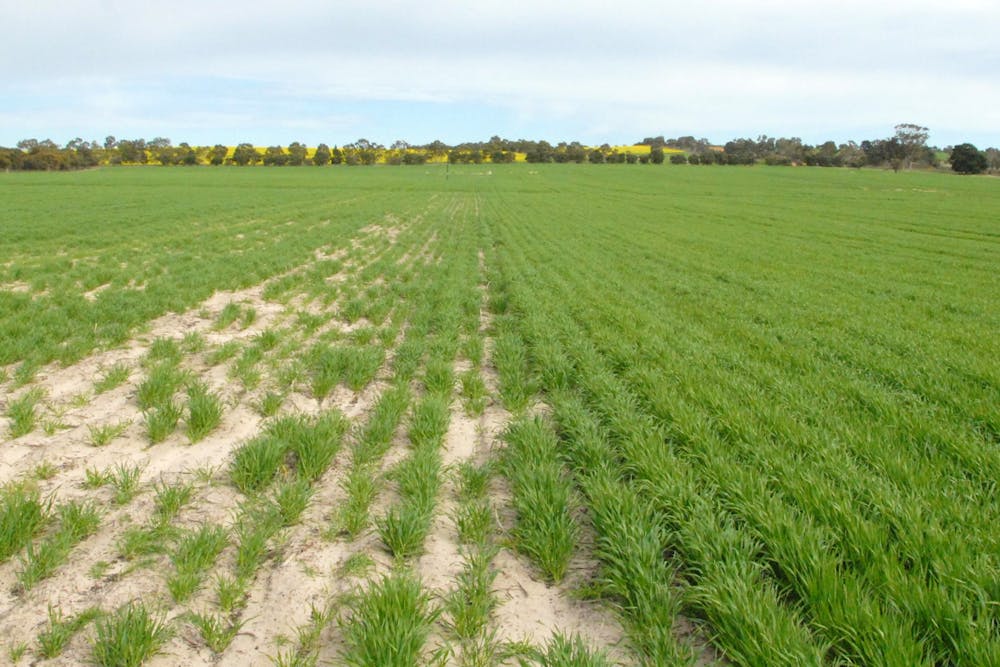 Soil management practices can help overcome barriers to plant growth. On the right, wheat is growing in soil helped by strategic tillage – done once in a decade – while those on the left are in untreated soil.
SoilsWest
Soil management practices can help overcome barriers to plant growth. On the right, wheat is growing in soil helped by strategic tillage – done once in a decade – while those on the left are in untreated soil.
SoilsWest
It’s alive!
Researchers recently estimated soil contains about three-fifths of all species on the planet, including bacteria, fungi, viruses, nematodes, mites, worms and insects.
Soil is, in short, teeming with life. Some underground lifeforms are pests to farmers, chewing on the roots of crops. But many others are beneficial.
If we improve our understanding and measurement of soil microorganisms, we could use them to speed up recovery of degraded landscapes, such as former mine sites or unproductive farmland.
Our understanding of how things living in soil impact environments and respond to change is rapidly growing, but we are still scratching the surface. For example, more than 90% of the estimated 5 million species of fungi are currently unknown.
Digging deeper
Australia has the world’s third highest loss of soil carbon over the last 250 years, caused largely by very high rates of land clearing. We risk releasing even more soil carbon in the future, as climate change is expected to worsen erosion and bushfire intensity.
One response by the government has been to create a market for soil carbon credits, the first of which went on sale last year. The market-based approach has been widely criticised. Soil experts have called for the credit system to be much more robust to ensure it actually works.
Research into the problems facing our soil is important, but we’ll need government and industry backing to better coordinate the response.
That’s why last year’s action plan has been broadly welcomed, despite being 18 months overdue. The joint federal-state plan indicates governments at both levels recognise the danger to our soil. Framed around securing soil as a “national asset”, the plan envisages standardising soil data collection and sharing, accelerating uptake of best-practice soil management, among other things.
Will it stop the damage done to our lifegiving soils? That remains to be seen.
Authors: Ryan Borrett, Science Communications Coordinator, Murdoch University


















