

what's the difference between decodable and predictable books, and when should they be used?
- Written by: Simmone Pogorzelski, PhD Candidate, Sessional Academic, Edith Cowan University
A child’s early experiences with books both at home and later in school have the potential to significantly affect future reading performance. Parents play a key role in building oral language and literacy skills in the years prior to school. But it’s teachers who are responsible for ensuring children become readers once at school.
While there’s much we know about how students learn to read, research on books used to support beginning reading development is sparse. Guidelines provided in the Australian Curriculum and the National Literacy Progressions complicate matters further. Teachers are required to use two types of texts: decodable and predictable books.
Read more: Explainer: what is phonics and why is it important?
Each book is underpinned by a different theory of reading, arguably in conflict. This contributes to uncertainty about when and how the books might be used.
The difference between decodable and predictable books
Predictable books and their associated instructional strategies align with a whole-language approach to reading.
In this approach, meaning is prioritised. Children are encouraged to draw on background knowledge, memorise a bank of the most common words found in print, and to use cues to guess or predict words based on pictures and the story. This method is not consistent with a phonics approach.
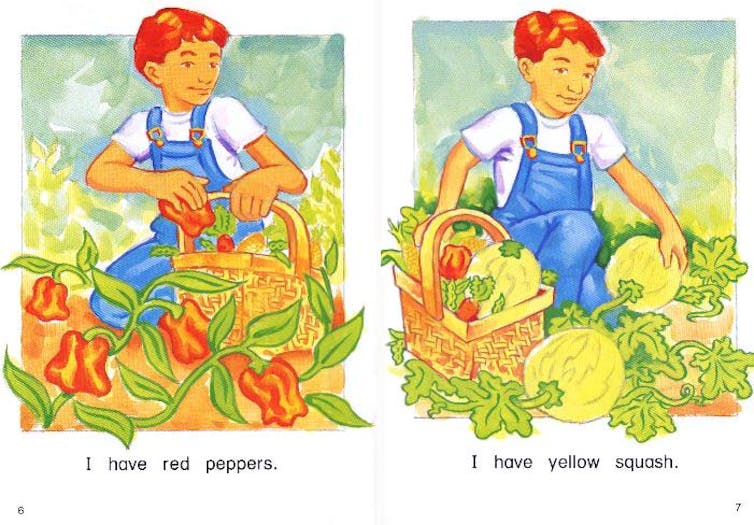 This is a good example of predictable text.
Author provided, Author provided
This is a good example of predictable text.
Author provided, Author provided
At the earliest levels, predictable and repetitive sentences scaffold beginning readers’ attempts at unknown words. Word identification is supported by close text to picture matches and familiar themes for children in the early years (such as going to the doctor).
While there is some evidence the repetitive nature of predictable books facilitates the development of fluency, the features contained within disadvantage young readers as they do not align with the letter-sound correspondences taught as part of phonics lessons. This is particularly problematic for children who are at risk of later reading difficulties.
In comparison, decodable books consist of a high percentage of words in which the letters represent their most common sounds. Decodable books align with a synthetic phonics or code-based approach to reading. This approach teaches children to convert a string of letters (our written code) into sounds before blending them to produce a spoken word.
The reading video above is an example of a child reading one of the many widely available decodable books.When reading decodable books, children draw on their accumulating knowledge of the alphabetic code to sound out any unknown words. Irregularly spelt words (for example was, said, the) are also included, and children receive support to read these words, focusing on the sounds if necessary.
There is mounting evidence for the use of decodable books to support the development of phonics in beginning readers and older kids who haven’t grasped the code easily. Decodable books have been found to promote self-teaching, helping children read with greater accuracy and independence. This leads to greater gains in reading development.
The role of books in early reading development
Children need lots of opportunities to practise reading words in books. Given research demonstrates a synthetic phonics approach provides young readers with the most direct route to skilled reading, there’s a strong logical argument for supporting early reading with decodable books.
Read more: As easy as ABC: the way to ensure children learn to read
Until the most recent version of the Australian Curriculum, only predictable books were included in the Foundation and Year one English curricula. The addition of decodable books recognises the critical support they provide beginning readers. But this places teachers in a difficult position because the elaborations in the curriculum documents place more emphasis on the strategies designed primarily for use with predictable books.
Using different books in the classroom
While reading is an extraordinarily complex process, a model of reading called the Simple View of Reading is very helpful from an educational perspective. It explains skilled reading as the product of both decoding and language comprehension. This helps us understand what we need to do when teaching children to read, and the types of books they need to support early reading development.
Before they enter school, the majority of children are considered to be in the “pre-alphabetic” stage of reading. In this stage, children have little or no understanding the written code represents the sounds of spoken language. They would not have the skills to use decodable books.
Instead, they recognise words purely by contextual clues and visual features. For example, children know the McDonalds sign because of the big yellow arches (the M) or can read the word “stop” when they see the sign, but not out of that context.
Predictable books would help the pre-alphabetic reader gain insight into the workings of texts, especially with regard to meaning. In particular making the connection between spoken words – which they are familiar with – and written words, which they are not.
 After decodable books have been used to get children beyond beginning reading, real books provide broader vocabulary and language structure.
from www.shutterstock.com
After decodable books have been used to get children beyond beginning reading, real books provide broader vocabulary and language structure.
from www.shutterstock.com
Beyond this stage, predictable texts become less useful because memorisation and meaning-based strategies aren’t sustainable long term. Once children have advanced to the partial and full alphabetic stages of reading, usually fairly quickly after starting formal reading instruction, they benefit more from decodable books which allow them to apply the alphabetic code.
So where to from here?
There is no evidence children benefit from the continued use of decodable books beyond the beginning stages of reading. In the absence of any empirical studies, we suspect it would be a good idea to move children on once they have sufficient letter-sound knowledge and decoding skills that they can apply independently. At this point, the introduction of real books would benefit students and provide access to more diverse language structures and vocabulary.
Read more: International study shows many Australian children are still struggling with reading
Given what we know about how reading works, it makes sense for children in the early stages of learning to read to be given decodable books to practise and generalise their developing alphabetic skills. At the same time, they will continue to benefit from hearing the rich vocabulary and language forms in the children’s books being read with (to) them.
It’s less clear what predictable texts contribute to beginning reading in schools when considering how reading skills develop. But there is evidence they might have a useful role to play in pre-school prior to the start of formal reading instruction.
Authors: Simmone Pogorzelski, PhD Candidate, Sessional Academic, Edith Cowan University


















