

Expanding suspension powers for schools is harmful and ineffective
- Written by: Linda J. Graham, Professor in the School of Early Childhood & Inclusive Education, Queensland University of Technology
New research released today reveals extraordinary increases in suspensions and exclusions in Queensland state schools. But these increases don’t necessarily mean student behaviour is getting worse.
Education reform and changes in school policy can also contribute to rising rates of school exclusions and suspensions. Some groups of students can be more adversely affected by these changes than others. It is important to examine policy effects because suspensions and exclusions are more harmful than helpful and tend not to resolve the behaviour in question.
This research is relevant to all education sectors and states as rising school suspension rates are not unique to Queensland. Other states are implementing reforms that could lead to similar problems.
Why were changes to legislation made?
In 2014, the Queensland government introduced legislation to grant school principals greater disciplinary powers. Among these new powers were options to impose community service and Saturday detentions.
Read more: Why suspending or expelling students often does more harm than good
The Queensland government also changed the maximum length of short suspensions from five to ten days and axed the appeals process. Parents are now unable to appeal short suspensions and, in the case of a long suspension (11 to 20 days), must apply to the Director-General of the Education Department.
One rationale provided for the Queensland government’s change to legislation was school exclusions were increasing and the government wanted to give principals more flexible options to respond to problem behaviour. In response to early community concern about emerging effects, the Education Minister promised schools would adjust and these changes would soon lead to a reduction in suspensions and exclusions.
They didn’t.
Which students were most affected and why?
Expanding principals’ disciplinary powers adversely affected students in all year levels in Queensland state schools but, particularly, high school students and those entering primary or secondary school for the first time.
In this study, exclusions and suspensions were examined as a proportion of enrolments. This takes into account increases or decreases in student numbers which may affect the number of suspensions reported each year.
Between 2013 and 2014, suspensions in the first or Preparatory year of primary school rose by 51.28% (as a proportion of enrolments) and have continued to increase each year since. Suspensions in year seven increased by 19.92% in 2014 and again, by a whopping 82.54%, in 2015. These rates show no sign of slowing.
Although some of the increases may appear moderate, if suspensions were keeping pace with enrolment growth, there should be no proportional increase. In other words, suspension growth outstripped enrolment growth in the Queensland state school system, which suggests something other than student numbers is driving suspension increases.
Two other education reforms occurred in Queensland around the same time as the expansion of principals’ powers. The first involved a reduction in the school starting age which meant children entering Prep in 2015 can be as young as four and a half years old when they first begin formal schooling. The second reform, also in 2015, involved moving year seven from the primary to secondary schooling phase.
Read more: Help disruptive students, don't just suspend them
The most powerful indication something other than student behaviour is driving suspension increases is the doubling of the suspension rate for year sevens in 2015. The only observable difference between the year sevens in that year and those every year before them is the school environment.
Why do increases in suspension matter?
Research shows suspension is associated with an increase in anti-social behaviour and contact with the criminal justice system, due to a lack of adult supervision and greater freedom to associate with deviant peers. Contrary to popular belief, suspension does not promote behavioural change.
This is because inappropriate behaviours need to be replaced, and replacement behaviours need to be explicitly taught. Sending kids home doesn’t give them the skills they need to do better next time or help solve the problem that led to the suspension.
There is conclusive evidence suspension leads to academic failure and school dropout, even after controlling for prior achievement. This is because suspension weakens students’ sense of school belonging and makes gaps in achievement worse by taking vulnerable children away from teaching and learning, rather than providing them with the support and positive guidance they need.
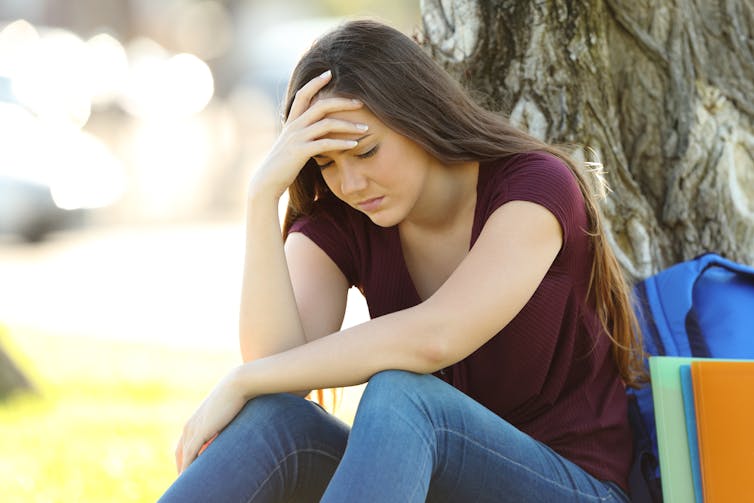 Suspension can predict contact with the criminal justice system.
from www.shutterstock.com
Suspension can predict contact with the criminal justice system.
from www.shutterstock.com
Disadvantaged children, children with a disability, Indigenous children and children in out-of-home care are all significantly overrepresented in school suspension statistics. These are the children who most need to be at school and for whom suspension is most likely to have serious and long-term negative impact.
Suspension is also known to reinforce problem behaviours. For example, if a student is persistently engaging in task avoidance, disruption or truanting, suspension will reward that behaviour. Rather than decrease the behaviour, suspension will increase it.
In short, there is no evidence to support the increased use of suspension and ample evidence governments should try to limit or even eradicate its use.
When is suspension appropriate and when is it not?
There are times when suspension is appropriate, such as when a student brings drugs or a weapon to school, or engages in physical violence resulting in injury. Hitting a teacher is never OK. But even here, it’s important to make sure a frightened five-year-old accidentally connecting with a teacher mid-meltdown is not construed as a deliberate act of violence.
Sustained bullying (cyber or otherwise) is another example where suspension may be appropriate. But in-school suspension, where students are removed from their regular classes and required to complete their work in a supervised setting, is a better option than out-of-school suspension.
Read more: Excluding Indigenous youth from schools may severely increase their risk of incarceration
Extreme behaviours are not the only reasons principals suspend and there are instances where it’s done for the wrong reason. Suspending a student to appease teachers or other parents, or to “send a message” to other students are inappropriate uses of suspension.
What are better ideas?
Knowing the source of behaviour is the most important key to solving it. This is because similar behaviours can have very different antecedents and responses that don’t address the root problem will fail.
For example, a common frustration for teachers is when students appear not to listen in class and continually ask for further explanation or don’t follow instructions. Careful observation and clarification with students will provide clues as to why some appear not to be listening.
Some may have a language disorder and may be experiencing difficulty understanding what was said. Others may have attention difficulties or poor working memory and may miss key information.
Such difficulties are common among students receiving suspensions. Without consistent, high-quality responsive teaching, these students will experience failure and frustration, leading to classroom disruption and conflict with teachers.
 Negative behaviours need to be replaced with positive ones, not just removed from the classroom.
from www.shutterstock.com
Negative behaviours need to be replaced with positive ones, not just removed from the classroom.
from www.shutterstock.com
For students who have language disorders or attention difficulties, teachers can adopt proactive strategies that benefit all students. These strategies include:
clear and consistent routines
well-designed seating plans
variations in verbal tone and pace with frequent pauses to allow students to process information
clear and simple verbal instructions delivered in logical sequence
visual aids to enhance students’ comprehension of verbally described concepts and/or complementary written instructions
regular reiteration of learning objectives, instructions, and classroom expectations
positive reinforcement of good behaviour and recognition of effort
providing one-to-one clarification and feedback to students who experience learning and behavioural difficulties
in-class pairing with another student who is a friendly and academically supportive role model.
For some students these strategies will not be enough on their own and these students will need more intensive supports, such as targeted interventions to enhance academic skills, counselling, mentoring/monitoring, and skills training for teachers.
Using proactive supports to address underlying issues, de-escalating conflict when it occurs, and using in-school suspension as a last resort will help address rising suspension rates. Governments should be acting in the best interests of everyone by backing approaches that have positive evidence and backing away from those for which there is none.
Authors: Linda J. Graham, Professor in the School of Early Childhood & Inclusive Education, Queensland University of Technology
Read more http://theconversation.com/expanding-suspension-powers-for-schools-is-harmful-and-ineffective-106525


















