

If plants can pick fungi to help fight pests and diseases, it opens a door to greener farming and ecosystem recovery
- Written by: Adam Frew, Lecturer and ARC DECRA Fellow, Hawkesbury Institute for the Environment, Western Sydney University
Just beneath your feet, an ancient and silent alliance endures. This alliance between plants and arbuscular mycorrhizal (AM) fungi is one of the oldest biological partnerships on Earth.
Going back almost half-a-billion years, this relationship paved the way for plants to make it onto land. These early plants, simple and without the complex root systems of plants today, forged an alliance with fungi. This alliance has been instrumental to the evolution of plant life and has helped shape our ecosystems.
These fungi grow into roots where the plants supply them with the carbon (as sugar and fat) they need to survive. The fungi extend thin root-like threads called mycelia into the soil to make expansive networks that can access nutrients beyond the reach of plant roots.
But these hidden microbes do more than just help plants get nutrients. Plants are constantly dealing with insect pests and diseases, and have done for a long time. To deal with this, they evolved sophisticated defences. AM fungi can dramatically enhance these defences.
So could plants be picking their fungal allies based on their ability to enhance defences against pests and diseases? We recently explored this question and proposed hypotheses around how this could happen. The answer could have huge implications for making agriculture more sustainable.
Harnessing the ancient alliance
Considering the benefits AM fungi can provide plants, it’s no surprise there has been a lot of interest in using them in environmental management. Studies show AM fungi can have huge benefits for ecosystem restoration by supporting the establishment of native plant communities. Their importance to ecosystem function makes it clear mycorrhizal fungi should be included in conservation efforts.
In agricultural systems, fungi can increase crop growth, nutrient uptake and yields. These benefits have been a major focus for researchers since the 1950s.
While there is ample evidence of the benefits AM fungi can provide for crops, results in the field are inconsistent. There can be a mismatch between the nutritional needs of the crops and the ability of the fungi that are present or introduced to the soil to meet those needs.

Do plants pick their fungal partners for defence?
Within the roots of a single plant, numerous fungal species can co-exist, forming complex communities. The species that make up these communities may each offer different capabilities – some are better at defence, while others are better at nutrient uptake. The benefit a plant gets from its fungal partners is, in part, determined by which species are present within its roots.
We can apply AM fungi to the soil but this doesn’t mean these fungi will actually partner up with the plant.
So what determines which fungi gain entry to the roots? Do plants have a say in this? And, if so, how do they choose? These questions have long been on the minds of ecologists and biologists.
At the core of this relationship is a complex exchange system. Plants provide the fungi with carbon they need, and the fungi provide benefits to the plants.
Research has shown a plant will play favourites (at least in some cases) with the fungi. They will partner up and give more carbon to the fungi that provide the most nutrients.
Yet there are significant challenges to exploiting these nutritional benefits in agriculture, where large inputs of nutrients are added to the soil. This can limit our ability to use the fungi in this way by removing plant reliance on the fungi for nutrients.
But can we exploit this partnership for plant defences? Globally, insect pests consume up to 20% of the major grain crops alone.
Given that we know plants can play favourites, could they select their fungi to boost defence? We have developed hypotheses to try to better understand this question, to set the stage for future research.
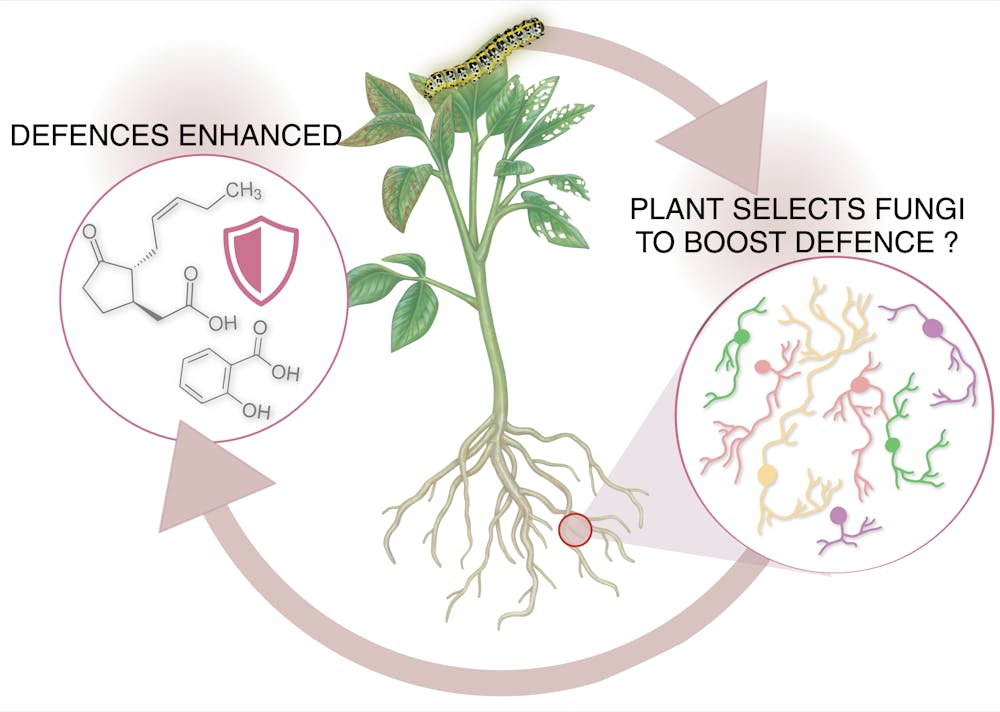 Potential defence-based selection of mycorrhizal fungi by plants.
Author provided
Potential defence-based selection of mycorrhizal fungi by plants.
Author provided
A complex question with big implications
There are many complications. When a plant is under attack by pests, this compromises its ability to supply carbon to its fungal allies, as its carbon resources are strained. It is still not known how these changes affect the plant’s “choice” of fungal partners.
We need a better understanding of how such choices happen and how herbivores can interfere with the ability of plants to reward those fungi providing the most benefit.
However, if plants can pick out the fungi that help them fight off pests and diseases, it could change the way we think about nature’s partnerships. It has big implications for farming, conservation and restoring damaged environments.
Knowing how plants select fungal allies would pave the way for better-defended crops, reducing the need to apply synthetic pesticides. It would open up exciting possibilities for helping ecosystems recover and thrive.
The possibility that plants can identify and select fungi based on the benefits they derive opens up exciting new frontiers in ecological research. As we explore these underground interactions, we inch closer to harnessing the potential of one of the Earth’s oldest symbioses. It is a reminder of the complex relationships that maintain life on the planet, connections that are as important today as they were 500 million years ago when the first plants reached for the sun above and the fungi below.
Authors: Adam Frew, Lecturer and ARC DECRA Fellow, Hawkesbury Institute for the Environment, Western Sydney University


















