

King Charles is having cancer treatment. What can he, and others with cancer, expect?
- Written by: Sathana Dushyanthen, Academic Specialist & Lecturer in Cancer Sciences & Digital Health| Superstar of STEM| Science Communicator, The University of Melbourne
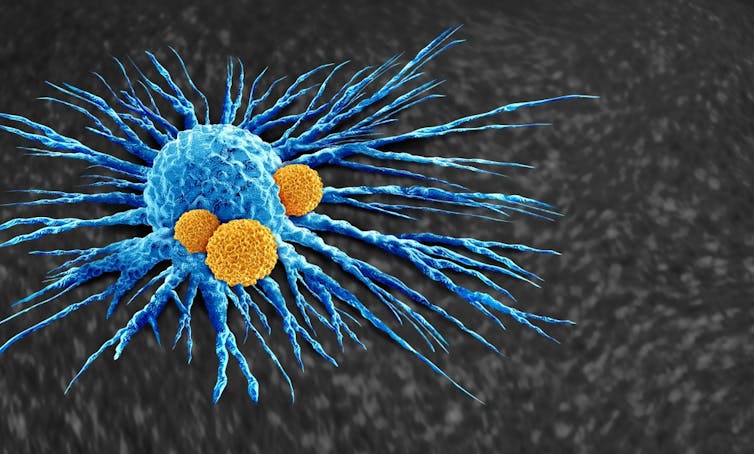
King Charles’ cancer diagnosis, which was identified recently during treatment for an enlarged prostate, continues to make news globally.
The type of cancer has not been revealed, but it has been confirmed it is not prostate cancer.
So what can King Charles and the millions of others who are newly diagnosed with cancer each year expect? And how has cancer treatment changed to improve survival rates?
What actually is cancer?
The body constantly makes new cells to help us grow, replace worn-out tissue and heal injuries. Normally, cells multiply and die in a regulated way, so each new cell replaces a cell that is lost. Sometimes, however, cellular processes become dysregulated and cells keep multiplying. These abnormal cells may turn into cancer.
In solid cancers, such as breast or prostate, the abnormal cells form a mass (tumour). In blood cancers, such as leukaemia, the abnormal cells build up in the blood.
Cancerous tumours may spread. They may invade nearby tissue, destroying normal cells. The cancer cells can break away and travel through the bloodstream or lymph vessels to other parts of the body.
The cancer that first develops is the primary cancer. It is considered localised cancer as it has not spread to other parts of the body. If the primary cancer cells grow and form another tumour at a new site, it is called a secondary cancer or metastasis.

Read more: How does cancer spread to other parts of the body?
Millions of new cases each year
Cancer is becoming more common as the population ages. And King Charles’ diagnosis is one of roughly 19.3 million new cases of cancer diagnosed worldwide each year.
We do not know which cancer King Charles has. However, worldwide, the most common are lung, colorectal (bowel), stomach, breast, pancreatic, oesophageal, prostate and liver cancers.
The most common cancers can vary between countries, due to a number of factors such as genetics, lifestyle and environment. In Australia, for example, the most common cancers are prostate, breast, skin melanoma, colorectal cancer and lung cancer.
Read more: I’ve just been diagnosed with cancer, now what?
Cancer accounts for 1 in 6 deaths
Cancer is a leading cause of death, accounting for nearly 10 million deaths in 2020 (nearly one in six deaths) globally.
Worldwide, leading cancer-related deaths are from lung, colorectal, stomach, breast, pancreatic, oesophageal, prostate and liver cancer.
In 2023, there were roughly 165,000 cases of cancer diagnosed and 51,000 cancer deaths in Australia. The top cancer-related deaths are attributed to lung, colorectal, pancreatic, prostate and breast cancers.
Read more: Why are we more likely to get cancer as we age?
But more people are surviving cancer
Often, when cancer is still localised (has not spread to other parts of the body), it can be removed through surgery or killed with radiotherapy. However, as cancer spreads, more systemic treatments that act throughout the body are required.
Advances in medicine and treatments for cancer have led to more people surviving cancer.
Over the years, there has been a huge shift towards personalised medicine, where each patient is treated based on the genetic make-up of their specific cancer.
Treatment usually includes surgery, radiotherapy, and/or systemic therapy (chemotherapy, hormonal treatments, targeted biological therapies) in combination.
Read more: How cancer doctors use personalised medicine to target variations unique to each tumour
Technological advances have seen traditional surgical methods move towards robotic surgery, using robotic arms to perform precise, minimally invasive surgeries to remove cancer.
The precision of radiotherapy is also improving. This therapy destroys cancer cells using a controlled dose of radiation to kill or damage cancer cells so they cannot grow, multiply or spread, while sparing surrounding healthy tissue.
In recent years, there has been major progress in systemic therapies such as immunotherapy, antibody therapy and bone marrow transplant therapy. There is also “CAR T-cell therapy”, which harnesses the body’s own immune system to fight against cancer.
Thanks to COVID, mRNA technology and other nanoparticle delivery systems are also an area yielding promising results for cancer vaccines.
With the boom in artificial intelligence, we can now potentially predict, diagnose and select treatments for cancer, with greater precision and accuracy.
Do treatments work?
With such new treatments, cancer survival rates have improved significantly. In Australia, for example, five-year survival rates improved from 52% to 70% from 1989–1993 to 2014–2018.
Survival rates for some cancers are also better than others. In Australia, cancers with the worst survival rates after ten years are cancers of the brain, liver, lung, oesophagus and pancreas.
An individual’s survival rate also depends on a number of factors. These include their age, lifestyle and environment (obesity, infections, UV exposure, alcohol consumption and smoking), ethnicity and genetics, socioeconomic status, access to treatment, stage at diagnosis, metastasis of disease, type of treatment and whether their cancer is resistant to treatment.
In a nutshell
King Charles’ cancer diagnosis, at the age of 75, is one of millions of new cancer diagnoses globally. While cancer remains a leading cause of death worldwide, survival rates are improving thanks to extensive advances in treatments and treatment options.
Read more: What happens if King Charles can no longer perform his duties?
Authors: Sathana Dushyanthen, Academic Specialist & Lecturer in Cancer Sciences & Digital Health| Superstar of STEM| Science Communicator, The University of Melbourne


















