

How First Nations artists are reclaiming colonial objects and celebrating culture through garments
- Written by: Treena Clark, Chancellor’s Postdoctoral Indigenous Research Fellow, Faculty of Design, Architecture and Building, University of Technology Sydney
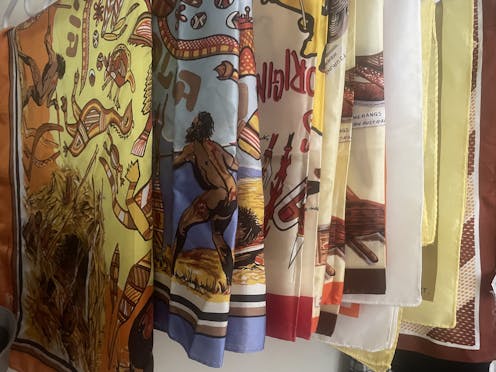
A few years back, I started collecting vintage Australian tourist scarves that portray First Nations people as primitive caricatures and noble savages. Now, I own more than ten scarves with images ranging from Western depictions of First Nations art and objects, to Indigenous people in tokenistic scenes.
Collecting these tourist wares isn’t new. Kitsch items are often gathered and reclaimed by First Nations peoples, artists, designers and academics.
My fascination with kitsch scarves involves wearing them as outfits, which I recently did at the Darwin Country to Couture runway show.
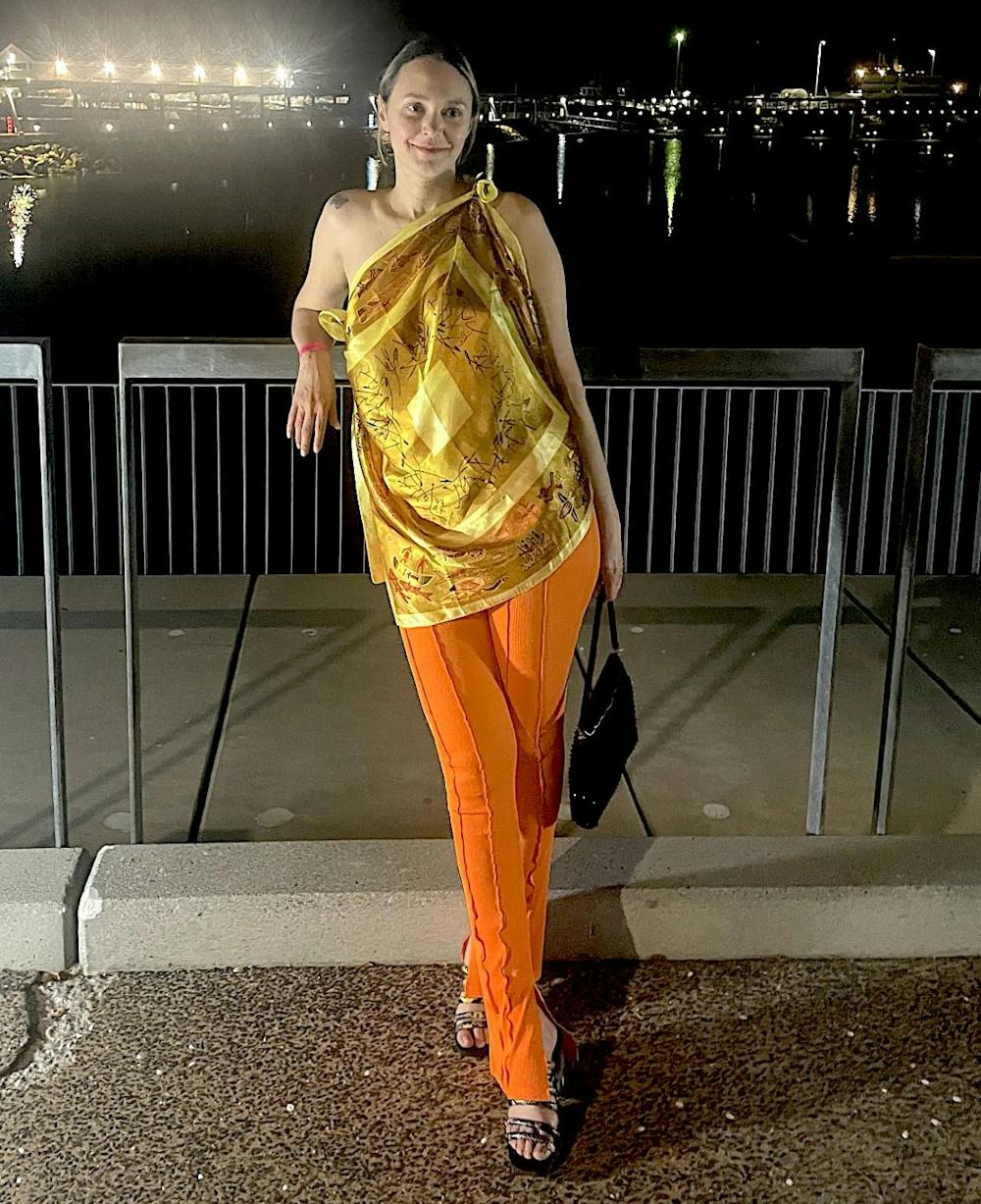
I did so as a creative response to my academic work on First Nations fashion, art and style and to engage with the practice of First Nations garmenting – the use of clothing and adornment as art.
Aboriginalia and Koori Kitsch
Artists such as Destiny Deacon and Tony Albert use several names to describe items with Western depictions of First Nations people, art and objects, including Koori Kitsch and Aboriginalia.
You can find these depictions in souvenirs and bric-a-brac in the form of tea towels, tablecloths, postcards, ashtrays, dolls, scarves, badges and patches.
Destiny Deacon (KuKu/Erub/Mer) has used Koori Kitsch objects for decades. In one work titled Border Patrol (2006), Deacon photographs a white doll atop a tea towel featuring Australian landmarks, plants, animals and Aboriginal people hunting.
Tony Albert’s (Girramay/Yidinji/Kuku-Yalanji) art often features vintage souvenir ashtrays and textiles. Albert has been credited with creating the term “Aboriginalia” to describe the portrayal of Western stereotypes of First Nations peoples and cultures in kitsch items.
Kait James (Wadawurrung) has decolonised vintage souvenir towels through embroidered embellishments to highlight their problematic designs and reclaim them as First Nations art. James recently also disrupted the Barbie doll by creating a custom Aboriginal flag dress and banner saying “Faboriginal Barbie”.
In Kayla Dickens’ (Wiradjuri) 2022 exhibition, Return to Sender, collage backdrops featured enlarged vintage postcards with superimposed images, symbols and text interrogating colonisation and colonial sexual exploitation.
First Nations garmenting
First Nations peoples are also using Aboriginalia within fashion. Paul McCann (Marrithiyel) has embellished couture outfits with vintage textiles depicting First Nations peoples, animals and plants.
One of McCann’s designs at the 2022 Australian Fashion Week, Blinged Out Warrior, disrupted a kitsch item of an Aboriginal man by placing it front and centre on a bedazzled top. This form of work, termed “garmenting”, emphasises contemporary artists’ use of clothes in their pieces.
While Aboriginalia and Koori Kitsch are popular terms, First Nations garmenting is a recent definition yet to reach mainstream use. It’s an emerging trend adopted by many First Nations artists whose work is interested in confronting or reshaping history, highlighting the current world, or imagining a new future.
This could look like creating modern versions of traditional pieces, or critiquing and talking back to colonial clothing forced upon First Nations peoples. Several artists also create works that reflect contemporary protest wear, or futuristic pieces that depict fantasies or predict trends.
Peter Waples-Crowe’s (Ngarigo) Ngarigo Queen – Cloak of queer visibility (2018) features a reworked possum skin cloak with rainbow colours and a train to reference his two identities of Aboriginal and queer.
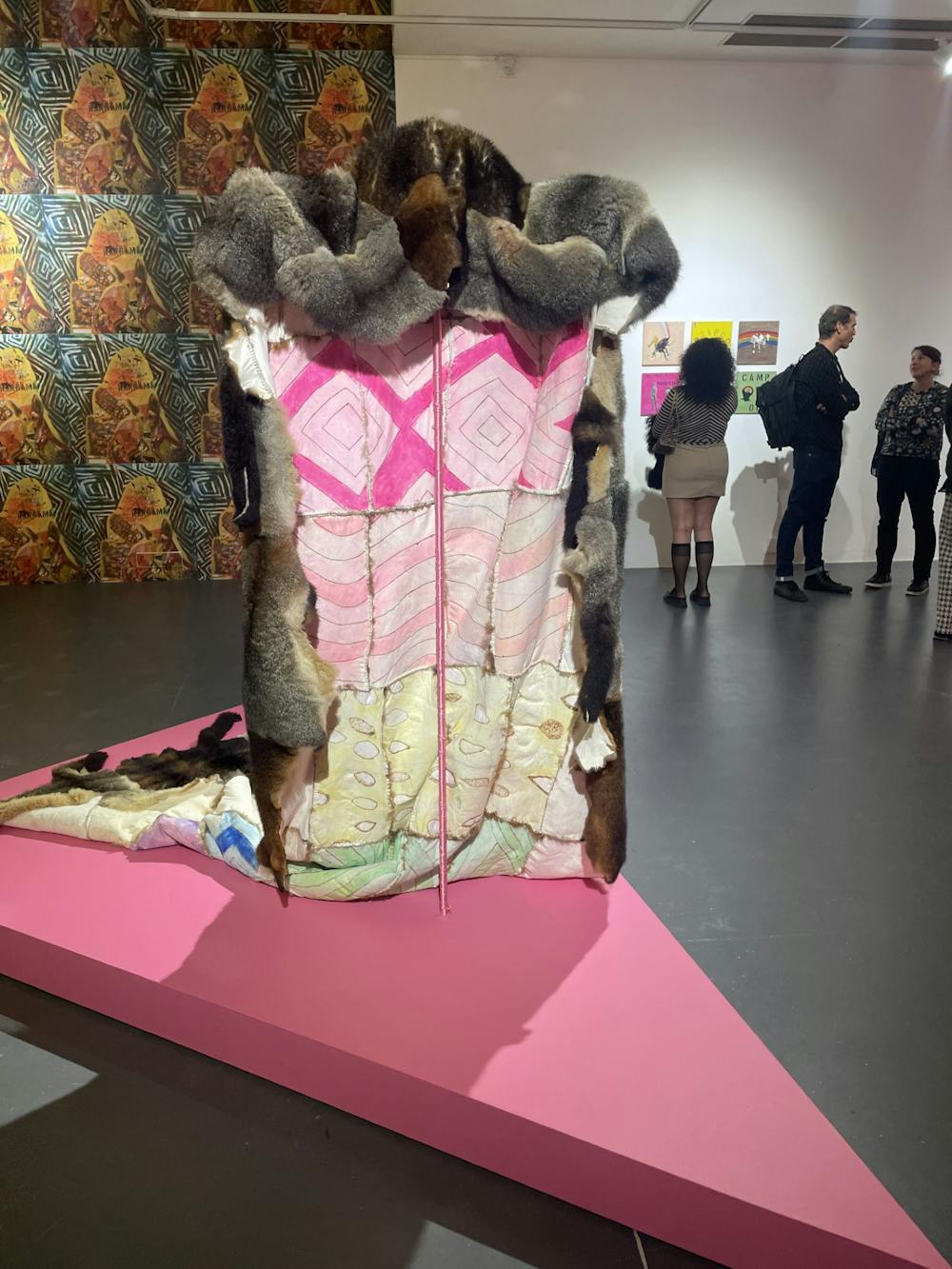 Peter Waples-Crowe, Ngarigo Queen – Cloak of queer visibility (2018).
Treena Clark
Peter Waples-Crowe, Ngarigo Queen – Cloak of queer visibility (2018).
Treena Clark
Kelly Koumalatsos (Wergaia/Wemba Wemba) uses possum fur as a stamp to create cultural fabrics. Significant works use these fabrics to form colonial and Western outfits that speak back to colonisation.
When displaying her garments in galleries, Koumalatsos also includes old family portraits within the works to further contextualise the forced colonial clothes.
Kyra Mancktelow (Quandamooka) specialises in creating garments in sculptural or print form to interrogate colonial histories of forced Western clothing and the removal of cultural wear. The items she recreates range from forced military jackets, to outfits worn in missions, to contemporary forms referencing the history of activism.
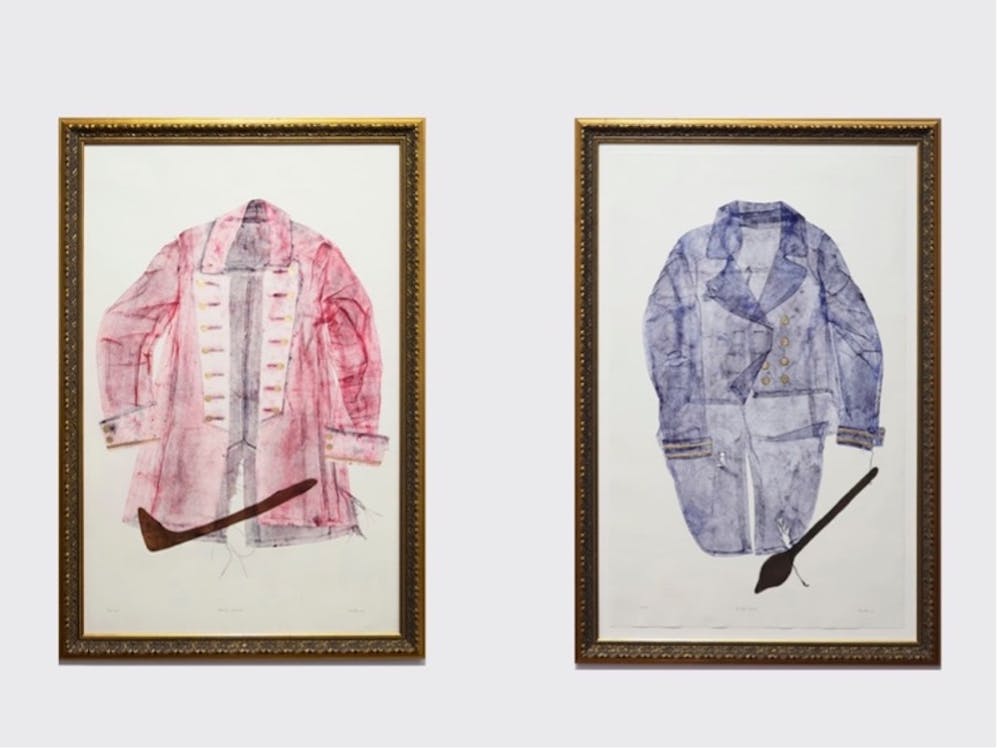 Kyra Mancktelow, Gubba Up, 2021-22. Two ink impressions with gold leaf on Hahnemühle paper, 140cmx92cm each.
Courtesy of the artist and N.Smith Gallery, Sydney.
Kyra Mancktelow, Gubba Up, 2021-22. Two ink impressions with gold leaf on Hahnemühle paper, 140cmx92cm each.
Courtesy of the artist and N.Smith Gallery, Sydney.
Carly Tarkari Dodd’s (Kaurna/Narungga/Ngarrindjeri) exhibition, Royal Jewels (2022), showcased Indigenised versions of jewellery pieces owned by the English royal family. Using cultural weaving techniques to replicate the English monarch’s jewellery collection, Dodd confronts colonisation by turning the tables and inspiring truth-telling about this country’s history.
The artist Coffinbirth (Charlotte Allingham, Wiradjuri/Ngiyampaa) illustrates designs featuring First Nations people in unique outfits across time. Coffinbirth notably reimages or recreates First Nations culture or issues through pop-culture graphics and comic-style art.
Dennis Golding (Kamilaroi/Gamilaraay) creates hand-painted superhero capes to celebrate the power of First Nations identity. He often works with young First Nations people to develop their own versions.
Disrupting, reclaiming and Indigenising
Many First Nations people have an inherent need to expel harmful histories and channel cultural practices creatively.
This can be through artists exhibiting their works, fashion designers telling their stories, or everyday First Nations people who like to practise culture through outfits. When First Nations artists use colonial souvenirs and garments, they can disrupt colonisation and celebrate their culture.
Wearing my kitsch scarves means I join a distinguished group of First Nations artists who use these objects and clothing within their works and creative expressions.
Read more: A brief look at the long history of First Nations fashion design in Australia
Authors: Treena Clark, Chancellor’s Postdoctoral Indigenous Research Fellow, Faculty of Design, Architecture and Building, University of Technology Sydney


















