

Population can’t be ignored. It has to be part of the policy solution to our world’s problems
- Written by: Jenny Stewart, Professor of Public Policy, UNSW Sydney
There is a growing consensus that environmental problems, particularly the effects of climate change, pose a grave challenge to humanity. Pollution, habitat destruction, intractable waste issues and, for many, deteriorating quality of life should be added to the list.
Economic growth is the chief culprit. We forget, though, that environmental impacts are a consequence of per capita consumption multiplied by the number of people doing the consuming. Our own numbers matter.
Population growth threatens environments at global, national and regional scales. Yet the policy agenda either ignores human population, or fosters alarm when perfectly natural trends such as declining fertility and longer lifespans cause growth rates to fall and populations to age.
That there are still too many of us is a problem few want to talk about. Fifty years ago, population was considered to be an issue, not only for the developing world, but for the planet as a whole. Since then, the so-called green revolution in agriculture made it possible to feed many more people. But the costs of these practices, which relied heavily on pesticide and fertiliser use and relatively few crops, are only now beginning to be understood.
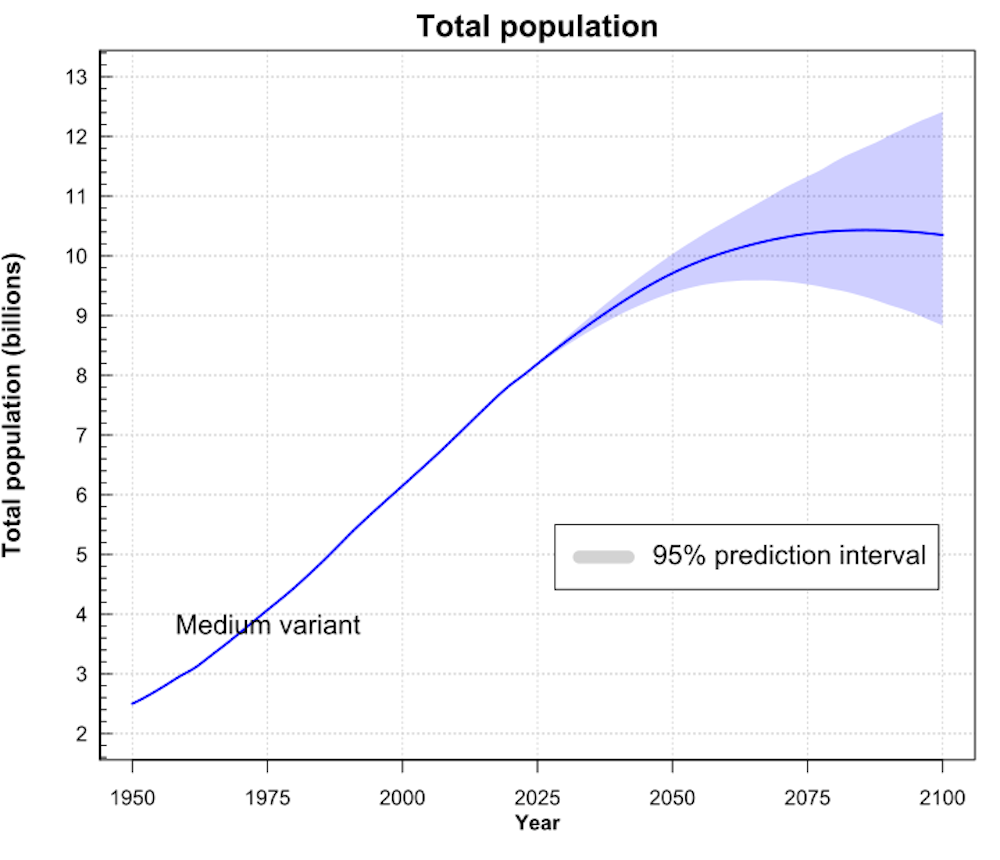
The next 30 years will be critical. The most recent United Nations projections point to a global population of 9.7 billion by 2050 and 10.4 billion by 2100. There are 8 billion of us now. Another 2 billion will bring already stressed ecosystems to the point of collapse.
It’s the whole world’s problem
Many would agree overpopulation is a problem in many developing countries, where large families keep people poor. But there are too many of us in the developed world, too. Per person, people in high-income countries consume 60% more resources than in upper-middle-income countries and more than 13 times as much as people in low-income countries.
From 1995 to 2020, the UK population, for example, grew by 9.1 million. A crowded little island, particularly around London and the south-east, became more crowded still.
Similarly, the Netherlands, one of the most densely populated countries, had just under 10 million inhabitants in 1950 and 17.6 million in 2020. In the 1950s, the government encouraged emigration to reduce population densities. By the 21st century, another 5 million people in a tiny country certainly caused opposition to immigration, but concern was wrongly focused on the ethnic composition of the increase. The principal problem of overpopulation received little attention.
Australia is celebrated as “a land of boundless plains to share”. In reality it’s a small country that consists of big distances.
As former NSW Premier Bob Carr predicted some years ago, as Australia’s population swelled, the extra numbers would be housed in spreading suburbs that would gobble up farmland nearest our cities and threaten coastal and near-coastal habitats. How right he was. The outskirts of Sydney and Melbourne are carpeted in big, ugly houses whose inhabitants will be forever car-dependent.
Doing nothing has a high cost
The longer we do nothing about population growth, the worse it gets. More people now inevitably mean more in the future than there would otherwise have been.
We live very long lives, on average, so once we’re born, we tend to stick around. It takes a while for falling birthrates to have any impact.
And when they do, the population boosters respond with cries of alarm. The norm is seen as a young or youngish population, while the elderly are presented as a parasitical drag upon the young.
Falling reproduction rates should not be regarded as a disaster but as a natural occurrence to which we can adapt.
Recently, we have been told Australia must have high population growth, because of workforce shortages. It is rarely stated exactly what these shortages are, and why we cannot train enough people to fill them.
Population and development are connected in subtle ways, at global, national and regional scales. At each level, stabilising the population holds the key to a more environmentally secure and equitable future.
For those of us who value the natural world for its own sake, the matter is clear – we should make room for other species. For those who do not care about other species, the reality is that without a more thoughtful approach to our own numbers, planetary systems will continue to break down.
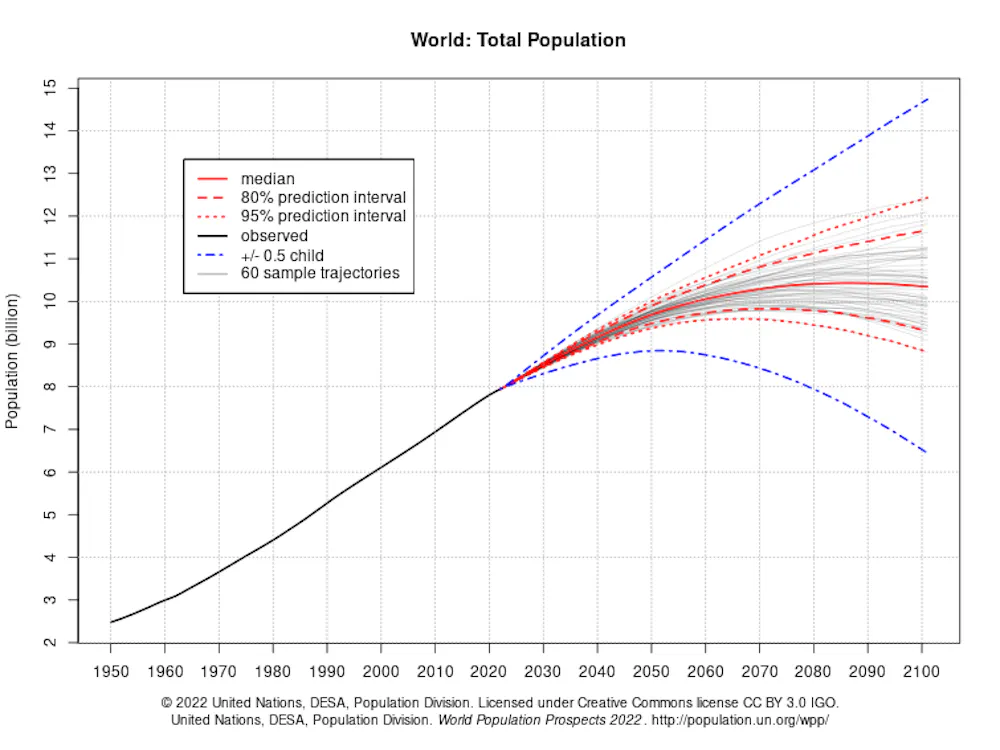 Cutting births by just 0.5 children per woman can dramatically reduce the level at which the world’s population peaks.
UN World Population Prospects 2022, CC BY
Cutting births by just 0.5 children per woman can dramatically reduce the level at which the world’s population peaks.
UN World Population Prospects 2022, CC BY
Let women choose to have fewer children
So, what to do? If we assume the Earth’s population is going to exceed 10 billion, the type of thinking behind this assumption means we are sleepwalking our way into a nightmarish future when a better one is within our grasp.
A radical rethink of the global economy is needed to address climate change. In relation to population growth, if we can move beyond unhelpful ideologies, the solution is already available.
People are not stupid. In particular, women are not stupid. Where women are given the choice, they restrict the number of children they have. This freedom is as basic a human right as you can get.
A much-needed demographic transition could be under way right now, if only the population boosters would let it happen.
Those who urge greater rates of reproduction, whether they realise it or not, are serving only the short-term interests of developers and some religious authorities, for whom big societies mean more power for themselves. It is a masculinist fantasy for which most women, and many men, have long been paying a huge price.
Women will show the way, if only we would let them.
Authors: Jenny Stewart, Professor of Public Policy, UNSW Sydney


















