

bad for them and the planet
- Written by: Hulya Gilbert, PhD Candidate, University of South Australia
Children today spend more time in cars than previous generations. They also spend less time playing on the streets and in unstructured and unsupervised activity outdoors. The lack of opportunities for physical activity and the loss of freedom to explore their local neighbourhood is bad news for children’s physical, social and mental well-being.
Read more: City-by-city analysis shows our capitals aren’t liveable for many residents
Though equally important, the environmental cost of these trends is not well understood. As rapid urbanisation extends across the globe, transport planning continues to be challenging. Transport is one of the biggest sources of greenhouse gas emissions. And 46% of transport-related emissions come from private vehicles.
We know surprisingly little, however, about the detailed reasons for individual private car use. An international study highlights that households with children have higher rates of car ownership and use. In Australia, official statistics on transport pay a great deal of attention to the “journey to work”, but car travel that can be attributed to child-related activities has not been fully explored.
Research on children’s travel patterns tends to focus on the “journey to school”. While school trips are important, this provides only a narrow image of children’s actual travel patterns. They also make many trips to non-school destinations and extracurricular activities such as sport, music and dance classes.
We recently reviewed local government policies related to sustainable mobility and child-and-youth-friendly cities. Our review found little consideration of children and young people in transport planning policies across Australia. This is despite the fact that the decline in their walking and cycling rates was widely recognised.
Read more: Australian cities are far from being meccas for walking and cycling
Why are walking and cycling rates decreasing?
Several factors contribute to lower rates of walking and cycling among children and their limited use of public transport. These range from urban form to social and economic conditions.
Australian suburbs typically have low density and segregated land uses, which privilege the car over other travel modes. This situation is worse in outer suburbs which have limited public transport and poor provision for walking and cycling. These outer suburbs are also more likely to have lower socio-economic status and a larger proportion of families with children.
All together, these suburban conditions add to the social disadvantage resulting from limited access to services and activities that are critical for families with children. This further encourages private car use.
Read more: Designing suburbs to cut car use closes gaps in health and wealth
Changing social structures mean families usually are on tight schedules. These changes include increases in employment for women and in the number of both single-parent families and families where both parents are in paid work. Because the car is relatively cheap and easy to use for individual mobility in Australian cities, it is generally the uncontested way to manage these schedules.
In addition, the increased individualisation as a common characteristic of Western societies usually means parents are expected to provide strict supervision of children’s movements. In the conditions described above, the most practical way to do this is usually to drive them in a car.
Of course this increases the number of cars on our streets, particularly around schools and other common destinations for children. This then perpetuates parents’ concerns about traffic safety, leading in turn to even more private car use.
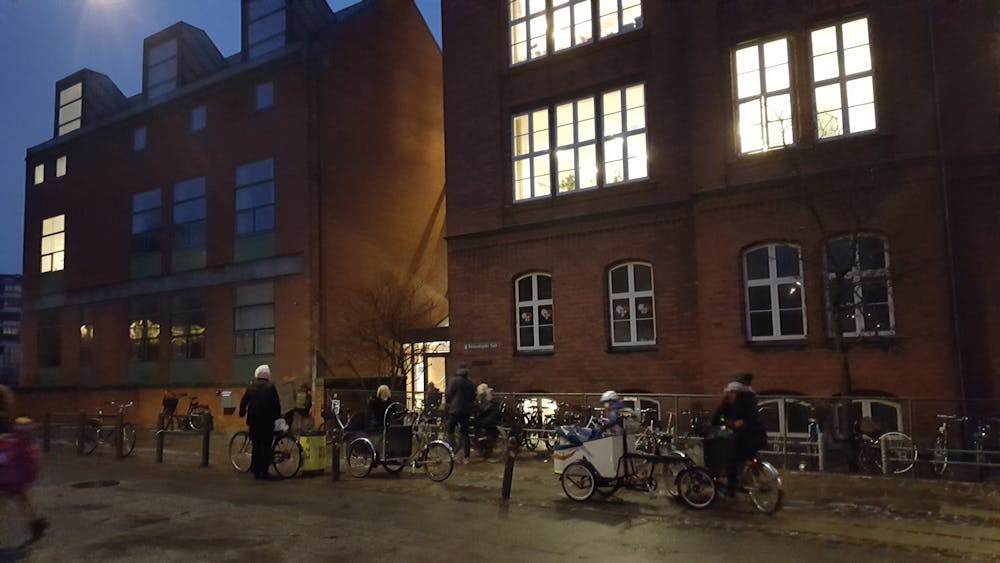 Notice the difference? Drop-off time at an inner-city Copenhagen school.
Hulya Gilbert, Author provided
Notice the difference? Drop-off time at an inner-city Copenhagen school.
Hulya Gilbert, Author provided
Read more: Young people want walkable neighbourhoods, but safety is a worry
Child-centred sustainable mobility
What is perhaps most striking about the trend towards chauffeuring children is that these facts are seemingly becoming accepted as unavoidable outcomes of modern society. They are largely ignored in transport planning.
We have argued that children have a pivotal role in sustainable mobility. Greater attention to the mobility needs of families with children will produce many social and environmental benefits.
The importance of children’s role in sustainable mobility can be grouped under two themes.
First, children’s needs in today’s lifestyles mean they have an active role in contributing to increased private car use. The daily lives of families with children offer a good example of the context in which carbon-intensive travel patterns occur. If their mobility needs can be met more sustainably (even partially) we are likely to achieve significant carbon savings.
Second, and perhaps more importantly, children have a role as catalysts for behavioural change towards sustainable cities. This is because childhood is a key stage for establishing sustainable travel habits as opposed to “trying to modify already ingrained habits later in life”.
A better understanding of children’s travel patterns would provide a solid foundation for sustainable mobility policies. Planning and transport policies that are responsive to children’s specific needs are likely to have more effective and longer-lasting outcomes, with many related benefits for social sustainability and public health.
Authors: Hulya Gilbert, PhD Candidate, University of South Australia
Read more http://theconversation.com/children-in-the-car-era-bad-for-them-and-the-planet-105377


















