

New logging rules in NSW put the greater glider closer to extinction. When will we start protecting these amazing animals?
- Written by: David Lindenmayer, Professor, The Fenner School of Environment and Society, Australian National University
Forty years ago when my colleagues and I did spotlighting surveys, the southern greater glider was the most common animal we’d see. Now, this amazing species is endangered. In many areas it is hard to find; in others it has been lost altogether.
Australia has a disproportionately large number of in-danger species, and their decline follows a well-trodden path. Common species become uncommon, then uncommon species become rare. Rare species become threatened or endangered. Then tragically, endangered species go extinct.
Australia leads the world in native mammal extinctions – roughly 10% have become extinct since British invasion. The southern greater glider is heading towards this fate.
That’s why ecologists were shocked by a recent announcement by New South Wales environment authorities that we believe loosens protections for southern greater gliders in logging areas.
A marsupial to cherish
The southern greater glider is an iconic marsupial. It’s one of three species of greater gliders found in eastern Australia. It was listed as vulnerable to extinction under national environment law in 2016, then uplisted to endangered in 2022.
Greater gliders are amazing animals. Their diet is low on nutrients, comprised almost entirely of eucalypt leaves and buds. Yet they are the world’s largest gliding marsupial, weighing up to 1.3 kg and capable of gliding up to 100m through a forest.
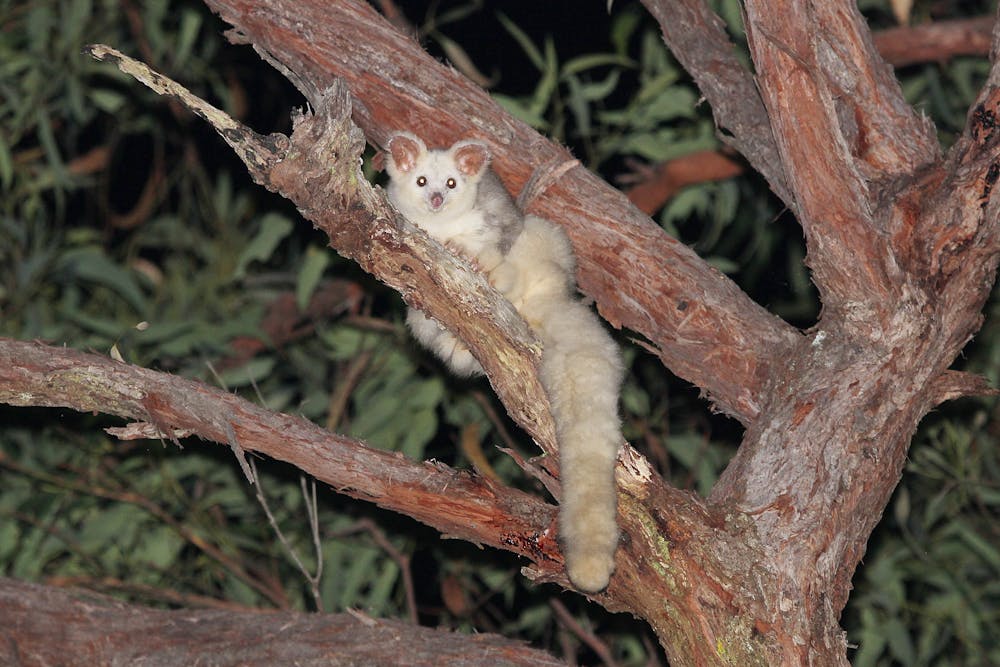
Southern greater gliders have white bellies and thick back fur that ranges from pure white to jet black.
The species is highly dependent on forest habitat and, in particular, large trees with hollows where they shelter and breed. But sadly, extensive glider habitat has been burnt, logged or both. Climate change poses a further risk.
We have long been concerned for the southern greater glider. In the wet forests of Victoria, for example, their numbers have declined by 80% since 1997. In 2007, the species became regionally extinct at Booderee National Park, south of Sydney.
When the southern greater glider was upgraded to endangered, Federal Environment Minister Tanya Plibersek said the new listing would “ensure prioritisation of recovery actions to protect this iconic species”. She noted that habitat protection and land clearing were “primarily the responsibility of state governments”.
You might think, then, that state governments would now be working harder to protect greater glider habitat. But a recent decision in NSW suggests little has changed.
What the changes mean
The NSW Environment Protection Authority this month announced changes to rules in logging operations. It claims the amendments constitute “new protections” for greater gliders. But many ecologists, us included, believe the changes are designed to make logging easier and will leave the species at greater risk.
At present, Forestry Corporation staff undertake pre-logging habitat searches for trees that might contain hollows. They must retain eight of these trees per hectare but can log right up to the tree base. The staff must also look for den trees (where an animal is actually seen entering or leaving a tree hollow) – although this is problematic as gliders are active at night and the surveys take place during the day. If a den tree is found, it must be protected and a 50m area around it retained.
Under the proposed new rules, Forestry Corporation will have to keep more large hollow-bearing trees per hectare – 14 instead of the current eight in high-density glider areas, and 12 instead of the current eight in low-density areas. A 50m exclusion zone will remain around known recorded locations of greater glider dens, but there will no longer be a requirement to specifically find or protect den trees.
This means actual habitat where greater gliders currently occur, and occupy den trees, may not be protected. We believe this will increase the gliders’ rate of decline and fast-track it towards extinction.
The new rules were due to begin on February 9, but were postponed by a week. In a statement, the authority said it was “consulting with stakeholders and considering their feedback to ensure we find the most appropriate way to address concerns while achieving long-term protections for this endangered species”.
If the authority is serious about protecting greater gliders, it will move to strengthen not weaken protections for greater glider habitat.
Logging glider habitat is nonsensical
Since the southern greater glider was listed as vulnerable in 2016, its habitat continued to be destroyed. This is poor management for many reasons:
gliders often die on site when their habitat is disturbed
young forests recovering after disturbances tend to be hotter and drier, which is bad for gliders because they are heat-sensitive
removing hollow-bearing trees not only destroys a key part of glider habitat immediately, but it can take decades (if not centuries) for forest to become suitable again
logging makes forests more flammable and gliders are particularly sensitive to fire
logging can change the composition of tree species in a forest, reducing the availability of quality food for gliders.
The choice is ours
Human activity has left few remaining refuges for the southern greater glider. Any remaining habitat should be subject to the highest protections.
Logging those refuges is nonsensical given the large body of scientific work demonstrating its negative effects. And tinkering around the edge of logging rules will have limited benefits.
Australia has already lost so many wonderful mammal species. Do we want the southern greater glider to suffer the same fate? If not, let’s stop destroying the forests our species need to survive.
Authors: David Lindenmayer, Professor, The Fenner School of Environment and Society, Australian National University


















