

more Australian species than ever are struggling to survive
- Written by: Frédérik Saltré, Research Fellow in Ecology for the ARC Centre of Excellence for Australian Biodiversity and Heritage, Flinders University
Australia is home to about one in 12 of the world’s species of animals, birds, plants and insects – between 600,000 and 700,000 species. More than 80% of Australian plants and mammals and just under 50% of our birds are found nowhere else.
But habitat destruction, climate change, and invasive species are wreaking havoc on Earth’s rich biodiversity, and Australia is no exception.
In 2023, the federal government added another 144 plants, animals and ecological communities to the threatened species list – including iconic species such as the pink cockatoo, spiny crayfish and earless dragons.
More and more species stand on the edge of oblivion. That’s just the ones we know enough about to list formally as threatened. Many more are in trouble, especially in the oceans. Change is the new constant. As the world heats up and ecosystems warp, new combinations of species can emerge without an evolutionary connection, creating novel communities.
It is still possible to stop species from dying out. But it will take an unprecedented effort.
Read more: Explainer: what is biodiversity and why does it matter?
How species end
The modern extinction crisis is quite recent. Between 1970 and 2018, wildlife populations around the world fell by almost 70%. But the collapse of these populations isn’t equal – Latin America and the Caribbean have lost around 94% of the individuals in wild populations. Africa has lost 65%, Asia-Pacific about 45%, while North America and Europe have lost 45% and Central Asia 33%.
In the 250 years since Europeans arrived, at least 100 unique Australian species have gone extinct. That’s about 6% to 10% of all recorded extinctions worldwide since the year 1500. If we look at mammals alone, we have the worst track record of any country.
Extinction doesn’t happen overnight. An abundant species might be exposed to a new predator such as feral cats. Its population could fall to the point where it is listed as threatened, meaning it has a high chance of becoming extinct in the near future.
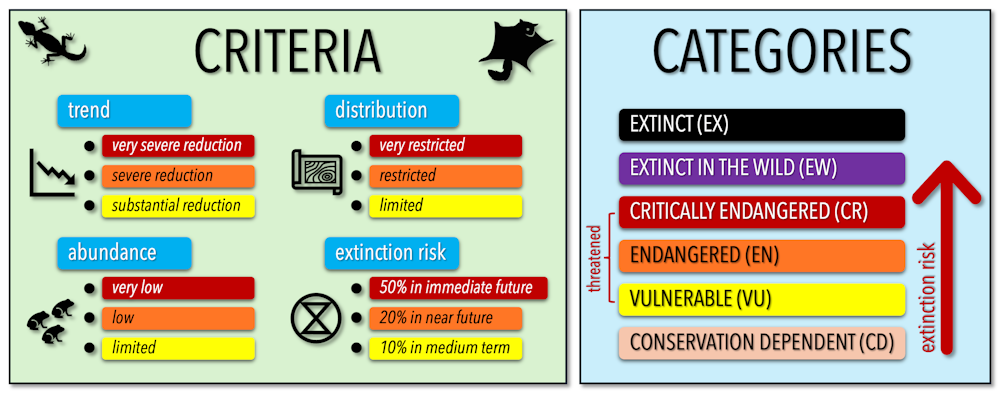
If the species can’t adapt and if we do nothing, the species can become critically endangered and decline to a few hundred individuals. If pressure continues, it can go extinct in the wild. And if zoos can’t establish breeding populations or we simply don’t know about it, the entire species can wink out of existence.
Tip of the iceberg
Australia’s threatened species list is useful, because it helps us prioritise which species to help. But it does not show the true number of species in danger. There are well known gaps, such as many invertebrates that have gone extinct unnoticed because of their secretive nature and small size.
The list likely misses other lesser-known or hard to research groups such as microorganisms, hard to find marine species, snakes and lizards, and rare plants.
Neither does the list take into account species that depend on each other, such as wasps relying on one species to parasitise and pollinators specialising on a few types of flowers. Yet these complex interactions are essential to healthy functioning of ecosystems.
To list a species as threatened takes work. By the time we have catalogued all species on Earth – estimated to take 100–200 years at current discovery rates – experts estimate most species will have already gone extinct.
Read more: Worried about Earth's future? Well, the outlook is worse than even scientists can grasp
Can species come back?
For decades, conservationists have used species recovery programs to try and bring threatened species back from the brink. You need a combination of approaches – there’s no point breeding thousands of endangered woylies if their habitat has been replaced with farmland or plantation.
One measure with good results is to use policy measures to cut forest loss and other habitat destruction. Lost habitat is the main reason more than 85% of our threatened species are on the list in the first place. Invasive species and diseases can worsen damage from habitat loss – or act alone.
Extinction is not inevitable. Between 2000 to 2022, we saw 29 species recover to the point they could be taken off the threatened list.
But the road to recovery is long, complicated, and far from assured for most of our worst-affected species.
Novel ecosystems and climate change
Each species has a climate it prefers and can survive in. But the magnitude of expected future climate change is likely to produce climates without precedent in many regions. We could see the creation of entirely new biological communities and environments, as has happened before.
Read more: What is a 'mass extinction' and are we in one now?
The best-known novel communities emerged at high latitudes mostly between 17,000 and 12,000 years ago. Here, for instance, spruce and ash trees in North America grew side by side – even though they now live far apart – and pines were less common than today.
Unfortunately, the emergence of novel communities often led to an increase in species extinctions.
But the emergence of new types of ecosystems doesn’t mean all species will suffer. For instance, novel habitats in Melbourne’s suburbs have led to a surge in southern brown bandicoots, who find strips of native and introduced plants along roads, canals and railways to their liking.
New ecosystems can sometimes harbour more species and actually be more resilient due to the variety of species traits, behaviours, and genetic diversity. But this is not guaranteed.
Managing these new ecosystems will be challenging. We will have to come up with creative ways to handle these changes by adopting Indigenous practices or applying novel solutions such as genetic rescue, mass reforestation and assisted migration to reduce extinction rates.
With unprecedented climates, novel ecosystems, invasive species, and disruptions to the food chain, we can expect more and more species to be added to the threatened list.
Read more: Climate-driven species on the move are changing (almost) everything
Authors: Frédérik Saltré, Research Fellow in Ecology for the ARC Centre of Excellence for Australian Biodiversity and Heritage, Flinders University


















