

The brightest object in the universe is a black hole that eats a star a day
- Written by: Christian Wolf, Associate Professor, Astronomy & Astrophysics, Australian National University
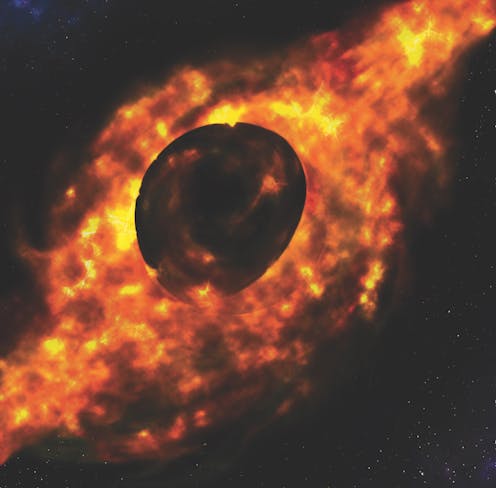
Scientists have no reported evidence of the true conditions in Hell, perhaps because no one has ever returned to tell the tale. Hell has been imagined as a supremely uncomfortable place, hot and hostile to bodily forms of human life.
Thanks to a huge astronomical survey of the entire sky, we have now found what may be the most hellish place in the universe.
In a new paper in Nature Astronomy, we describe a black hole surrounded by the largest and brightest disc of captive matter ever discovered. The object, called J0529-4351, is therefore also the brightest object found so far in the universe.
Supermassive black holes
Astronomers have already found around one million fast-growing supermassive black holes across the universe, the kind that sit at the centres of galaxies and are as massive as millions or billions of Suns.
To grow rapidly, they pull stars and gas clouds out of stable orbits and drag them into a ring of orbiting material called an accretion disc. Once there, very little material escapes; the disc is a mere holding pattern for material that will soon be devoured by the black hole.
The disc is heated by friction as the material in it rubs together. Pack in enough material and the glow of the heat gets so bright that it outshines thousands of galaxies and makes the black hole’s feeding frenzy visible to us on Earth, more than 12 billion light years away.
The fastest-growing black hole in the universe

The accretion disc of J0529-4351 emits light that is 500 trillion times more intense than that of our Sun. Such a staggering amount of energy can only be released if the black hole eats about a Sun worth of material every day.
It must also have a large mass already. Our data indicate J0529-4351 is 15 to 20 billion times the mass of our Sun.
There is no need to be afraid of such black holes. The light from this monster has taken more than 12 billion years to reach us, which means it would have stopped growing long ago.
In the nearby universe, we see that supermassive black holes these days are mostly sleeping giants.
Black holes losing their grip
The age of the black hole feeding frenzy is over because the gas floating around in galaxies has mostly been turned into stars. And after billions of years the stars have sorted themselves into orderly patterns: they are mostly on long, neat orbits around the black holes that sleep in the cores of their galaxies.
Even if a star dove suddenly down towards the black hole, it would most likely carry out a slingshot manoeuvre and escape again in a different direction.
Read more: Why do black holes twinkle? We studied 5,000 star-eating behemoths to find out
Space probes use slingshot manoeuvres like this to get a boost from Jupiter to access hard-to-reach parts of the Solar System. But imagine if space were more crowded, and our probe ran into one coming the other way: the two would crash together and explode into a cloud of debris that would rapidly fall into Jupiter’s atmosphere.
Such collisions between stars were commonplace in the disorder of the young universe, and black holes were the early beneficiaries of the chaos.
Accretion discs – a no-go zone for space travellers
Accretion discs are gateways to a place whence nothing returns, but they are also profoundly unfriendly to life in themselves. They are like giant storm cells, whose clouds glow at temperatures reaching several tens of thousands of degrees Celsius.
The clouds are moving faster and faster as we get closer to the hole, and speeds can reach 100,000 kilometres per second. They move as far in a second as the Earth moves in an hour.
The disc around J0529-4351 is seven light years across. That is one and a half times the distance from the Sun to its nearest neighbour, Alpha Centauri.
Why only now?
If this is the brightest thing in the universe, why has it only been spotted now? In short, it’s because the universe is full of glowing black holes.
The world’s telescopes produce so much data that astronomers use sophisticated machine learning tools to sift through it all. Machine learning, by its nature, tends to find things that are similar to what has been found before.
This makes machine learning excellent at finding run-of-the-mill accretion discs around black holes – roughly a million have been detected so far – but not so good at spotting rare outliers like J0529-4351. In 2015, a Chinese team almost missed a remarkably fast-growing black hole picked out by an algorithm because it seemed too extreme to be real.
Read more: Astronomers see ancient galaxies flickering in slow motion due to expanding space
In our recent work, we were aiming to find all the most extreme objects, the most luminous and most rapidly growing black holes, so we avoided using machine learning tools that were guided by too much prior knowledge. Instead we used more old-fashioned methods to search through new data covering the entire sky, with excellent results.
Our work also depended on Australia’s current 10-year partnership with the European Southern Observatory, an organisation funded by several European countries with a huge array of astronomical facilities.
Authors: Christian Wolf, Associate Professor, Astronomy & Astrophysics, Australian National University


















