

Google AI


Modern Australian

Emissions from households’ water use are on a par with aviation. The big cuts and savings they can make are being neglected

  • Written by: Steven Kenway, Research Group Leader, Water-Energy-Carbon, The University of Queensland

Emissions from households’ water use are on a par with aviation. The big cuts and savings they can make are being neglected

Why is there such a big gap between people, industries and government agreeing we need urgent action on climate change, and actually starting? Scope 3 emissions are a great example. These are greenhouse gas emissions that organisations can influence, but don’t directly control.

Our research has identified the benefits of tackling these emissions in Australia’s urban water sector. If we consider the energy we use to heat water, water costs us far more than we think. It’s an issue of cost of living as well as water supply and energy infrastructure.

In Victoria, for example, water utilities are the largest source (about a quarter) of scope 1 and 2 emissions from the government sector. Scope 1 emissions come from activities utilities directly control, such as driving their vehicles. Scope 2 emissions are from the energy they buy.

Our research has found the gains from pursuing scope 3 emissions from the use of water that utilities supply could be about ten times bigger than their planned reductions in scope 1 and 2 emissions.

Extrapolating from Melbourne household data suggests domestic water heating accounts for 3.8% of each person’s share of Australia’s greenhouse gas emissions – on a par with the 4.1% from aviation. Our research indicates that in Melbourne alone a city-wide program to retrofit showerheads could, by reducing water and energy use, have the same impact on emissions as taking tens of thousands of cars off the road.

Such a program would cost much less than all other renewable energy investments water utilities are making. It would also save water users money.

Read more: Australian homes can be made climate-ready, reducing bills and emissions – a new report shows how

How to tackle scope 3 emissions

Water utilities don’t directly control scope 3 emissions, but they could influence what customers do. If they encourage more efficient water use, customers use less water and, in turn, less energy to heat it.

Water utilities account for 24% of scope 1 and 2 emissions from the Victorian government sector. While the sector has shown leadership in acting on these emissions, there is very little active accountability for, or even quantification of, scope 3 emissions.
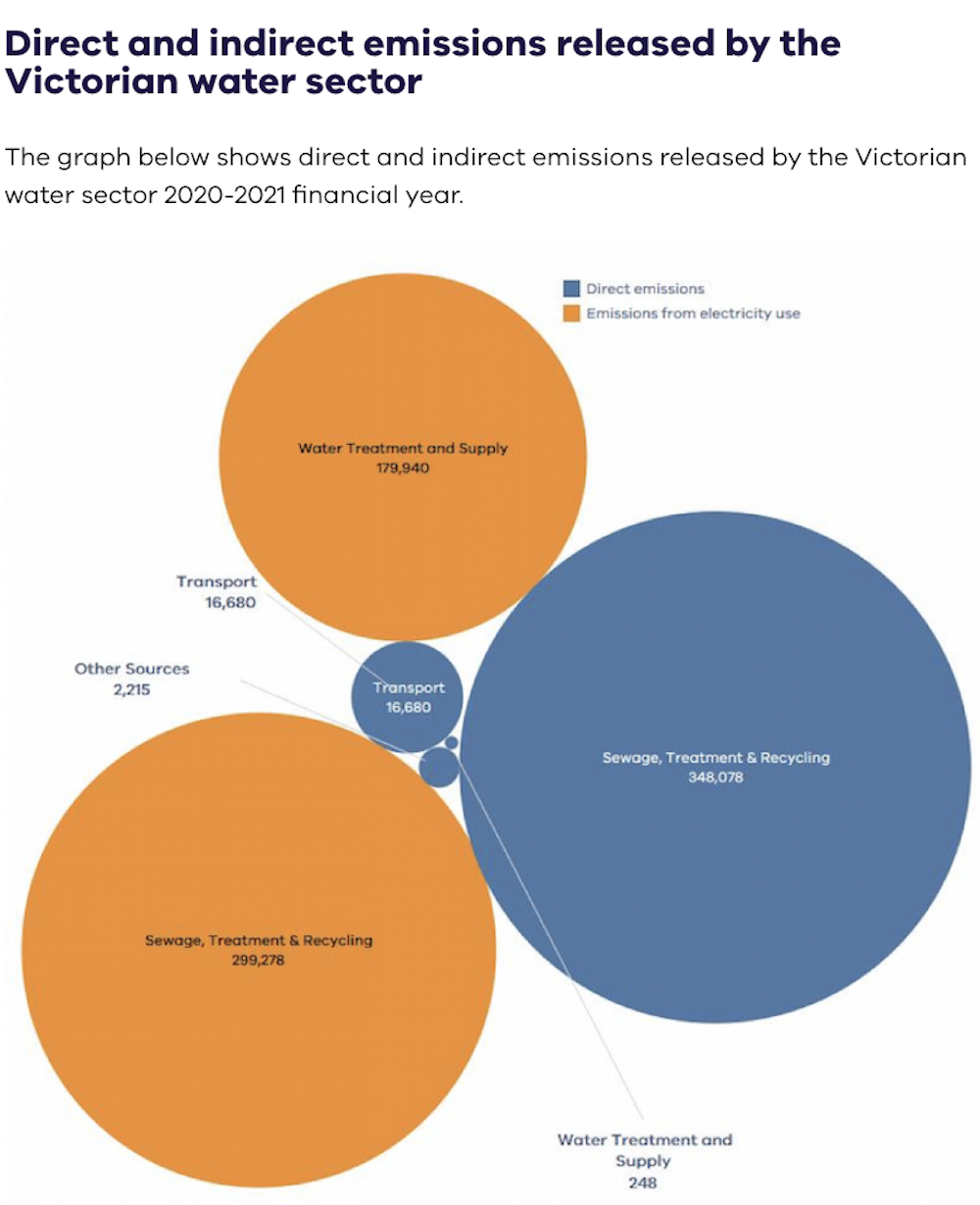
Graph showing the sources of stage 1 and 2 emissions from the Victorian water sector
Victorian Department of Energy, Environment and Climate Action, CC BY Our research has found a Melbourne-wide program to retrofit showerheads to next-generation technology could save 12-27 billion litres (GL) of water a year (about 6% of current use). The resulting energy savings would be 380-885GWh per year, cutting emissions by 98,000-226,000 tonnes. That equates to taking 21,000 to 49,000 cars off the roads. Customers would also save up to $160 a year on their bills. The full economic benefit to society is more than five times the cost of the program. Read more: How to maximise savings from your home solar system and slash your power bills Who influences water use? Everyone Helping customers adopt highly efficient showerheads could cut emissions at much lower cost than all other renewable energy investments water utilities are making. Most households don’t realise hot water systems account for around 24% of their total energy use. Their total energy use for water heating is larger as it includes appliances such as washing machines, dishwashers and kettles. An even larger percentage of household energy use is “water-related” if pool filtration, rainwater tank pumps and so on are included. Read more: Using electric water heaters to store renewable energy could do the work of 2 million home batteries – and save us billions We think only of the savings on water bills, but efficient water use also affects our power bills and emissions. But communicating the link isn’t easy. Showerhead manufacturers tell us they aren’t promoting efficient showerheads because they respond to demand. Water utilities don’t invest in them because it is a present cost for a future benefit – it doesn’t help them balance their budgets. And for policymakers it’s hard to celebrate the water and energy you don’t need to consume. The combined impact is lack of action on saving water to reduce emissions – even though it’s a great option. A ‘tragedy of the commons’ dilemma Without direct control or accountability by any one organisation, we face a “tragedy of the commons” – individuals overconsuming a shared resource at the wider expense of society. The limited resource today is the ability of our planet to process greenhouse gas emissions before they change our climate. The tragedy of the commons was used to describe externalities: costs borne by others that a decision-maker does not pay for. Examples include the future costs of increased flooding, more severe droughts and bushfires, and rising sea levels. If we fully considered the costs and benefits to consumers and society (rather than just costs to utilities), investment priorities would change towards “least cost to the community” solutions. Many water utilities will be carbon-neutral for scope 1 and 2 by 2025. This means they are at the global forefront of reducing emissions – but the water industry can do much more by tackling scope 3 emissions. Committing to a scope 3 reduction challenges a water company to move toward things it can only influence rather than control. So, does it pursue all possibilities, without knowing if it can cut emissions? Or does it take a conservative approach and commit to only scope 1 and 2 emissions? Reducing emissions from water use requires community, industry and government to act together. The stumbling block is decision-making and current legislation. A road runs along the top of the Thomson Dam wall Water utilities have focused on cutting their own emissions and costs, neglecting the much bigger gains to be had from changing water users’ behaviour. Simon Maddock/Shutterstock Read more: All-electric homes are better for your hip pocket and the planet. Here's how governments can help us get off gas So, what is the solution? First, we need to call out the problem. Second, we must find a way to ensure the reward for pursuing action is higher than the penalty for failure. A key to this will be highlighting how much cheaper and better many actions are that focus on scope 3 emissions, rather than solely “within business” strategies. We need to find solutions that are genuinely “least cost to community” rather than “least cost to individual business entities”. Third, as a “commons”, this challenge must be communicated beyond utilities and government to communities. There needs to be broad understanding of the benefits of new approaches and of the pitfalls of a “do nothing” approach. Big savings are up for grabs in the water industry. More broadly, all industries (from manufacturing to mining) need to consider scope 3 emissions from use of the products they sell. Authors: Steven Kenway, Research Group Leader, Water-Energy-Carbon, The University of Queensland

Read more https://theconversation.com/emissions-from-households-water-use-are-on-a-par-with-aviation-the-big-cuts-and-savings-they-can-make-are-being-neglected-221853

Pool and Deck Design: How to Plan the Perfect Outdoor Living Space for Your Sydney Home

For many Australians, the backyard is where life happens. Summer barbecues, weekend swims and long evenings outdoors are all part of the lifestyle, ...

Is Solar Pool Heating Worth It? What Sydney Homeowners Should Know

There's nothing quite like a backyard pool on a hot Sydney day. But once autumn rolls in, many pools sit unused for months because the water is simp...

Planning a Luxury House Move: A Week-by-Week Timeline for Prestige Sydney Homes

Selling or buying a prestige home is a major milestone. Whether it's a waterfront residence in Birchgrove, a grand Federation home in Haberfield or ...

Downsizing or Upgrading Your Caravan? Here's How to Sell It Without the Hassle

Selling a caravan can feel like a major task, especially when you are unsure about its value, paperwork, or how to find a buyer. Whether you are dow...

The Best Overseas Adventure Holidays for Australians Who Love the Outdoors

Australia offers no shortage of incredible outdoor experiences, but sometimes the best way to satisfy your sense of adventure is to head overseas. A...

Cape Town Wine Shuttle: Winelands Tasting & Tours

Embark on an unforgettable journey through the picturesque Cape Winelands, where world-class wines and breathtaking scenery await. Our Cape Town Win...

Metal Fabrication: Choosing Metal Fabrication Melbourne Services for Custom Projects

What Modern Metal Fabrication Involves From individual components to complete structures, metal fabrication brings together processes such as desig...

Why Giant Rats Tail Grass Keeps Coming Back After Spraying

Giant Rats Tail Grass (GRT) is one of the most frustrating pasture weeds for farmers and lifestyle property owners. You spray an infested area, see th...

When Custom Cardboard Boxes Make Sense for Your Business

Custom cardboard boxes can be useful when a standard carton does not fit a product, packing method or presentation requirement particularly well. A ...

Bottle Label Printing: Key Factors for a Professional Finish

Why the Printing Method Matters When businesses need packaging or printed containers developed for a particular application, the right supplier can m...

Virtual Livestock Fencing and GPS Tracking: Improving Visibility Across Cattle Properties

What Virtual Livestock Fencing Means for Modern Cattle Management Managing cattle across extensive properties requires more than knowing where anim...

Sydney Pawnbrokers Explained: How Hocking Your Car Actually Works

Sometimes you need cash, and you need it soon. If you own a car, you may already have a way to get it. That's what people mean when they say they've...

Moving Interstate from the Gold Coast to Brisbane (or Back)? What Removalists Wish You Knew First

Have you talked to anyone who’s done the move? They say the same thing: the drive up the M1 is the easy part. It's everything around it that catches...

Why the Spring School Holidays Are a Great Time to Visit Coffs Harbour

The spring school holidays are a good time to spend a few days on the Coffs Coast. The weather is starting to warm up, there is plenty to do outdoor...

What to Do When an Older Car Is No Longer Worth Keeping in Melbourne

Ever looked at another repair quote and wondered whether your old car is still worth the trouble? It is a common turning point for Melbourne motoris...

Your Baby's First Year: A Local Guide to Feeding, Sleep, and When to Get Extra Support

Ask ten parents in a Brisbane mothers' group how their baby is feeding or sleeping, and expect ten different answers.  Someone's baby sleeps throug...

Kitchen and Laundry Makeover Ideas That Don't Require a Full Renovation

Full kitchen renos are expensive — and most people don't actually need one.  They need the kitchen to stop looking like it's stuck in 2009, or they...

How Technology Is Reshaping the Modern Australian Commercial Kitchen

The commercial kitchen has always been shaped by technology. Refrigeration changed how ingredients could be stored, modern ventilation transformed k...

















