

Google AI


Modern Australian

It looks like an anchovy fillet but this ancient creature helps us understand how DNA works

  • Written by: Ozren Bogdanovic, Lab Head-Developmental Epigenomics and Senior Research Fellow, Garvan Institute

Today a large international consortium of researchers published a complex but important study looking at how DNA works in animals. The research focused on a marine organism, a creature called amphioxus (also known as “the lancelet”), to explore some of the steps that took place as animals evolved from invertebrates (animals without a backbone) to more complex back-boned vertebrates, including us humans.

Ozren Bogdanovic is one of the lead authors of the study.

What is this animal, and why do you work with it?

The creature is called Mediterranean amphioxus, or amphy for short (the scientific name is Branchiostoma lanceolatum). Amphy normally lives buried in the sand in the Mediterranean, in the Black Sea and along coastal beaches of the European Atlantic.

Amphioxus looks like a vertebrate (an animal with a backbone, like humans and other mammals) but lacks the specialisations of animals like us, such as a complex brain and limbs. It shares with vertebrates a basic body plan, and has some comparable organs and structures in its body.

So amphy is used in research as an example of one of the simplest animals with a backbone that has some features in common with more complex lifeforms.

Because it “sits in the middle” between invertebrates and vertebrates, it can tell us about some of the steps and developments that took place as animals became more complex over millions of years of evolution.

More simple examples of invertebrates include insects, worms and jellyfish.

Read more: Guide to the classics: Darwin's On the Origin of Species

What does your new paper tell us about how DNA is used in the body?

For this work we sequenced the amphy genome (all of its DNA) and generated data required to study its genes.

This study gives us an overview of layers and control mechanisms that work around genes, and how these play a role in building more complex animals.

We found that some genes that perform only very general functions in amphy are used in a much more specialised way in vertebrates, particularly in the brain.

As individual animals, both we humans and amphy have two copies of each gene in each cell – one from each of our parents. But in humans, each of those genes further exists in two versions (they are duplicated), whereas in amphy each only exists in one version.

So it seems that the existence of two versions of each gene in vertebrates is linked with the ability to create specialised tissues and functions in our bodies.

Read more: Ancient fish evolved in shallow seas – the very places humans threaten today
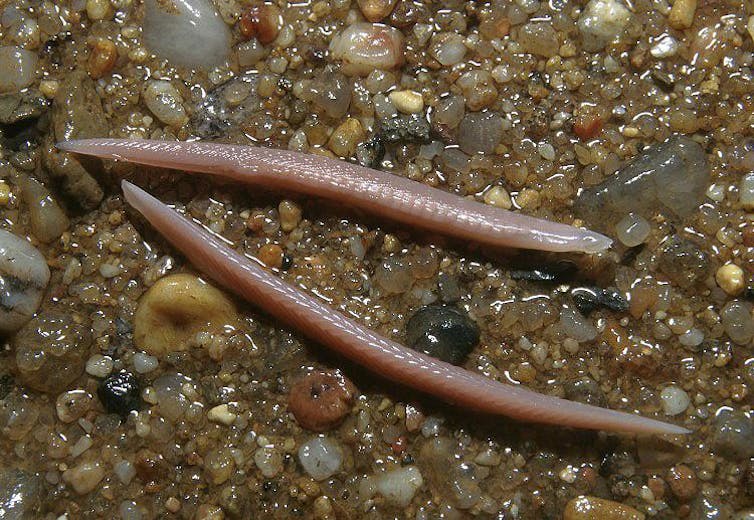
It looks like an anchovy fillet but this ancient creature helps us understand how DNA works Not anchovy fillets! UniProt

What does the research help us learn about how DNA is controlled?

One of the most exciting aspects of this new paper is that – for the first time – it shows us that for some of its genes, amphy uses a similar method to vertebrates to control whether genes are active or not.

This system is called DNA methylation. Small molecules called methyl groups sit on top of a particular part of the DNA and act like signposts that tell genes to switch off.

In more simple animals, such as invertebrates like worms and insects, methylation has been observed at very low levels. Amphy also has low DNA methylation levels in general.

But in this study we found focused sites of dense DNA methylation in the amphy DNA. In these regions, the methylation carries out functions similar to the functions in vertebrates – that is, it participates in gene regulation. This has not been observed before in invertebrates.

For amphy to use DNA methylation to control activities of some of its genes tells us that the regulatory function of DNA methylation might have evolved millions of years earlier than we initially thought.

This new finding may help us understand more about how DNA regulation works, and how it goes wrong in disease.

Authors: Ozren Bogdanovic, Lab Head-Developmental Epigenomics and Senior Research Fellow, Garvan Institute


Read more http://theconversation.com/it-looks-like-an-anchovy-fillet-but-this-ancient-creature-helps-us-understand-how-dna-works-107353

Pool and Deck Design: How to Plan the Perfect Outdoor Living Space for Your Sydney Home

For many Australians, the backyard is where life happens. Summer barbecues, weekend swims and long evenings outdoors are all part of the lifestyle, ...

Is Solar Pool Heating Worth It? What Sydney Homeowners Should Know

There's nothing quite like a backyard pool on a hot Sydney day. But once autumn rolls in, many pools sit unused for months because the water is simp...

Planning a Luxury House Move: A Week-by-Week Timeline for Prestige Sydney Homes

Selling or buying a prestige home is a major milestone. Whether it's a waterfront residence in Birchgrove, a grand Federation home in Haberfield or ...

Downsizing or Upgrading Your Caravan? Here's How to Sell It Without the Hassle

Selling a caravan can feel like a major task, especially when you are unsure about its value, paperwork, or how to find a buyer. Whether you are dow...

The Best Overseas Adventure Holidays for Australians Who Love the Outdoors

Australia offers no shortage of incredible outdoor experiences, but sometimes the best way to satisfy your sense of adventure is to head overseas. A...

Cape Town Wine Shuttle: Winelands Tasting & Tours

Embark on an unforgettable journey through the picturesque Cape Winelands, where world-class wines and breathtaking scenery await. Our Cape Town Win...

Why Giant Rats Tail Grass Keeps Coming Back After Spraying

Giant Rats Tail Grass (GRT) is one of the most frustrating pasture weeds for farmers and lifestyle property owners. You spray an infested area, see th...

When Custom Cardboard Boxes Make Sense for Your Business

Custom cardboard boxes can be useful when a standard carton does not fit a product, packing method or presentation requirement particularly well. A ...

Virtual Livestock Fencing and GPS Tracking: Improving Visibility Across Cattle Properties

What Virtual Livestock Fencing Means for Modern Cattle Management Managing cattle across extensive properties requires more than knowing where anim...

Sydney Pawnbrokers Explained: How Hocking Your Car Actually Works

Sometimes you need cash, and you need it soon. If you own a car, you may already have a way to get it. That's what people mean when they say they've...

Moving Interstate from the Gold Coast to Brisbane (or Back)? What Removalists Wish You Knew First

Have you talked to anyone who’s done the move? They say the same thing: the drive up the M1 is the easy part. It's everything around it that catches...

Why the Spring School Holidays Are a Great Time to Visit Coffs Harbour

The spring school holidays are a good time to spend a few days on the Coffs Coast. The weather is starting to warm up, there is plenty to do outdoor...

What to Do When an Older Car Is No Longer Worth Keeping in Melbourne

Ever looked at another repair quote and wondered whether your old car is still worth the trouble? It is a common turning point for Melbourne motoris...

Your Baby's First Year: A Local Guide to Feeding, Sleep, and When to Get Extra Support

Ask ten parents in a Brisbane mothers' group how their baby is feeding or sleeping, and expect ten different answers.  Someone's baby sleeps throug...

Kitchen and Laundry Makeover Ideas That Don't Require a Full Renovation

Full kitchen renos are expensive — and most people don't actually need one.  They need the kitchen to stop looking like it's stuck in 2009, or they...

How Technology Is Reshaping the Modern Australian Commercial Kitchen

The commercial kitchen has always been shaped by technology. Refrigeration changed how ingredients could be stored, modern ventilation transformed k...

The Number on a Roller Blind Fabric That Nobody Explains

Somewhere in the fabric book, next to the colour name, there is a percentage. Three per cent. Five per cent. Ten per cent. Nobody explains it, most c...

What’s Trending in Men’s Jewellery This Father’s Day!

Finding a Father’s Day gift that feels personal, stylish and genuinely wearable is not always easy. While socks and novelty mugs have traditionally ...















