

Our native animals are easy prey after a fire. Could artificial refuges save them?
- Written by: Darcy Watchorn, PhD Candidate, Deakin University
Australia is home to some of the most spectacular and enigmatic wildlife on Earth. Much of it, however, is being eaten by two incredibly damaging invasive predators: the feral cat and the red fox.
Each year in Australia, cats and foxes kill an estimated 697 million reptiles, 510 million birds, and 1.4 billion mammals, totalling a staggering 2.6 billion animals. Since the predators were introduced more than 150 years ago, they have contributed to the extinction of more than 25 species – and are pushing many more to the brink.
Research suggests cats and foxes can be more active in areas recently burnt by fire. This is a real concern, especially as climate change increases the frequency and severity of fire in south-eastern Australia.
We urgently need new ways to protect wildlife after fires. Our study trialled one such tool: building artificial refuges across burnt landscapes. The results are promising, but researchers need to find out more.
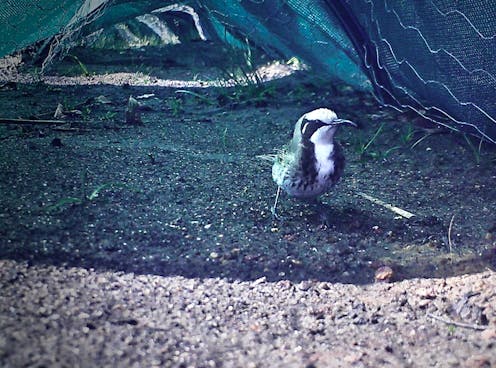
Video showing a buttonquail using an artificial refuge built by the researchers.Triple threat: cats, foxes and fire
Many native animals are well-adapted to fire. But the changing frequency and intensity of fire is posing a considerable threat to much of Australia’s wildlife.
Fire removes vegetation such as grass, leaf litter and shrubs. This leaves fewer places for native animals to shelter and hide, making it easier for cats and foxes to catch them.
We conducted our experiment in three Australian ecosystems: the forests of the Otway Ranges (Victoria), the sand dunes of the Simpson Desert (Queensland) and the woodlands of Kangaroo Island (South Australia). Each had recently been burnt by fire.
We built 76 refuges across these study areas. They were 90cm wide and up to 50m long – and backbreaking to install! They were made from wire mesh, mostly covered by shade cloth. Spacing in the mesh of 50mm allowed small animals to enter and exit from any point, while completely excluding cats, foxes and other larger animals. The shade cloth obstructed the vision of predators.
We then placed remote-sensing camera traps both inside and away from each refuge, and monitored them for periods ranging from four months to four years.
The placement of the cameras meant we could compare the effect of the refuges with what occurred outside them.
Read more: A season in hell: bushfires push at least 20 threatened species closer to extinction
What we found
Across the three study areas, the artificial refuges were used by 56 species or species groups. This included the critically endangered Kangaroo Island dunnart, the threatened white-footed dunnart and the threatened southern emu-wren.
For around half the species, we detected more individuals inside the refuges than outside. As we predicted, the activity of small birds and reptiles, in particular, was much higher inside the refuges.
But surprisingly, reptile activity was also generally higher inside the refuges, particularly among skinks. We had not predicted that, because the shade cloth likely made conditions inside the refuges cooler than outside, and reptiles require warmth to regulate their body temperature.
Over time, the number of animals detected inside the refuges generally increased. This was also a surprise. We expected detections inside the refuges to decline through time as the vegetation recovered and the risk of being seen by predators fell.
But there were also a few complicating factors. For example, in the Otway Ranges and Simpson Desert, similar numbers of the mammals were detected inside and away from the refuges. This suggests the species didn’t consider the refuges as particularly safe places, which means the structures may not reduce the risk of these animals becoming prey.
So what’s the upshot of all this? Our findings suggest that establishing artificial refuges after fire may help some small vertebrates, especially small birds and skinks, avoid predators across a range of ecosystems. However, more research is required before this strategy is adopted as a widespread management tool.
Read more: This critically endangered marsupial survived a bushfire – then along came the feral cats
Important next steps
Almost all evidence for an increase in cat and fox activity after fire comes from Australia, particularly the tropical north. But cats are an invasive species in more than 120 countries and islands.
That means there’s real potential for post-fire damage to wildlife to worsen globally, especially as fire risk increases with climate change.
Our results suggest artificial refuges may be a way to help animals survive after fire. But there are still important questions to answer, such as:
- can artificial refuges improve the overall abundance and survival of individuals and species?
- if so, how many refuges would be required to achieve this?
- in the presence of natural refuges – such as rocks, logs, burrows, and unburnt patches – are artificial refuges needed?
- does their effectiveness vary between low-severity planned burns and high-severity bushfires?
These questions must be answered. Conservation budgets are tight. After fires, funds must be directed towards actions that we know will work. That evidence is not yet there for artificial refuges.
Our team is busy trying to find out more. We urge other ecologists and conservationists to do so as well. We also encourage collaboration with designers and technologists to improve on our refuge design. For example, can such large refuges be made biodegradable and easier to deploy?
Solving these problems is important. It’s almost impossible to rid the entire Australian continent of cats and foxes. So land managers need all the help they can get to stop these predators from decimating Australia’s incredible wildlife.
The impact of roaming pet cats on Australian wildlife.Authors: Darcy Watchorn, PhD Candidate, Deakin University


















