

Poland has opened its arms to nearly 1 million Ukrainian refugees, but will they be able to stay for the long term?
- Written by: Kate Golebiowska, Senior Research Fellow, Charles Darwin University
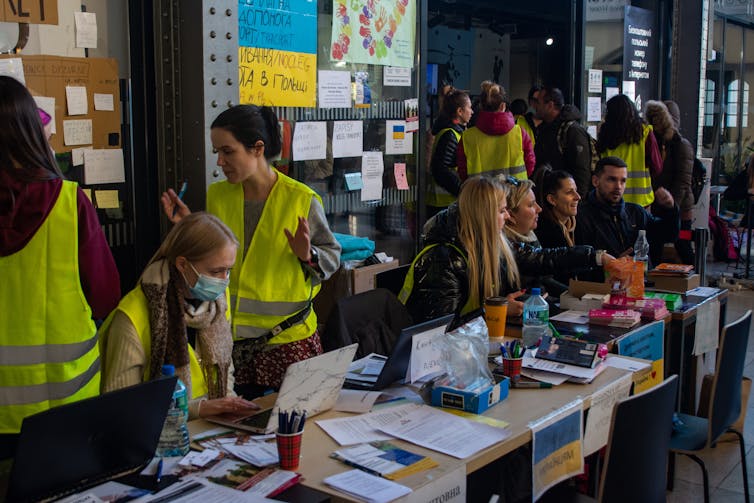
Two years after Russia’s full-scale invasion of Ukraine, the European landscape has been completely transformed by Ukrainian migrants fleeing their homeland.
According to the European Union, around 4.2 million Ukrainians currently receive temporary protection in EU countries, which entitles them to residence permits, working rights and access to health care and education.
The largest number are in Germany, where 1.2 million Ukrainians were living as of November 2023. Surprisingly, the second-largest number of refugees (960,000) are in Poland, a country with no significant history of accepting forced migrants.
In the weeks after Russia’s full-scale invasion in February 2022, Poland immediately opened its borders and became the primary recipient of Ukrainian refugees. By May 2022, 3.5 million Ukrainians – or 53% of all people who fled the country – had crossed the border into Poland.
Many have since returned to Ukraine or settled elsewhere, but many have stayed. Why has Poland been so open to this large number of migrants – and how long will they be able to stay?
Why Poland?
The large number of refugees was no doubt facilitated by the 530-kilometre border shared by the two countries. But Ukraine and Poland have much more in common. They share a complex, intertwined history marked by territorial wars, mutual antagonisms and historical disagreements, as well as linguistic and cultural similarities and first-hand experience of communist rule.
During Poland’s post-1989 transition to democracy, migrants from Ukraine became an important part of the labour force. Then, in 2014, conflict sparked by Russian-backed separatists in eastern Ukraine drove more Ukrainian migrants to Poland.
Before the 2022 Russian invasion, roughly 2 million foreigners lived in Poland – some 1.35 million of them Ukrainians. These Ukrainians were largely male workers, benefiting from the huge demand for labour in a country with an ageing and shrinking workforce.
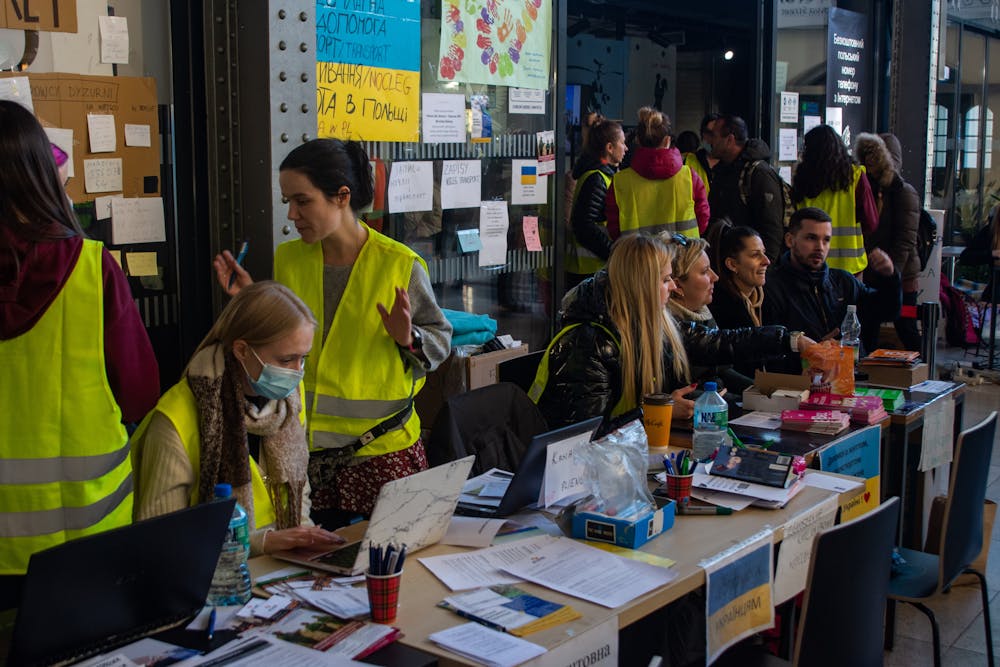
Given this history of migration, it stands to reason Poland would show solidarity with Ukrainians after the invasion. And the large Ukrainian migrant population already familiar with living in Poland volunteered to help the refugees when they arrived – mostly women with children.
This spontaneous welcome and support was also offered by ordinary Polish citizens and local NGOs. They even opened their homes to refugees and helped them find (or offered) employment. The level of support from the public was unprecedented.
What drove this huge swell of public empathy? While some were motivated by their previous contact with migrants, the collective memory of Soviet invasion and occupation was also important.
As the war has dragged on, some Poles have begun to worry about the impact of refugees on the country’s finances and health care. While public support was nearly universal (94%) for admitting Ukrainian refugees in March 2022, it slipped to 65% in September 2023.
A notable shift from the government
The Polish government also swiftly adopted a special-purpose law that gave Ukrainians temporary protection status and access to the same publicly funded services as Poles, such as welfare and employment rights, including business ownership. This law is rooted in the 2001 EU Temporary Protection Directive, which was activated after the invasion for the first time.
By December 2023, more than 1.64 million Ukrainians had applied for asylum or temporary protection in Poland – by far the highest number in eastern Europe. Their protection status was recently extended until June 30 of this year, with a further extension expected.
This was a startling move for the right-wing, anti-immigration, populist government led by the Law and Justice party. After all, this is the same Polish government that did not implement the EU relocation scheme in response to the 2015–16 European migration crisis. It also responded with force when neighbouring Belarus manufactured another crisis in 2021 by sending hundreds of migrants from the Middle East and Africa to the Polish border.
We believe this paradox can be explained by the Ukrainian refugees being aligned with the government’s then-criteria for acceptance. They were perceived as being “genuine” refugees (for example, women, children and elderly people fleeing war) and shared cultural traits with Poles.
This open-door response contrasted with the earlier rhetoric of right-wing politicians and media, who presented non-European refugees as a security risk and a threatening “other” forced on the government by EU quotas.
Better opportunities beyond Poland
Because Ukrainian refugees now hold various residency permits, thanks to their EU-mandated temporary protection status, they can cross borders easily. There have been more than 17 million crossings from Ukraine to Poland since the invasion, and nearly 14.7 million crossings in the other direction.
Between August 2022 and June 2023, some 350,000 Ukrainian refugees also left Poland for other countries. About 100,000 resettled in Germany, lured by stories of better wages and welfare benefits.
Given their high mobility, it remains to be seen how many Ukrainian migrants decide to stay in Poland. The ability to work is key. In 2022, one survey showed the employment rate of Ukrainian refugees in Poland to be 65% – the highest for displaced Ukrainians in Europe. A year later, it had only dipped slightly to 62%.
According to other Polish surveys, between 48% and 70% of Ukrainian refugees also hold tertiary qualifications.
However, just like in other OECD countries, many Ukrainians in Poland have been working below their qualifications.
About half the refugees in one survey said they couldn’t find a job in 2023, double the rate the year before. And only 7.7% said they wouldn’t take a job below their qualifications, compared with 20% the year before.
Read more: Ukraine: The good, bad and ideal refugees
Will they return home?
Whether refugees ultimately return to Ukraine, however, depends on several factors. Surveys show upwards of 39% of migrants intend to remain in Poland permanently or for the long term. The main reasons include the ability to work and provide for themselves and their families, job satisfaction, the opinions of their children, and better housing.
Although more Ukrainians are gaining Polish language skills, about a third report needing formal language training and assistance in finding employment.
How Poland responds to these needs will influence whether Ukrainian refugees feel welcome to stay and further integrate into Polish society, particularly under the newly elected, more liberal Polish government.
Authors: Kate Golebiowska, Senior Research Fellow, Charles Darwin University


















