

Alabama ruling frozen embryos are equivalent to living children has worrying implications for IVF
- Written by: Alex Polyakov, Medical Director, Genea Fertility Melbourne; Clinical Associate Professor, Faculty of Medicine, Dentistry & Health Sciences, The University of Melbourne
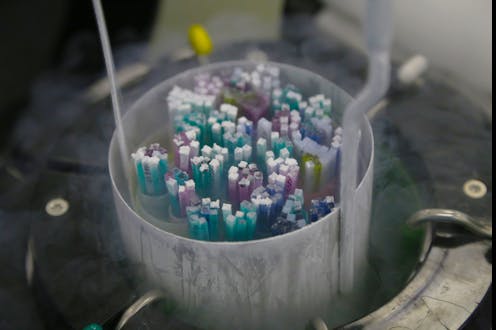
In December 2020 in Alabama, a hospital patient gained unauthorised access to an adjoining IVF storage facility, which was not adequately secured. The patient is said to have removed several frozen embryos, which they then dropped on the floor, owing to a freeze-burn to their hand. The embryos were destroyed.
In Alabama, the Wrongful Death of a Minor Act allows parents of a deceased child to recover punitive damages for their child’s death, and three couples affected by the incident subsequently brought lawsuits against the clinic under this legislation.
When this case was heard recently in the Supreme Court of Alabama, the majority of justices opined this statute applies to frozen embryos because:
an unborn child is a genetically unique human being whose life begins at fertilization and ends at death.
This essentially means frozen embryos are protected under Alabama law to the same extent as any living child. While this was a civil matter, it’s not inconceivable that, based on this interpretation, anyone who destroys a frozen embryo in Alabama – accidentally or on purpose – could face criminal penalties, such as manslaughter or even murder charges.
Likely for fear it’s too risky, clinics in the state are now limiting their IVF services, leaving patients having to seek treatment elsewhere.
Read more: Considering using IVF to have a baby? Here's what you need to know
Ascribing personhood to frozen embryos is not a novel idea, but such a conviction is held only by the very fringes of the religious and conservative spectrum. There are clear political dimensions to this ruling, which appears to be an extension of a radical agenda on the altar of which the Supreme Court of the United States recently sacrificed the right to abortion.
This ruling from the Supreme Court of Alabama reflects a profound ignorance about how the process of IVF works.
Creating multiple embryos is essential for overall IVF success
The process of in vitro fertilisation, or IVF, begins with a “stimulated” cycle, where hormones are injected into a woman to stimulate an ovary to produce multiple eggs. These eggs are then collected and combined with sperm, forming embryos that are placed in an incubator to grow.
Five days later, the embryos are assessed. Some develop into “good quality” embryos suitable for transfer into a woman’s uterus. The hope is that following the transfer, the embryo will implant and result in a viable pregnancy, ultimately leading to the birth of a healthy child. Any good-quality embryos not used in a stimulated cycle are usually frozen for future attempts.
Unfortunately, IVF is somewhat inefficient, with attrition a prominent feature at every stage. Not all collected eggs are suitable for fertilisation, not all fertilise, not all embryos fertilise normally, and not all normally-fertilised embryos are of good quality. Poor-quality eggs, abnormally-fertilised embryos and poor-quality embryos are routinely discarded.
The practical implications of this process and the heartbreaking reality for individuals and couples undergoing IVF is that it takes, on average, three to five eggs to produce one good-quality embryo. However, this number is age-dependent and significantly higher for older women.
The chance of achieving pregnancy from one embryo transfer is also significantly influenced by the woman’s age, being as high as 50% in younger women but decreasing exponentially as a woman gets older. At the age of 46, it can be as low as 1-2%.
So it’s vital to be able to safely produce as many good-quality embryos as possible from one stimulated IVF cycle in case multiple sequential embryo transfers are needed to achieve a healthy pregnancy.
Read more: The business of IVF: how human eggs went from simple cells to a valuable commodity
Should the initial embryo transfer fail to produce a viable pregnancy, and frozen embryos are available, those can be thawed and transferred into a woman’s uterus in a “thaw” cycle. These cycles usually don’t require the use of injectable hormones or an egg collection and, in most instances, require only monitoring (including ultrasounds and blood tests), and timed embryo transfer.
The risks associated with IVF, such as bleeding and infections, are mostly confined to the stimulated cycles, while thaw cycles pose minimal risk. Notably, the most labour-intensive, and, therefore, costly portion is the stimulated cycle, while a thaw cycle can be around three to four times cheaper.
Should embryo freezing become unavailable, all people undergoing IVF would have to rely solely on stimulated cycles to achieve pregnancy, significantly increasing the risks and radically escalating the costs.
The judge’s error in interpreting Australian practice
Tom Parker, the Chief Justice of the Supreme Court of Alabama, made the following statement in his judgement:
in Australia and New Zealand, prevailing ethical standards dictate that physicians usually create only one embryo at a time.
He implied that in Australia, the only IVF cycles ethically permitted are stimulated cycles, where just one embryo is created and transferred, with no embryos being frozen.
However, this assertion is demonstrably false. There are no guidelines or regulations in Australia that discourage the creation of multiple embryos, as this practice enhances overall pregnancy rates, while making IVF safer and more cost-effective.
What is discouraged is the transfer of multiple embryos at one time, as this increases the likelihood of multiple births, which carry heightened medical risks for both mothers and babies.
It seems the Chief Justice has fundamentally misunderstood the Australian regulatory framework. Ironically, the excellent IVF outcomes and very low rates of multiple births in Australia are largely attributable to the widespread use of frozen embryo transfer cycles – a practice now under threat in Alabama.
Authors: Alex Polyakov, Medical Director, Genea Fertility Melbourne; Clinical Associate Professor, Faculty of Medicine, Dentistry & Health Sciences, The University of Melbourne


















