

cooling the Earth by reflecting sunlight back to space is a dangerous distraction
- Written by: James Kerry, Adjunct Senior Research Fellow, James Cook University, Australia and Senior Marine and Climate Scientist, OceanCare, Switzerland, James Cook University
The United Nations Environment Assembly this week considered a resolution on solar radiation modification, which refers to controversial technologies intended to mask the heating effect of greenhouse gases by reflecting some sunlight back to space.
Proponents argue the technologies will limit the effects of climate change. In reality, this type of “geoengineering” risks further destabilising an already deeply disturbed climate system. What’s more, its full impacts cannot be known until after deployment.
The draft resolution initially called for the convening of an expert group to examine the benefits and risks of solar radiation modification. The motion was withdrawn on Thursday after no consensus could be reached on the controversial topic.
A notable development was a call from some Global South countries for “non-use” of solar radiation modification. We strongly support this position. Human-caused climate change is already one planetary-scale experiment too many – we don’t need another.
A risky business
In some circles, solar geoengineering is gaining prominence as a response to the climate crisis. However, research has consistently identified potential risks posed by the technologies such as:
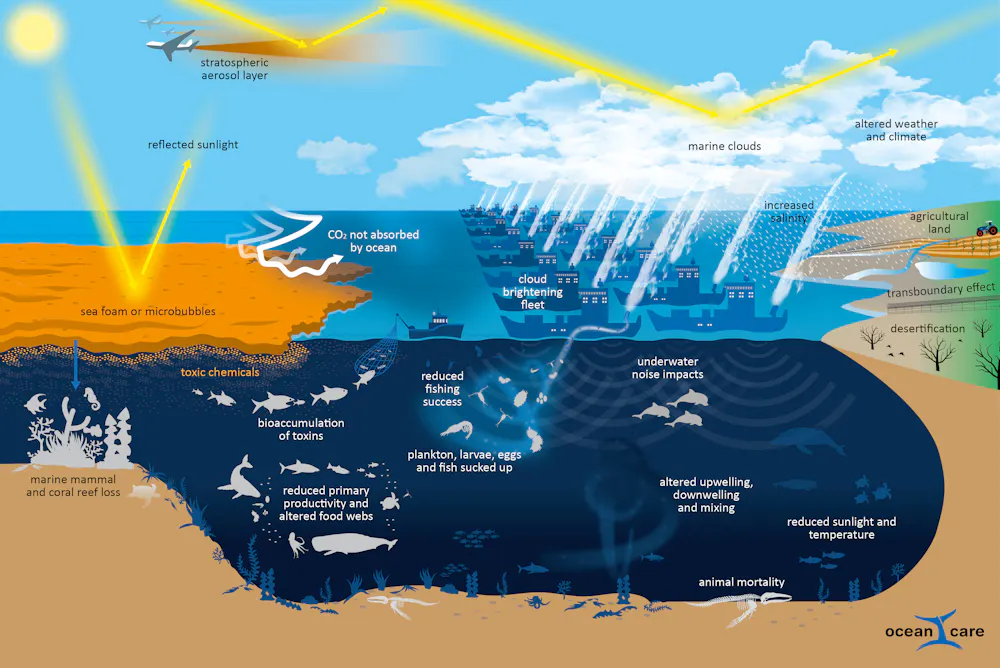
Here, we discuss several examples of solar radiation modification which exemplify the threats posed by these technologies. These are also depicted in the graphic below.
A load of hot air
In April 2022, an American startup company released two weather balloons into the air from Mexico. The experiment was conducted without approval from Mexican authorities.
The intent was to cool the atmosphere by deflecting sunlight. The resulting reduction in warming would be sold for profit as “cooling credits” to those wanting to offset greenhouse gas pollution.
Appreciably cooling the climate would, in reality, require injecting millions of metric tons of aerosols into the stratosphere, using a purpose-built fleet of high-altitude aircraft. Such an undertaking would alter global wind and rainfall patterns, leading to more drought and cyclones, exacerbating acid rainfall and slowing ozone recovery.
Once started, this stratospheric aerosol injection would need to be carried out continually for at least a century to achieve the desired cooling effect. Stopping prematurely would lead to an unprecedented rise in global temperatures far outpacing extreme climate change scenarios.
Read more: Trying to cool the Earth by dimming sunlight could be worse than global warming
Heads in the clouds
Another solar geoengineering technology, known as marine cloud brightening, seeks to make low-lying clouds more reflective by spraying microscopic seawater droplets into the air. Since 2017, trials have been underway on the Great Barrier Reef.
The project is tiny in scale, and involves pumping seawater onto a boat and spraying it from nozzles towards the sky. The project leader says the mist-generating machine would need to be scaled up by a factor of ten, to about 3,000 nozzles, to brighten nearby clouds by 30%.
After years of trials, the project has not yet produced peer-reviewed empirical evidence that cloud brightening could reduce sea surface temperatures or protect corals from bleaching.
The Great Barrier Reef is the size of Italy. Scaling up attempts at cloud brightening would require up to 1,000 machines on boats, all pumping and spraying vast amounts of seawater for months during summer. Even if it worked, the operation is hardly, as its proponents claim, “environmentally benign”.
The technology’s effects remain unclear. For the Great Barrier Reef, less sunlight and lower temperatures could alter water movement and mixing, harming marine life. Marine life may also be killed by pumps or negatively affected by the additional noise pollution. And on land, marine cloud brightening may lead to altered rainfall patterns and increased salinity, damaging agriculture.
More broadly, 101 governments last year agreed to a statement describing marine-based geoengineering, including cloud brightening, as having “the potential for deleterious effects that are widespread, long-lasting or severe”.
A cloud brightening field trip in 2021 (Southern Cross University)Balls, bubbles and foams
The Arctic Ice Project involves spreading a layer of tiny glass spheres over large regions of sea ice to brighten its surface and halt ice loss.
Trials have been conducted on frozen lakes in North America. Scientists recently showed the spheres actually absorb some sunlight, speeding up sea-ice loss in some conditions.
Another proposed intervention is spraying the ocean with microbubbles or sea foam to make the surface more reflective. This would introduce large concentrations of chemicals to stabilise bubbles or foam at the sea surface, posing significant risk to marine life, ecosystem function and fisheries.
No more distractions
Some scientists investigating solar geoengineering discuss the need for “exit ramps” – the termination of research once a proposed intervention is deemed to be technically infeasible, too risky or socially unacceptable. We believe this point has already been reached.
Since 2022, more than 500 scientists from 61 countries have signed an open letter calling for an international non-use agreement on solar geoengineering. Aside from the types of risks discussed above, the letter said the speculative technologies detract from the urgent need to cut global emissions, and that no global governance system exists to fairly and effectively regulate their deployment.
Calls for outdoor experimentation of the technologies are misguided and detract energy and resources from what we need to do today: phase out fossil fuels and accelerate a just transition worldwide.
Climate change is the greatest challenge facing humanity, and global responses have been woefully inadequate. Humanity must not pursue dangerous distractions that do nothing to tackle the root causes of climate change, come with incalculable risk, and will likely further delay climate action.
Authors: James Kerry, Adjunct Senior Research Fellow, James Cook University, Australia and Senior Marine and Climate Scientist, OceanCare, Switzerland, James Cook University


















