

The battle to be the Amazon (or Netflix) of transport
- Written by: Neil Sipe, Professor of Urban and Regional Planning, The University of Queensland
High-tech companies and venture capitalists have been striving to break into the transport and mobility market. Between 2016 and 2018, venture capital investment in urban technology surpassed that of many other areas, including pharmaceuticals and artificial intelligence. Almost 70% of this investment was in mobility.
Read more: Smart mobility alone is no substitute for strong policy leadership
There are many players in this space, but the three largest are Alphabet, Uber and Didi Chuxing.
So what do these companies do?
Alphabet, Google’s parent company, was recently dubbed a superpower of transportation by business research firm Gartner. Its market capitalisation, estimated at more than US$700 billion in November 2018, makes it one of the world’s most valuable companies.
Alphabet has many different investment arms, including GV, CapitalG and Gradient. All have invested heavily in transport companies such as Uber, Lyft, Gojek, SpaceX and Scotty Labs.
Google got started in transport by creating digital maps with navigation functions. Later it added features such as traffic conditions and street views. It’s estimated that nearly 70% of smartphone users use the Google Map app.
Alphabet also owns Waze, another navigation app that enables users to crowdsource information on highway construction and traffic congestion.
Google is acknowledged as a leader in autonomous vehicle research through Waymo, its self-driving car unit. To date, Waymo vehicles have logged more than 16 million kilometres in tests.
In October, Waymo marked a milestone of more than 16 million kilometres self-driven on public roads.Waymo is also working with cities to improve public transport. One of these initiatives is a partnership with Phoenix Valley Public Transit in Arizona to provide services to solve the “first and last mile” problem.
Another initiative related to autonomous vehicles involves developing self-driving buses. These will reduce costs of providing public transport by eliminating human drivers.
Read more: In a driverless future, what happens to today's drivers?
Alphabet created Sidewalk Labs in 2015 to focus on building better and “smarter” cities. Sidewalk Labs’ first experimental site in Toronto will feature flexible, modular streets and heated sidewalks.
Within Sidewalk Labs are three portfolio companies. Among these, Coord is involved with improving mobility in cities. Cityblock focuses on health. And Intersection is interested in urban innovation and technology.
Personal mobility is a key focus of the Sidewalk Toronto project.Read more: Can a tech company build a city? Ask Google
Finally, the Google founders are personally interested in developing flying cars and high-tech blimps.
Uber was founded in 2009 as a peer-to-peer ride-sharing company. It has been one of the most successful startups. As of August 2018, it was valued at US$72 billion. In a recent interview with The Economist, CEO Dara Khosrowshahi said his goal is for Uber to become the Amazon of transport.
As the previous CEO of Expedia, he has experience in aggregating services from a range of companies. This is what Expedia did by combining fare information for hotels, flights and car rentals into a single site.
Uber is involved in a range of transport-related offerings, including ride sharing, pooled ride sharing, share bikes and scooters, autonomous vehicles, food delivery and freight.
The company is looking to expand into public transit. Earlier this year, it created the Cincinnati Mobility Lab to conduct research and engage with employers to help Cincinnati, Ohio, develop a transport plan to increase public transport use.
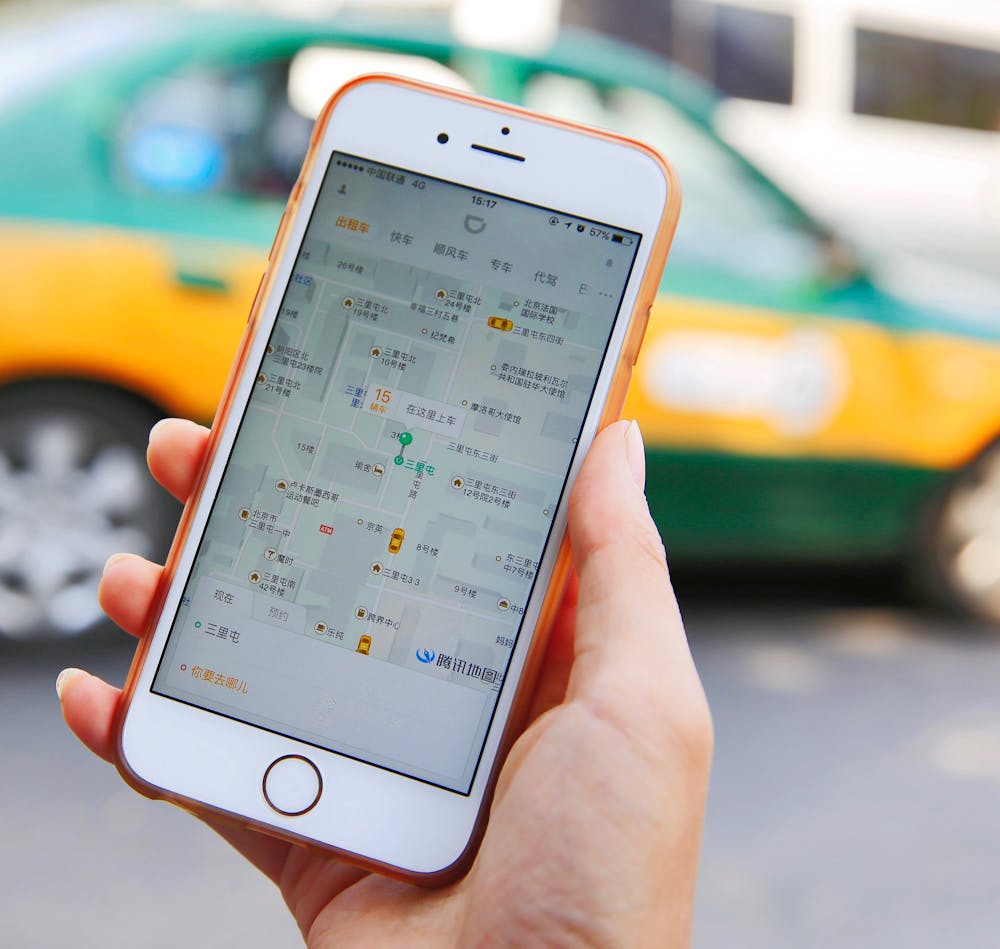 Didi Chuxing bought out Uber in China in 2016 and is now expanding to other countries, including Australia.
How Hwee Young/EPA
Didi Chuxing bought out Uber in China in 2016 and is now expanding to other countries, including Australia.
How Hwee Young/EPA
The third major player is Didi Chuxing. Established in 2012, the Beijing-based company has attracted venture capital funding and was valued at US$56 billion as of August 2018. Didi was a major competitor to Uber in China until in 2016 it purchased Uber’s Chinese operations for US$35 billion. Until recently it operated in China only, but is now branching out in Mexico, Brazil and Australia, with plans for further expansion into a number of other countries.
Like Uber, Didi provides transport services across taxis, minibuses, ride pooling and ride, car, bicycle and e-scooter sharing.
Read more: Can e-scooters solve the 'last mile' problem? They'll need to avoid the fate of dockless bikes
Recently Didi has expanded into three other transport-related areas: big data management to service its growing transport empire; artificial intelligence focusing on autonomous vehicles; and smart transport applications such as smart traffic signals, reversible traffic lane management and the like.
Read more: City streets become a living lab that could transform your daily travel
Mass transportation versus MaaS
While not specifically mentioning Mobility as a Service (MaaS), all of the tech companies are headed in the same direction. They all want to be the dominant provider of a transport services platform.
A company that has played a major role in promoting MaaS is MaaS Global. It’s much smaller than Alphabet, Uber and Didi Chuxing, but its CEO has aspirations for the company to become the Netflix of transport.
Read more: For Mobility as a Service (MaaS) to solve our transport woes, some things need to change
What’s behind all this interest?
Tech companies and venture capitalist may be interested in transport only because there is money to be made. Or, perhaps, they are also interested in solving a growing global problem.
Either way, with urbanisation increasing worldwide, traffic congestion will continue to worsen. Building more infrastructure is not only costly, but provides only a temporary fix. Perhaps improving mobility by making better use of existing infrastructure, as tech companies are proposing, is the way forward for cities.
Authors: Neil Sipe, Professor of Urban and Regional Planning, The University of Queensland
Read more http://theconversation.com/the-battle-to-be-the-amazon-or-netflix-of-transport-103351
-of-transport&media=https://www.modernaustralian.com/https://images.theconversation.com/files/246956/original/file-20181122-149721-n9km15.jpg?ixlib=rb-1.1.0&q=45&auto=format&w=237&fit=clip&description=The%20battle%20to%20be%20the%20Amazon%20(or%20Netflix)%20of%20transport "Pin It")

















