

old paintings and new photographs reveal some NZ glaciers may soon be extinct
- Written by: Andrew Lorrey, Principal Scientist & Programme Leader of Southern Hemisphere Climates and Environments, National Institute of Water and Atmospheric Research
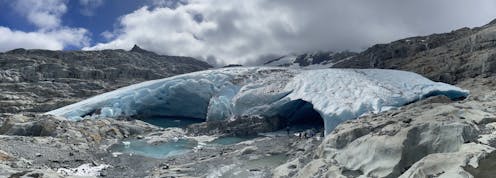
As the austral summer draws to a close, we are preparing to fly over the Southern Alps to survey glaciers. This annual flight supports the longest scientific study of Aotearoa New Zealand’s icescapes – and it shows that all of our glaciers have retreated since 1978.
This year’s survey comes on the heels of the warmest year on record globally and the second warmest for New Zealand, which produced extreme weather events and impacts that still cut deep for many local communities.
Despite strong El Niño conditions in the Pacific this season, which typically boost ice volume, we expect the recent heat grilling the glaciers will have had a grim effect.
Our work monitoring ice in the Southern Alps and central North Island shows many small glaciers are approaching an extinction horizon.The 46-year record of end-of-summer glacier images is incredibly valuable because it contains irrefutable visual evidence of climate change. We can see how glaciers are changing from year to year, with extremely hot years such as 2023 standing out clearly.
But our insights aren’t limited to images of glaciers taken from light aircraft. We can also learn from historic paintings of New Zealand’s mountain landscapes.
Portraits of past climate
Old paintings with glaciers are common for the European Alps, where many artists lived and visited. But similar offerings are relatively rare for our part of the world.
What’s remarkable for New Zealand is that some of these works of art were produced without the artist ever seeing the glaciers.
We recently scrutinised the artistic vistas painted by John Gully to see if they were true to the real landscapes. Gully based his works on field sketches by Julius Haast, one of the first scientists to formerly recognise widespread glaciation in New Zealand.
Gully’s paintings show features that can be linked to glacial landforms we can see today, including moraines (rocks deposited by a glacier, typically at its edges), outwash fans (sediment deposited by braided rivers fed by a melting glacier) and trimlines (lines that mark a glacier’s earlier, higher position in a valley).
Many of those features in the paintings have ice in direct contact with them, showing how accurately field scientists and artists depicted glaciers at the time.
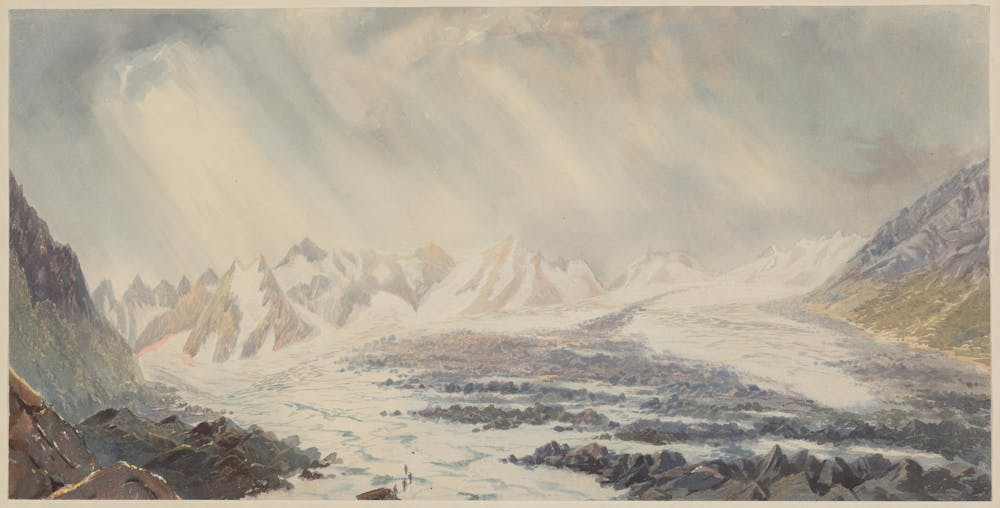
Gully’s paintings were intended to convey the dramatic scale of a mysterious land located far away from industrialised 19th-century society. Serendipitously, for contemporary scientists, comparing these artworks with current photos vividly shows the magnitude of ice loss that has occurred since the mid-1800s.
The perspective we get from Gully’s paintings concurs with studies that place the timing of ice retreat as being already underway in the mid-1800s. Prior to this time, known commonly as the Little Ice Age, New Zealand experienced cooler temperatures between about 1450 and 1850.
Modelling ice volume loss using these Little Ice Age landforms provides a benchmark. It illustrates that recent changes have occurred in a geological instant and that the peak summer flows from glaciers that helped create the braided river systems so typical of the South Island landscape are in the past.
Read more: How climate change made the melting of New Zealand's glaciers 10 times more likely
Accelerating pace of glacier retreat
Recent glacier changes are occurring ever more quickly. The long-term photographic record from the Southern Alps shows an acceleration of the pace at which snowlines rise due to climate warming.
For a glacier to exist, average summer temperatures must be cool enough for the summer snowline to remain below mountain tops so ice can accumulate. We now observe that ice is disappearing from mountains which held small amounts during the late 1970s. Glaciers there are going extinct.
Combining long-term snowline observations with direct field measurements of glacier mass balance and 3D models of ice volume change gives a good synopsis of how things have changed and a sense of things to come.
Read more: COP28: Earth's frozen zones are in trouble – we're already seeing the consequences
We estimate at least 13 trillion litres of water (in the form of ice) has been lost from the Southern Alps since 1978. This is equivalent to the basic water needs for all New Zealanders during that time.
The regions around the central Southern Alps that hold many small glaciers are experiencing accelerated ice loss. Some areas, like Southland and Otago, have small glaciers that are rapidly approaching an extinction horizon. And once they pass it, we are not likely to see them again.
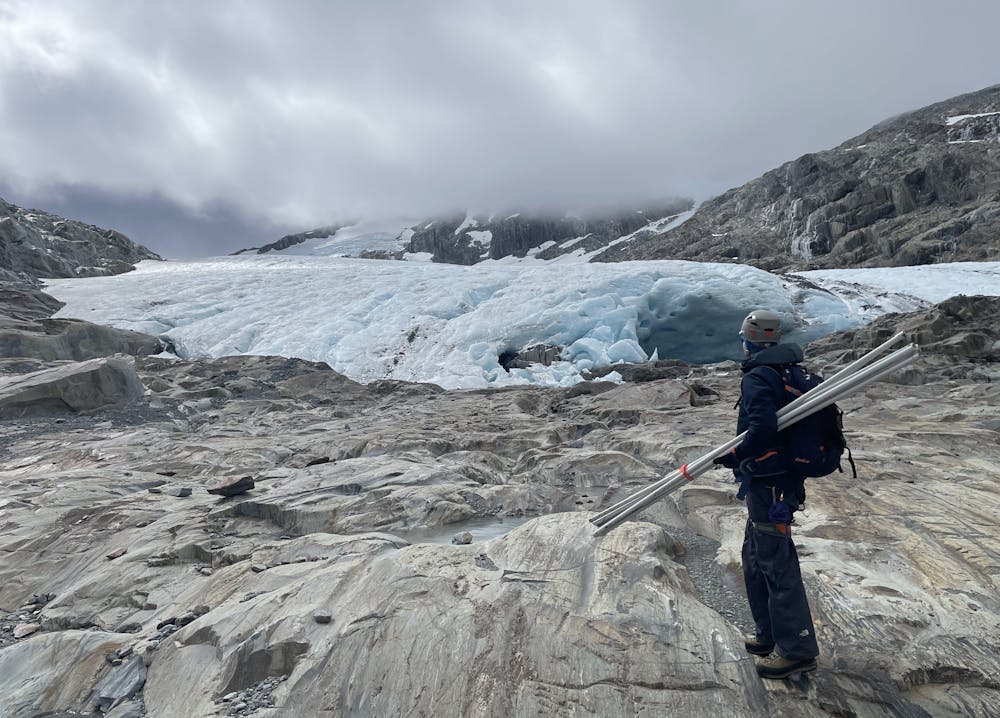 Brewster Glacier in Mt Aspiring National Park has the longest record of mass balance measurements. Using snowstakes, we document its retreat due to warming temperatures.
Andrew Lorrey, CC BY-SA
Brewster Glacier in Mt Aspiring National Park has the longest record of mass balance measurements. Using snowstakes, we document its retreat due to warming temperatures.
Andrew Lorrey, CC BY-SA
The central North Island also hosts a number of small glaciers on Mt. Ruapehu that feed into the headwaters of the Waikato and Whanganui rivers. Glaciers there were originally mapped in the mid-20th century, and again in 1978, 1988 and 2016. A recent photographic capture of Mt Ruapehu reflects a dire situation, indicating glaciers are fast approaching extinction.
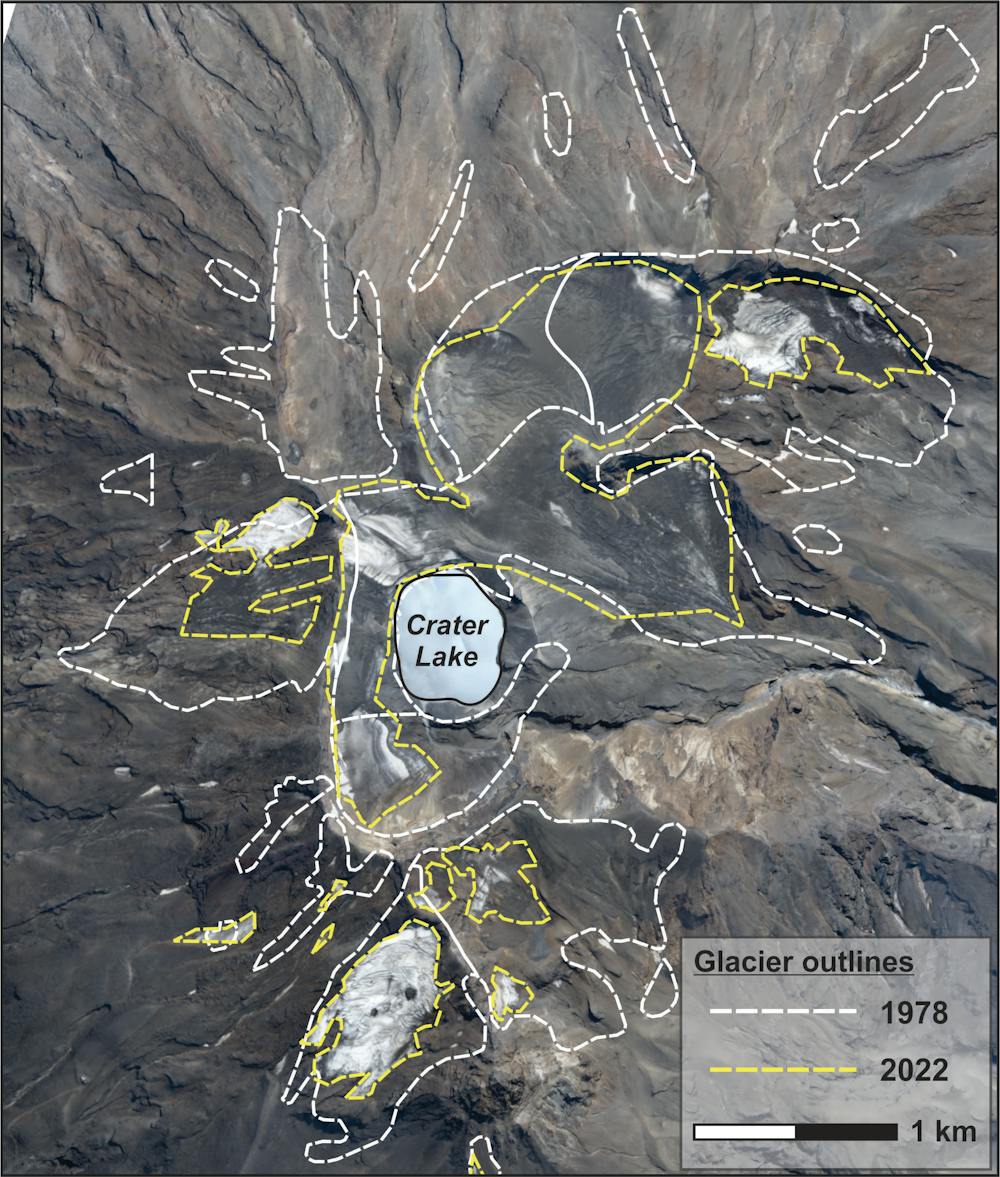 This aerial image of the Mt Ruapehu summit region shows the earliest complete glacier survey from the Randolph Glacier Inventory (1978, white-dashed line) and an assessment from 2022 (yellow-dashed line).
Shaun Eaves, CC BY-SA
This aerial image of the Mt Ruapehu summit region shows the earliest complete glacier survey from the Randolph Glacier Inventory (1978, white-dashed line) and an assessment from 2022 (yellow-dashed line).
Shaun Eaves, CC BY-SA
Environments and ethics
New Zealand’s diminishing glaciers and loss of ice across Earth are largely carrying on unabated. These changes are primarily caused by rising temperatures driven by human activities that produce greenhouse gas emissions.
The global increase in atmospheric carbon dioxide continues undiminished. This needs to change soon and rapidly to protect many of our glaciers.
We face particularly serious ethical questions with respect to Mt Ruapehu’s glaciers. They help sustain the Whanganui River Te Awa Tupua, which has been granted the rights of a living entity. The glaciers’ ongoing retreat – and possible extinction – highlights our collective responsibilities for doing simultaneous harm to the environment and people.
The authors acknowledge Rebekah Parsons-King at NIWA for her work on the Glacier Extinction Horizons video. We also thank Brian Anderson for his long-term leadership on the Brewster Glacier snowstakes programme, and Pascal Sirguey for his work calculating mass balance for Brewster Glacier.
Authors: Andrew Lorrey, Principal Scientist & Programme Leader of Southern Hemisphere Climates and Environments, National Institute of Water and Atmospheric Research


















