

Cultural burning is better for Australian soils than prescribed burning, or no burning at all
- Written by: Anthony Dosseto, Professor, University of Wollongong
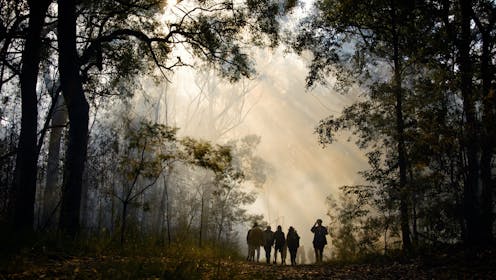
Imagine a landscape shaped by fire, not as a destructive force but as a life-giving tool. That’s the reality in Australia, where Indigenous communities have long understood the intricate relationship between fire, soil and life. Cultural burning has been used for millennia to care for landscapes and nurture biodiversity. In contrast, government agencies conduct “prescribed burning” mainly to reduce fuel loads.
In our new research, we compared cultural burning to agency-led prescribed burning or no burning. We studied the effects on soil properties such as moisture content, density and nutrient levels.
Both fire treatments increased soil moisture and organic matter, while reducing soil density. That means burning improved soil health overall. But cultural burning was the best way to boost soil carbon and nitrogen while also reducing soil density, which improves the soil’s ability to nurture plants.
Understanding the effects of different fire management techniques is crucial for developing more sustainable land management practices. By studying what happens to the soil, we can work out how best to promote healthy, resilient ecosystems while also reducing risks of uncontrolled bushfires.
Cultural Burning for Resilience (2021), a mini documentary featuring coauthors Vic Channell, Leanne Brook and Katharine Haynes.The vital role of fire
Fire has shaped Australian landscapes for millions of years, transforming ecosystems and influencing biodiversity.

For Indigenous Australians, fire is not just a tool but a way of life. Fire is used to care for Country, for cultural purposes including ceremonies, to promote new plant growth and food resources, and to facilitate hunting and gathering.
Cultural burning is only ever conducted when it will benefit the health of Country. It is a practice deeply rooted in Indigenous knowledge and traditions. Fires are small, slow and cool. Practitioners read signs in the environment in relation to the local flora and fauna that provide guidance on the right time to burn.
In comparison, prescribed burning, conducted by government agencies, is principally conducted to reduce fuel loads and minimise the risk of wildfires. Fires are often larger and burn hotter than cultural burning.
In recent times, bushfires have become more frequent and severe in parts of Australia. So understanding and supporting Indigenous-led fire management practices is becoming increasingly important for sustainable land management.
Read more: How 1970s conservation laws turned this ‘paradise on Earth’ into a tinderbox
Unlocking the secrets of soil health
Our new research sheds light on the impact of fire management techniques on soil properties. The study was conducted on the south coast of New South Wales, on land managed by the Ulladulla Local Aboriginal Land Council. At this plot, one area of land experienced no burn, another was burnt by NSW Rural Fire Service and another experienced a cultural burn.
While the area burnt was relatively small, about 5,000 square metres for each plot, it can still help shed a light on the effect of fire treatments on soil properties.
We found both agency-led prescribed burning and cultural burning increased soil moisture levels. There may be different reasons for this. For soils that experienced the cultural burn, the extra moisture could be explained by the reduction in soil density, which promotes water flow. For soils that experienced the agency-led prescribed burn, where density didn’t decrease much, it’s possible the hotter fire removed the water-repellant layer of soil that sometimes develops following a fire, allowing more moisture to soak in.
Cultural burning had a more pronounced effect on reducing soil density and increasing organic matter content. Having more organic matter in the soil means more nutrients such as carbon and nitrogen are available to plants. Lower density improves soil structure. Both improve the capacity of ecosystems to withstand environmental stress such as drought and wildfire.
These findings suggest cultural burning not only benefits soil health but also helps make ecosystems more resilient, by providing more water and nutrients that native plants need.
 Carbon dioxide emissions from soil can be measured in the field.
Jessica Davis
Carbon dioxide emissions from soil can be measured in the field.
Jessica Davis
Embracing Indigenous wisdom
Indigenous communities use cultural land management practices, of which cultural burning is one tool, to care for Country as kin. They do not see themselves as separate to the environment. Instead their practices are guided by place-based knowledge that weaves human, spiritual and ecological needs together in a symbiotic relationship where one cannot thrive without the other.
Supporting Indigenous-led fire practices is not just about what it can do for the environment. It’s also a recognition of the deep cultural and spiritual connections Indigenous communities have with the land.
By learning from and working with Indigenous communities, we can foster a more harmonious relationship with Country, one that benefits both people and the environment.
 Cultural burning is a team effort.
Ulladulla Local Aboriginal Land Council
Cultural burning is a team effort.
Ulladulla Local Aboriginal Land Council
Rekindling our relationships
Indigenous fire management practices offer invaluable wisdom and the potential to transform our approach to land stewardship.
By embracing these practices, we can nurture healthier soils, promote biodiversity, and foster more resilient ecosystems.
Practically, to make this possible, ongoing investment is required to build the capacity of Indigenous communities to fulfil their obligations to care for Country. Policies must be updated to allow greater access to Country and to reduce red tape and bureaucracy.
There is a danger here. Government agencies often want to incorporate or take on some of the principles of cool burns themselves, forgetting the cultural aspects and the need for this to be Indigenous-led. We must understand this is not just about managing fires, it’s about rekindling our relationship with the land and learning from those who have lived in harmony with it for thousands of years.
Authors: Anthony Dosseto, Professor, University of Wollongong


















