

Google AI


Modern Australian

Each Easter we spend about $62 a head on chocolates, but the cost of buying unsustainable products can be far greater

  • Written by: Stephanie Perkiss, Associate professor in accounting, University of Wollongong
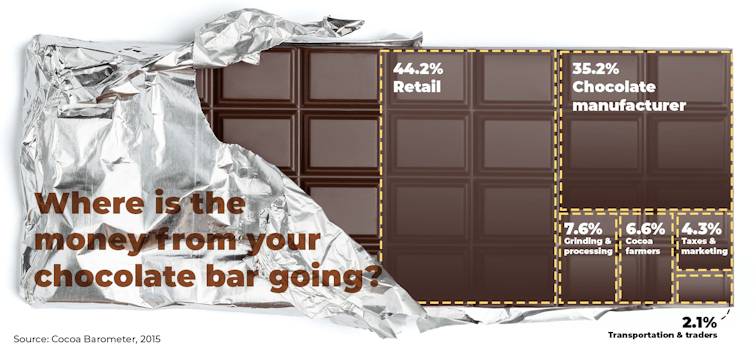
A chocolate bar divided up by boxes to show where money goes in the chocolate industry

Australians enjoy chocolate, consuming on average the equivalent of 32 kilograms a year, but there is growing interest in its origins and how it’s made.

They want to know their product is sustainably made by companies that only deal with ingredient suppliers who engage in fair labour practices and safeguard against deforestation and other environmentally damaging processes.

But according to the 5th Edition of the Chocolate Scorecard, produced by Be Slavery Free, two Australian universities and several sustainability interest groups, some retailers are lagging when it comes to stocking sustainable products.

The scorecard is released at Easter, the busiest time of the year for the sweet treat. Sales in this period account for 75% of chocolate sold annually in Australia, with the average consumer spending $62 on Easter chocolates.

The scorecard ranks the policies and practices of chocolate traders, manufacturers, brands and retailers, assessing 63 companies on six criteria. These are traceability and transparency, living income, child and forced labor, climate change and deforestation, agroforestry and agrochemical use.

Next year’s report card will also include a rating based on gender equality which is being added as a seventh criteria.

Read more: The real cost of your chocolate habit: new research reveals the bittersweet truth of cocoa farming in Africa's forests

It assesses companies deemed industry leaders in sustainable policies and practices and awards them a green rating (or “egg”), while yellow and orange ratings are given to companies considered to be “progressing” and “needing improvement”. Red is given to those “trailing in policy and practice” and grey indicates a lack of transparency.

This year, the German brand, Ritter Sport, available in some large Australian supermarkets, was given a Good Egg Award in the medium and large company category for its progress and to show bigger companies can do much better.

Dutch brand, Tony’s Chocolonely, was given a special achievement award in the same category for consistently rating green. New Zealand manufacturer Whittaker’s was a highly rated yellow.

Mars Wrigley (maker of Mars bars, Snickers, Milky Way and Twix) rated strongly among the world giants of chocolate, followed by Nestle (Kit Kat, Smarties), Hershey’s (Kisses, chocolate syrup) and Ferrero (Nutella, Kinder, Ferrero Rocher), all of which received yellow awards.

Lindt and Mondelēz, whose portfolio includes Cadbury, Toblerone and Green & Black’s, received orange, indicating the need for improvement.

Globally, no retailers were rated green. Of the stores operating in Australia, Aldi (run by Aldi Sud), received yellow while Woolworths (including Big W) scored a disappointing orange. This was followed by red recipients Coles, David Jones and Kmart.

Chocolate is a growing business

Global revenue from chocolate is expected to reach US$254 billion in 2024. Around US$3.5 billion is generated in Australia and this is expected to grow by nearly 8% over the next few years.

According to the United Nations Guiding Principles on Business and Human Rights, a business is responsible for any and all adverse human rights impacts either through their or their suppliers’ activities. Responsibility should not be shifted to another level in the supply chain.

Research on retail stores reveals confectionery is often an impulse purchase. Stores stock sweet products at payment areas, setting a high profit margin. These products can financially make or break a retailer.

So when a retailer sells chocolate, they have a responsibility to address human rights and environmental issues.
A chocolate bar divided up by boxes to show where money goes in the chocolate industry
CC BY-SA Some retailers are falling behind in sustainable sourcing Unlike other regions, all Australian retailers took part in this year’s chocolate scorecard. These companies were early adopters in responding to human rights and environmental issues through certifications such as Fairtrade and Rainforest Alliance. But most retailers have poor data on their supply chains. While they develop a code of practice for their manufacturers and suppliers for the chocolate to be certified, it’s up to suppliers to adopt. This cascading model can lead to all responsibility resting with the farmer. US retailers are the largest in the world and have the resources to lead the way. However, all US retailers received “grey” ratings in this year’s scorecard for not responding. This list includes three of the largest outlets in the US by revenue, Walmart, Costco, and Kroger. One likely reason the US chocolate industry is lagging is because it has not passed regulations to curb deforestation. The European Union has passed the EU Deforestation Regulation, to ensure commodities such as cocoa, sold in the EU, are not sourced from deforested areas. The UK Environment Act 2021 calls for similar due diligence on critical forest-risk commodities. The US has proposed the Forest Act, but has not passed it. Making responsible decisions Retailers need to be aware that consumers are increasingly seeking ethically produced and sustainable products, including chocolate. Read more: Cocoa beans are in short supply: what this means for farmers, businesses and chocolate lovers Ethically-produced cocoa must become a core element of their corporate responsibility and business strategy. Retailers can make improvements by working with their suppliers and manufacturers to trace their cocoa supply chains to ensure they are untainted by human rights and environmental abuse. Consumers can use the 5th Edition Chocolate Scorecard to inform their sustainable purchasing decisions about the brands they buy and the retailers they buy from. Authors: Stephanie Perkiss, Associate professor in accounting, University of Wollongong

Read more https://theconversation.com/each-easter-we-spend-about-62-a-head-on-chocolates-but-the-cost-of-buying-unsustainable-products-can-be-far-greater-225784

Why the Spring School Holidays Are a Great Time to Visit Coffs Harbour

The spring school holidays are a good time to spend a few days on the Coffs Coast. The weather is starting to warm up, there is plenty to do outdoor...

What to Do When an Older Car Is No Longer Worth Keeping in Melbourne

Ever looked at another repair quote and wondered whether your old car is still worth the trouble? It is a common turning point for Melbourne motoris...

Your Baby's First Year: A Local Guide to Feeding, Sleep, and When to Get Extra Support

Ask ten parents in a Brisbane mothers' group how their baby is feeding or sleeping, and expect ten different answers.  Someone's baby sleeps throug...

Kitchen and Laundry Makeover Ideas That Don't Require a Full Renovation

Full kitchen renos are expensive — and most people don't actually need one.  They need the kitchen to stop looking like it's stuck in 2009, or they...

How Technology Is Reshaping the Modern Australian Commercial Kitchen

The commercial kitchen has always been shaped by technology. Refrigeration changed how ingredients could be stored, modern ventilation transformed k...

The Number on a Roller Blind Fabric That Nobody Explains

Somewhere in the fabric book, next to the colour name, there is a percentage. Three per cent. Five per cent. Ten per cent. Nobody explains it, most c...

What’s Trending in Men’s Jewellery This Father’s Day!

Finding a Father’s Day gift that feels personal, stylish and genuinely wearable is not always easy. While socks and novelty mugs have traditionally ...

Road Signs: Understanding Their Role in Clear and Effective Signage

Effective signage and display hardware can help businesses communicate information, promote products and organise customer or visitor movement. Road...

Bottle Label Printing: Key Factors to Consider Before Your Next Packaging Run

Effective packaging begins with understanding the product, bottle material, artwork and production requirements when planning bottle label printing. H...

Planning a Long-Distance Move With Interstate Movers Melbourne

Moving between states involves more planning than a typical local relocation. Along with packing and transporting household belongings, you need to...

Understanding the Role of an I/O Controller in Industrial Automation

Modern industrial systems depend on accurate communication between sensors, machines and control systems. An I/O controller can help manage this commu...

How the Right Mining Hose Supports Demanding Operations

Mining environments place considerable demands on equipment used for material transfer, water management and processing. Hoses operating in these co...

Simple Ideas for Making Social Gatherings More Memorable

We have all been to those parties where everyone just stands around the kitchen island, staring at their phones, waiting for someone else to make a mo...

Outdoor Wall Lights: Improving Exterior Lighting Around Your Home

Lighting can influence how a room looks, feels and functions, so the right fitting should be selected according to both appearance and practical req...

Commercial Office Cleaning: Combining Routine Office Cleaning With Melbourne Service

Keeping a workplace clean requires a service that can accommodate everyday tasks as well as the particular needs of the business. Professional comme...

Caravan Sales in Queensland: How to Find the Right Caravan for Sale QLD

Caravan ownership is about more than having somewhere to sleep while travelling. For many Queenslanders, it is one of the best ways to explore regio...

What Sir Walter Buffalo Turf Actually Costs in 2026 (And Why Quotes Vary So Much)

Two quotes landed on a Hills District homeowner's kitchen table last spring for the exact same 80-square-metre backyard. One said $12 a metre. The o...

Nearly 1,300 NSW Hospital Beds Are Occupied By People Who Are Ready To Go Home

1,276 people in NSW hospitals have been medically cleared for discharge but remain in hospital because they're still waiting for NDIS or aged care sup...
















