

We created a VR tool to test brain function. It could one day help diagnose dementia
- Written by: Joyce Siette, Research Theme Fellow in Health and Wellbeing, Western Sydney University
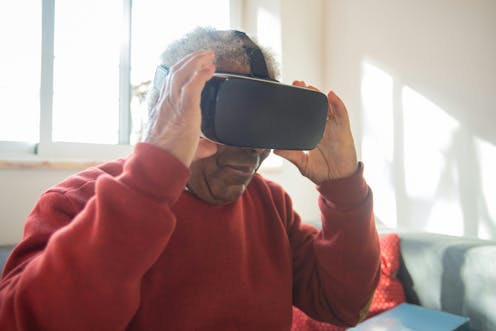
If you or a loved one have noticed changes in your memory or thinking as you’ve grown older, this could reflect typical changes that occur with ageing. In some cases though, it might suggest something more, such as the onset of dementia.
The best thing to do if you have concerns is to make an appointment with your GP, who will probably run some tests. Assessment is important because if there is something more going on, early diagnosis can enable prompt access to the right interventions, supports and care.
But current methods of dementia screening have limitations, and testing can be daunting for patients.
Our research suggests virtual reality (VR) could be a useful cognitive screening tool, and mitigate some of the challenges associated with current testing methods, opening up the possibility it may one day play a role in dementia diagnosis.
Where current testing is falling short
If someone is worried about their memory and thinking, their GP might ask them to complete a series of quick tasks that check things like the ability to follow simple instructions, basic arithmetic, memory and orientation.
These sorts of screening tools are really good at confirming cognitive problems that may already be very apparent. But commonly used screening tests are not always so good at detecting early and more subtle difficulties with memory and thinking, meaning such changes could be missed until they get worse.
Read more: These 12 things can reduce your dementia risk – but many Australians don't know them all
A clinical neuropsychological assessment is better equipped to detect early changes. This involves a comprehensive review of a patient’s personal and medical history, and detailed assessment of cognitive functions, including attention, language, memory, executive functioning, mood factors and more. However, this can be costly and the testing can take several hours.
Testing is also somewhat removed from everyday experience, not directly tapping into activities of daily living.
Enter virtual reality
VR technology uses computer-generated environments to create immersive experiences that feel like real life. While VR is often used for entertainment, it has increasingly found applications in health care, including in rehabilitation and falls prevention.
Using VR for cognitive screening is still a new area. VR-based cognitive tests generally create a scenario such as shopping at a supermarket or driving around a city to ascertain how a person would perform in these situations.
Notably, they engage various senses and cognitive processes such as sight, sound and spatial awareness in immersive ways. All this may reveal subtle impairments which can be missed by standard methods.
VR assessments are also often more engaging and enjoyable, potentially reducing anxiety for those who may feel uneasy in traditional testing environments, and improving compliance compared to standard assessments.
Most studies of VR-based cognitive tests have explored their capacity to pick up impairments in spatial memory (the ability to remember where something is located and how to get there), and the results have been promising.
Given VR’s potential for assisting with diagnosis of cognitive impairment and dementia remains largely untapped, our team developed an online computerised game (referred to as semi-immersive VR) to see how well a person can remember, recall and complete everyday tasks. In our VR game, which lasts about 20 minutes, the user role plays a waiter in a cafe and receives a score on their performance.
To assess its potential, we enlisted more than 140 people to play the game and provide feedback. The results of this research are published across three recent papers.
Testing our VR tool
In our most recently published study, we wanted to verify the accuracy and sensitivity of our VR game to assess cognitive abilities.
We compared our test to an existing screening tool (called the TICS-M) in more than 130 adults. We found our VR task was able to capture meaningful aspects of cognitive function, including recalling food items and spatial memory.
We also found younger adults performed better in the game than older adults, which echoes the pattern commonly seen in regular memory tests.
In a separate study, we followed ten adults aged over 65 while they completed the game, and interviewed them afterwards. We wanted to understand how this group – who the tool would target – perceived the task.
These seniors told us they found the game user-friendly and believed it was a promising tool for screening memory. They described the game as engaging and immersive, expressing enthusiasm to continue playing. They didn’t find the task created anxiety.
For a third study, we spoke to seven health-care professionals about the tool. Overall they gave positive feedback, and noted its dynamic approach to age-old diagnostic challenges.
However, they did flag some concerns and potential barriers to implementing this sort of tool. These included resource constraints in clinical practice (such as time and space to carry out the assessment) and whether it would be accessible for people with limited technological skills. There was also some scepticism about whether the tool would be an accurate method to assist with dementia diagnosis.
While our initial research suggests this tool could be a promising way to assess cognitive performance, this is not the same as diagnosing dementia. To improve the test’s ability to accurately detect those who likely have dementia, we’ll need to make it more specific for that purpose, and carry out further research to validate its effectiveness.
We’ll be conducting more testing of the game soon. Anyone interested in giving it a go to help with our research can register on our team’s website.
Authors: Joyce Siette, Research Theme Fellow in Health and Wellbeing, Western Sydney University


















