

Google AI
Modern Australian

why thousands of Rohingya are desperately trying to escape refugee camps by boats

  • Written by: Ruth Wells, Senior research fellow, Psychiatry and Mental Health, UNSW Sydney
why thousands of Rohingya are desperately trying to escape refugee camps by boats

Late last week, a boat crammed with Rohingya refugees fleeing a squalid camp in Bangladesh capsized off the coast of Indonesia. Around 75 people were rescued, including nine children, but more than 70 are missing and presumed dead.

This tragedy isn’t an isolated incident. The number of Rohingya people trying to escape refugee camps by boat has skyrocketed in recent months.

According to the UN High Commissioner for Refugees, 1,783 Rohingya refugees boarded boats from Bangladesh from January to October 1, 2023. Since then, around 3,100 people have embarked on these treacherous journeys – an increase of nearly 74%.

Since January 2023, around 490 Rohingya have been reported dead or missing, including 280 since October 1.

Their attempts to reach countries like Malaysia and most recently Indonesia are being met with refusals and pushbacks, leaving many Rohingya stranded at sea and vulnerable to exploitation, trafficking and even death.

Why are so many Rohingya trying to flee in recent months? And how should the international community respond to this increasingly desperate humanitarian crisis?

In a new article recently submitted for peer review, we (two Australian academics and six anonymous Rohingya activists) describe the “push factors” that have been identified in community-based research in the camps, which are forcing many people to board boats to try to reach safety.

Rohingya refugees disembark from a boat in Indonesia.
Rohingya refugees disembark from a boat after landing in North Aceh, Indonesia, in November. Rahmat Mirza/AP

Living with constant tension

The nearly 1 million Rohingya refugees now living in Bangladesh are survivors of a massive Myanmar military operation in 2017 aimed at driving them from their homes in western Rakhine state.

Estimates of the number of people killed during the operation range from around 7,800 to 24,000. The United Nations has called it a “textbook example of ethnic cleansing” and genocide.

Even before they were forced across the border, the Rohingya people had been subjected to decades of discrimination, denial of citizenship, exclusion from schools and work, restrictions on freedom of movement and violence from authorities.

Rohingya refugees rescued from sea.
Rohingya women rest in a temporary shelter at the Indonesian Red Cross office after being rescued by sea off the coast of Aceh province last week. Hotli Simanjuntak/EPA

Now, trapped in limbo in the refugee camps in Cox’s Bazaar, Bangladesh, they are experiencing many of the same things.

In 2019, we conducted on-the-ground interviews with 27 Rohingya community experts living in Cox’s Bazaar, including teachers, mothers, religious leaders, spiritual healers, youths and activists. We wanted to know how Rohingya people understand and describe the psychological impacts of genocide and displacement.

This understanding is important because most mental health services are based on Western terminology like “depression”, “anxiety” or “stress”. But these may not properly fit the Rohingya experience. Instead, we found the English word “tension” (in Rohingya, sinta) was used by many refugees, which conveys feelings of worry, concern and anxiety and captures the experience of being stateless.

As two anonymous adolescent Rohingya women described it to us:

There is no opportunity to do anything, all we do is stay inside.

Tension is loss. We’ve lost land, children, husband, that’s why we feel tension.

Tension is neck pain. Tension is throat, shoulders and head pain.

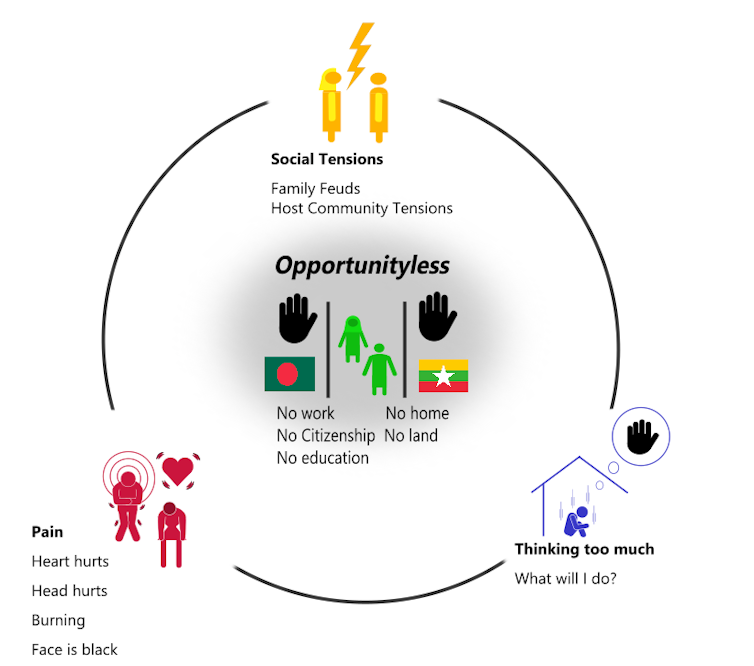
After conducting our interviews, we then developed a pictorial model of “tension”, as Rohingya is an oral language. The model (below) showed how being “opportunity-less” – from lack of work, education or freedom of movement – sits at the centre of tension.

Our interview subjects told us lack of opportunity leads to thinking too much, pain in the body and conflict in the family, between families and with the Bangladeshi community.

Author provided Why the situation has become even more dire The six Rohingya activists who helped us to conduct this research have since described to us how these sources of tension have worsened since 2019. Like so many in their communities, they have personally experienced arbitrary arrest, fabricated legal cases and imprisonment by the Bangladeshi authorities. After dark, the “night government” (armed groups) roam the camps, kidnapping and demanding ransoms from families, threatening people in their homes, trafficking drugs and killing anyone who tries to speak up. Women and girls are targeted for assault and trafficking. The camps are also fenced off, like open-air prisons. This means the refugees are trapped when fires break out, which happens frequently. In January, a huge fire spread quickly in the congested encampments, destroying some 800 shelters and leaving 7,000 people homeless. And with civil war raging inside Myanmar across the border, some Rohingya in Bangladesh have even been killed by stray mortar shells. Bangladesh, one of the most densely populated and poorest countries in the world, cannot address these push factors in the camps without support. International aid for the Rohingya, meanwhile, continues to rapidly decline. A fire-damaged refugee camp in Bangladesh.
A Rohingya refugee camp after a huge fire in Ukhia, Cox’s Bazar, Bangladesh, in early March. Stringer/EPA

What Australia and regional partners should do

What can – and should – the international community do to find a durable solution to this problem?

As a well-resourced regional partner, Australia can play a much bigger humanitarian role not focused solely on punishing people smugglers or the refugees themselves through boat turnbacks.

When people are faced with such dire conditions, they will move, no matter the cost. As recent refugee boat arrivals in Australia and Indonesia demonstrate, boat turnbacks and arrests fail to address the root causes of forced migration. They do not “stop the boats”.

Read more: Amid a worsening refugee crisis, public support is high in both Australia and NZ to accept more Rohingya

Here are our recommendations for what Australia, New Zealand and their regional partners should do instead to help the Rohingya people:

1. Exert diplomatic pressure on the Myanmar junta to recognise Rohingya citizenship and facilitate a peaceful resolution to the ongoing conflict in Rakhine state so the refugees can return home.

2. Address the shortfall in funding to humanitarian organisations working in Bangladesh to address the immediate needs of Rohingya refugees, including food, shelter, health care, proper education and psychosocial support. Invest in the resilience of refugees.

3. Increase pressure on Bangladesh to improve conditions in the refugee camps and provide livelihood opportunities for Rohingya refugees. This includes advocating for policies that allow refugees to work legally and contribute to the local economy.

4. Prioritise resettlement opportunities for Rohingya refugees in third countries, especially those who have been displaced since the 1990s. Resettlement offers a durable solution for those in need of international protection, providing them with the opportunity to rebuild their lives in safety and with dignity.

Authors: Ruth Wells, Senior research fellow, Psychiatry and Mental Health, UNSW Sydney

Read more https://theconversation.com/gangs-kidnappings-murders-why-thousands-of-rohingya-are-desperately-trying-to-escape-refugee-camps-by-boats-224515

What to Do When an Older Car Is No Longer Worth Keeping in Melbourne

Ever looked at another repair quote and wondered whether your old car is still worth the trouble? It is a common turning point for Melbourne motoris...

Your Baby's First Year: A Local Guide to Feeding, Sleep, and When to Get Extra Support

Ask ten parents in a Brisbane mothers' group how their baby is feeding or sleeping, and expect ten different answers.  Someone's baby sleeps throug...

Kitchen and Laundry Makeover Ideas That Don't Require a Full Renovation

Full kitchen renos are expensive — and most people don't actually need one.  They need the kitchen to stop looking like it's stuck in 2009, or they...

How Technology Is Reshaping the Modern Australian Commercial Kitchen

The commercial kitchen has always been shaped by technology. Refrigeration changed how ingredients could be stored, modern ventilation transformed k...

The Number on a Roller Blind Fabric That Nobody Explains

Somewhere in the fabric book, next to the colour name, there is a percentage. Three per cent. Five per cent. Ten per cent. Nobody explains it, most c...

What’s Trending in Men’s Jewellery This Father’s Day!

Finding a Father’s Day gift that feels personal, stylish and genuinely wearable is not always easy. While socks and novelty mugs have traditionally ...

Road Signs: Understanding Their Role in Clear and Effective Signage

Effective signage and display hardware can help businesses communicate information, promote products and organise customer or visitor movement. Road...

Bottle Label Printing: Key Factors to Consider Before Your Next Packaging Run

Effective packaging begins with understanding the product, bottle material, artwork and production requirements when planning bottle label printing. H...

Planning a Long-Distance Move With Interstate Movers Melbourne

Moving between states involves more planning than a typical local relocation. Along with packing and transporting household belongings, you need to...

Understanding the Role of an I/O Controller in Industrial Automation

Modern industrial systems depend on accurate communication between sensors, machines and control systems. An I/O controller can help manage this commu...

How the Right Mining Hose Supports Demanding Operations

Mining environments place considerable demands on equipment used for material transfer, water management and processing. Hoses operating in these co...

Simple Ideas for Making Social Gatherings More Memorable

We have all been to those parties where everyone just stands around the kitchen island, staring at their phones, waiting for someone else to make a mo...

Outdoor Wall Lights: Improving Exterior Lighting Around Your Home

Lighting can influence how a room looks, feels and functions, so the right fitting should be selected according to both appearance and practical req...

Commercial Office Cleaning: Combining Routine Office Cleaning With Melbourne Service

Keeping a workplace clean requires a service that can accommodate everyday tasks as well as the particular needs of the business. Professional comme...

Caravan Sales in Queensland: How to Find the Right Caravan for Sale QLD

Caravan ownership is about more than having somewhere to sleep while travelling. For many Queenslanders, it is one of the best ways to explore regio...

What Sir Walter Buffalo Turf Actually Costs in 2026 (And Why Quotes Vary So Much)

Two quotes landed on a Hills District homeowner's kitchen table last spring for the exact same 80-square-metre backyard. One said $12 a metre. The o...

Nearly 1,300 NSW Hospital Beds Are Occupied By People Who Are Ready To Go Home

1,276 people in NSW hospitals have been medically cleared for discharge but remain in hospital because they're still waiting for NDIS or aged care sup...

National Survey Launched to Measure Operational Impacts of Federal NDIS Policy Reforms

The effects of recent NDIS reforms are beginning to move beyond policy papers and into day to day service delivery. A new national survey is asking ...
















