

These extraordinary Australian islands are teeming with life – and we must protect them before it’s too late
- Written by: Ian Cresswell, Adjunct professor, The University of Western Australia
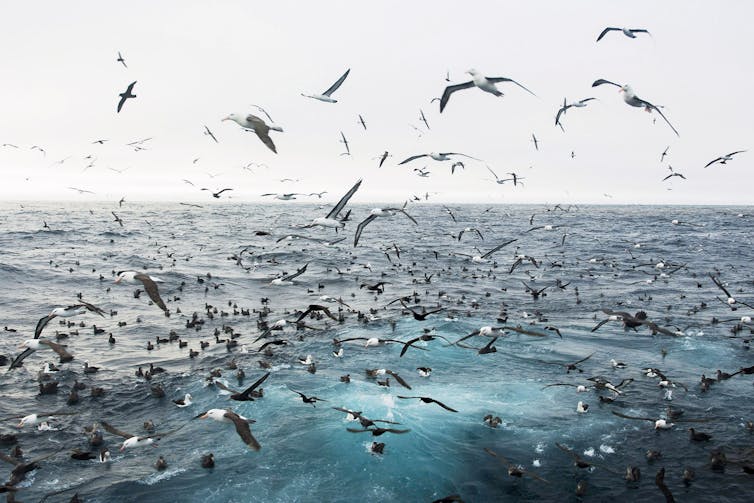
In the Southern Ocean about 4,000 kilometres from Perth lies a truly extraordinary place. Known as the Heard Island and McDonald islands, they are among the most remote places on Earth: a haven for marine life amid the vast ocean, virtually undisturbed by human pressures.
But as our report released today reveals, this special place in Australia’s territory is at risk. In particular, climate change is warming the waters around the islands, threatening a host of marine life.
More than 20 years ago, a marine reserve was declared over the islands and parts of the surrounding waters. At the time, it was a significant step forward in environmental protection. But since then, science has progressed and the threats have worsened.
Our report reviewed these protections and found they are no longer adequate. The marine reserve surrounding the Heard and McDonald islands must urgently be expanded.
Spotlight on the reserve system
The Heard and McDonald islands are just a tiny tip of the Kerguelen Plateau – a huge underwater mass rising high above the surrounding ocean basins.
The plateau intercepts the Antarctic Circumpolar Current, the strongest current system in the world. When the current hits the plateau, deep, nutrient-rich waters are pushed to the surface. This supports a food chain ranging from tiny plankton to fish, invertebrates, seabirds and marine mammals such as elephant seals and sperm whales.
On Heard Island, Mawson’s Peak is officially Australia’s highest mountain. It is 2,745 metres high and forms the summit of an active volcano known as Big Ben. Heard Island and McDonald Islands also host valuable fisheries for Patagonian toothfish and mackerel icefish.
The marine reserve around the islands was declared in 2002 and extended in 2014. It now covers 17% of what is known as the “exclusive economic zone” – the area of the sea in which a nation (in this case, Australia) has exclusive rights to resources such as fish and minerals.
The original reserve was primarily designed for waters shallower than 1,000m, because in 2002 little was known about the area’s deeper waters. A review of the reserve system is due this year.
Our report draws on more than 20 years’ of research conducted since the reserve was first declared. It highlights new scientific understanding of the region and the need to expand its protection.
Climate pressures on the plateau
Climate change poses wicked threats for the Heard and McDonald islands and surrounding marine environment.
We found the shelf area is becoming warmer. This potentially threatens species adapted to cold polar waters, such as the mackerel icefish. This species lives in shallow water and is an important food source for fur seals and other predators.
No other sub-antarctic shelf exists to the south of Heard Island, which means the region is a vital animal habitat. Maintaining the islands’ biodiversity in the face of climate change is best achieved by extending the existing marine reserve to cover more shallow waters, as well as protecting currently unprotected deeper waters.
Read more: Australia's only active volcanoes and a very expensive fish: the secrets of the Kerguelen Plateau
Protecting deep-water species
The Patagonian toothfish is a top predator species that connects different parts of the food web. Commercial fishing in the islands’ economic zone targets toothfish using “bottom longlines” which are weighted to the seafloor at depths down to 2,000m. The footprint of fishing operations has expanded over the past 30 years.
Our report suggests protecting spawning grounds of toothfish will reduce risks to this species and help ensure the fishery does not deplete fish stock.
Fishing is managed in such a way to eliminate the accidental catching (or by-catch) of seabirds. But there is still significant by-catch of a number of non-target fish species, especially skates.
Keeping fishing out of some areas can reduce pressure on vulnerable species. Important areas for achieving this are in the deeper waters to the southeast of Heard Island.
Read more: Climate risk index shows threats to 90 per cent of the world's marine species
Sustaining biodiversity into the future
Our analysis reveals an updated understanding of the marine ecosystems surrounding Heard and McDonald islands.
Scientists now know more about where marine mammals and birds forage – particularly in the important period when parents are feeding their young. We found some species that breed on Heard Island, including king penguins and fur seals, rely on areas not protected by the marine reserve during these times.
Our analysis also reveals a complex mosaic of productive habitats in shallow water, and less productive habitats in deeper water. This in turn affects the distribution of animal species.
Increased protection for the areas in the west, south, and southeast of the economic zone will be needed to protect animals in these habitats.
Looking ahead
The current marine reserve covering Heard and McDonald islands is not sufficient. It should cover deeper water ecosystems and provide protection for foraging areas of resident seals, penguins and albatross.
Protecting spawning grounds of toothfish and areas important to cold-adapted species, such as mackerel icefish, will help ensure these species have the best chance against continuing warming of the ocean.
Extending the protections would help Australia meet its domestic policy and international agreements. For example, the federal government has committed to protecting at least 30% of ocean ecosystems by 2030.
It would also ensure our marine protected areas are nationally representative – a key national objective Australia has committed to.
By extending adequate protection of Heard and McDonald islands, Australia has the chance to show global leadership in conserving this precious natural asset in the Southern Ocean.
Authors: Ian Cresswell, Adjunct professor, The University of Western Australia


















