

What is the Stations of the Cross ritual, and why do Christians still perform it at Easter?
- Written by Robyn J. Whitaker, Director of the Wesley Centre for Theology, Ethics, and Public Policy & Associate Professor, New Testament, Pilgrim Theological College, University of Divinity
A strange and eclectic range of activities takes place across these few weeks of the year. Some enjoy the season of hot cross buns and egg-shaped chocolates; others forgo such luxuries during daylight hours due to their Ramadan fast. Jews have recently celebrated Purim and remembered the bravery of Esther; meanwhile, the Hindu festival of Holi begins.
Elsewhere, hordes in their colours flock to the footy; others get involved in the Good Friday Appeal; and certain Christians enact a medieval tradition of walking the way of the cross around the streets of Melbourne.
So what is it, and why is it still performed?
Read more: Jesus wasn't white: he was a brown-skinned, Middle Eastern Jew. Here's why that matters
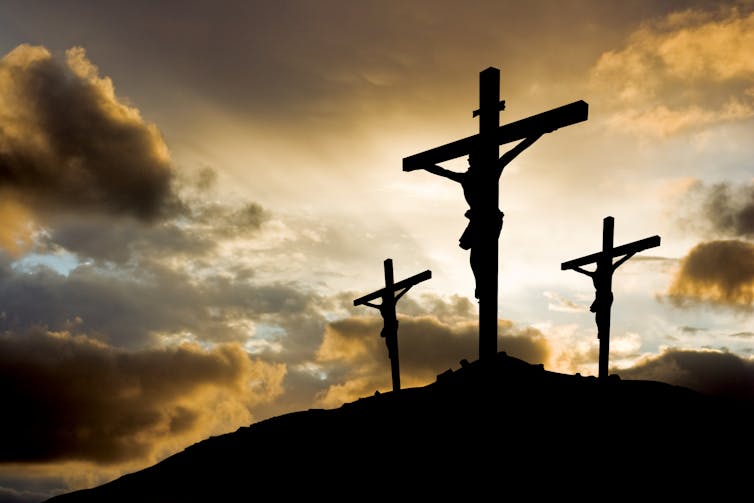
To enter into the Stations or Way of the Cross ritual is to enter into the last hours of Jesus before he was crucified, just outside Jerusalem around the year 33 CE.
Those last hours included a meal with his friends, prayer in a garden, his arrest and a trial that ends in the sentence of death by crucifixion. His body was then stripped and flogged, the cross placed on his shoulders to carry to the execution place. He stumbled under the weight of the cross, then was put on the cross to which he was nailed through his hands and feet before speaking his last words, and then dying. The last two stations, usually only visited on Easter morning, celebrate his resurrection from death.
The Stations of the Cross is a devotional and contemplative exercise, as pilgrims stop and pray, hear scripture, and ponder in silence the significance of each station, getting closer to the moment of Jesus’ death each time.
The practice of memento mori (remembering death) is found in a wide variety of religious and philosophical traditions. But Jesus’ death is a bit different – at least for Christians. At one level, Jesus died in a typical manner of execution for lower class people in the Roman Empire. As gruesome as it was, it was not unique or special.
But Christians quickly imbued this particular death with much more meaning. Jesus was believed to be the incarnation of God (that is, God in human form) and to have been raised from the dead three days later. And so his death and resurrection was interpreted as an event that brought salvation, forgiveness, and a new way of life into the world. It is this mystery Christians continue to celebrate all these years later.
The Stations of the Cross has its roots in early Christian pilgrims visiting Jerusalem to walk in the final footsteps of Jesus. While the origins are unclear, it became popular in the late medieval period and was common across Europe by the 16th century.
The Melbourne city version of these stations include 14 bronze reliefs located at a wide variety of churches in and around the CBD. Individuals can walk these themselves or join the city churches at 10am on Good Friday, starting at St Francis’ Church. Pre-COVID, this walking in the way of Jesus attracted up to 3,000 people each Good Friday.
This public expression of faith can seem unusual in a contemporary Australian city like Melbourne. Australian culture sometimes encourages people to keep their faith private. Our religious tolerance strains at its limits when religion spills out of homes, synagogues, temples, churches, or mosques and into the public sphere. People walking around the city stopping to reflect on a violent death that took place more than 2,000 years ago can seem awkward, even embarrassing to those looking on. Others watch with interest.
This raises the question of the kind of secular society we want to live in. One version of secularism says that religion should be kept well out of the public sphere, practised in private, and should not inform a person’s participation in public life. France often tends in this direction (see, for example, repeated attempts to ban the hijab in public).
Read more: Victim or victor? How the Easter story still resonates today
But another version of secularism says that while the state should not favour any particular religious or non-religious tradition, we are a stronger and richer society if we encourage all faiths and cultures to express themselves in public. Rather than hiding our deepest beliefs away, we should share them with each other.
On Good Friday afternoon, another tradition comes to life, as thousands gather to scream, yell and sing tribal songs as their teams fight it out on a football oval. To a non-AFL fan like myself, that gathering is equally strange. Yet, I can recognise the emotion and fervour as something familiar, something joyful, something that taps into our deepest desires and brings us together across cultural and social divides.
When footy games were first scheduled on this holy day for Christians, it was not without controversy. Headlines cried “religion versus sport” and genuine questions about consumerism and work were raised.
For me, there is a certain delight in living in a society where not everyone is religious and even if they are, they are not religious in the same way. I’m glad to live in a society where such activities occur side by side, be they footy, Purim, Ramadan, Holi, or Easter. I am glad to live in a society where some yell at the footy and some pray in a city street – and some do both.
The Stations of the Cross is one more visible sign of our multicultural, multifaith society at work. We can be proud to live in a society where rituals that seem strange to some are nonetheless tolerated and even welcomed. This is something everyone can celebrate, whether religious or not.
Authors: Robyn J. Whitaker, Director of the Wesley Centre for Theology, Ethics, and Public Policy & Associate Professor, New Testament, Pilgrim Theological College, University of Divinity

















