

Think $5.50 is too much for a flat white? Actually it’s too cheap, and our world-famous cafes are paying the price
- Written by Emma Felton, Adjunct Senior Researcher, University of South Australia
Even in a stubborn cost-of-living crisis, it seems there’s one luxury most Australians won’t sacrifice – their daily cup of coffee.
Coffee sales have largely remained stable, even as financial pressures have bitten over the past few years.
So too have prices. Though many of us became upset when prices began to creep up last year, they’ve since largely settled in the range between $4.00 and $5.50 for a basic drink.
But this could soon have to change. By international standards, Australian coffee prices are low.
No one wants to pay more for essentials, least of all right now. But our independent cafes are struggling.
By not valuing coffee properly, we risk losing the internationally renowned coffee culture we’ve worked so hard to create, and the phenomenal quality of cup we enjoy.
Coffee is relatively cheap in Australia
Our recent survey of Australian capital cities found the average price of a small takeaway flat white at speciality venues is A$4.78.
But in some international capitals, it’s almost double this, even after adjusting for local purchasing power parity.
In London, a small flat white costs about A$6.96. Singapore, A$8.42. In Athens, as much as A$9.95.
The cafe business is getting harder
Over the past few decades, coffee prices haven’t kept pace with input costs. In the early 2000s, after wages, food costs, utilities and rent, many cafes earned healthy profit margins as high as 20%.
The most recent data from IBISWorld show that while Australian cafe net profits have recovered from a drop in 2020, at 7.6%, they remain much lower than the Australian average business profit margin of 13.3%.
For an independent owner operating a cafe with the average turnover of A$300,000, this would amount to a meagre A$22,800 annual net profit after all the bills are paid.
What goes into a cup?
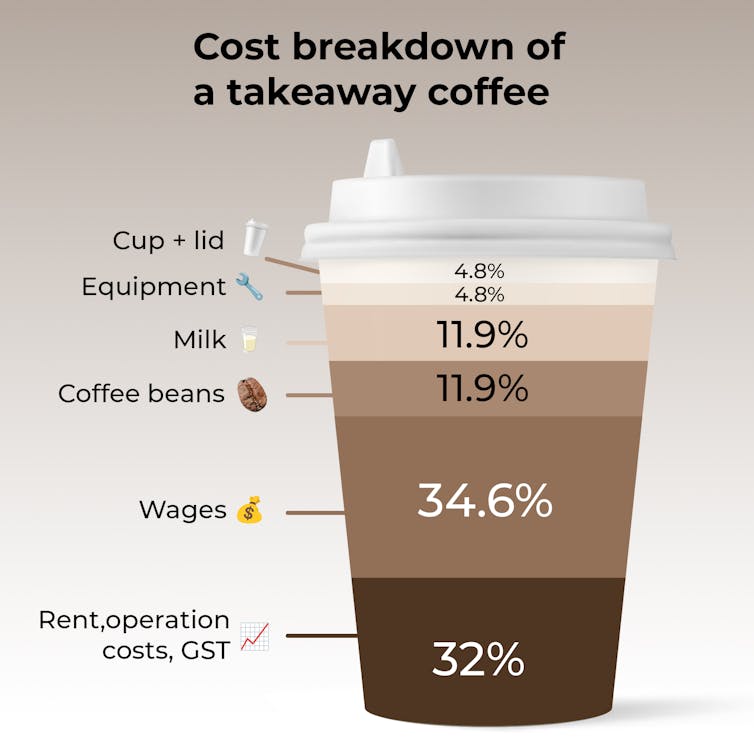
Just looking at the cost of raw inputs – milk, beans, a cup and a lid – might make the margin seem lucrative. But they don’t paint the whole picture.
Over the past few years, renting the building, keeping the lights on and paying staff have all become much bigger factors in the equation for coffee shop owners, and many of these pressures aren’t easing.
1. Green coffee price
Increasingly subject to the effects of climate change, the baseline commodity price of green (unroasted) coffee is going up.
Read more: From crop to cup – a new genetic map could make your morning coffee more climate resilient
Arabica – the higher quality bean you’re most likely drinking at specialty cafes – is a more expensive raw product. Despite levelling off from post-pandemic highs, its price is still trending up. In 2018, it sold for US$2.93 per kilogram, which is projected to increase to US$4.38 dollars in 2025.
Robusta coffee is cheaper, and is the type typically used to make instant coffee. But serious drought in Vietnam has just pushed the price of robusta to an all-time high, putting pressure on the cost of coffee more broadly.
2. Milk prices
The price of fresh milk has risen by more than 20% over the past two years, and remains at a peak. This has put sustained cost pressure on the production of our most popular drink orders: cappuccinos and flat whites.
3. Wages and utilities
Over the past year, Australian wages have grown at their fastest rate since 2009, which is welcome news for cafe staff, but tough on operators in a sector with low margins.
Electricity prices remain elevated after significant inflation, but could begin to fall mid-year.
Specialty vs. commodity coffee: why price expectations create an industry divide
One of the key factors keeping prices low in Australia is consumer expectation.
For many people coffee is a fundamental part of everyday life, a marker of livability. Unlike wine or other alcohol, coffee is not considered a luxury or even a treat, where one might expect to pay a little more, or reduce consumption when times are economically tough. We anchor on familiar prices.
Because of this, it really hurts cafe owners to put their prices up. In touch with their customer base almost every day, they’re acutely aware of how much inflation can hurt.
But in Australia, a huge proportion of coffee companies are also passionate about creating a world-class product by only using “specialty coffee”. Ranked at least 80 on a quality scale, specialty beans cost significant more than commodity grade, but their production offers better working conditions for farmers and encourages more sustainable growing practices.
Although not commensurate with the wine industry, there are similarities. Single origin, high quality beans are often sourced from one farm and demand higher prices than commodity grade coffee, where cheaper sourced beans are often combined in a blend.
Running a specialty cafe can also mean roasting your own beans, which requires a big investment in expertise and equipment.
It’s an obvious example of doing the right thing by your suppliers and customers. But specialty cafes face much higher operating costs, and when they’re next to a commodity-grade competitor, customers are typically unwillingly to pay the difference.
Approach price rises with curiosity, not defensiveness
When cafe owners put up their prices, we often rush to accuse them of selfishness or profiteering. But they’re often just trying to survive.
Given the quality of our coffee and its global reputation, it shouldn’t surprise us if we’re soon asked to pay a little bit more for our daily brew.
If we are, we should afford the people who create one of our most important “third spaces” kindness and curiosity as to why.
Read more: How cafes, bars, gyms, barbershops and other 'third places' create our social fabric
Authors: Emma Felton, Adjunct Senior Researcher, University of South Australia

















