

how to spot 2018's interplanetary bauble
- Written by: Jake Clark, PhD Candidate, University of Southern Queensland
We’re in for a pre-Christmas treat this weekend, as the cosmos entertains us with two equally exciting gifts: the Geminid meteor shower and the interplanetary comet 46P/Wirtanen.
The Geminids are actually an annual event. But the comet is a less frequent visitor, making a very close approach to Earth this year.
So what makes 46P/Wirtanen so special, and when can we see this comet hurtling across our skies?
Comets in orbits
Comets come in a variety of shapes and sizes, with the infamous Hale-Bopp comet roughly 120 kilometres across. Comet 46P/Wirtanen is much smaller: just 1.2km across.
Most comets, predominately made from dust and ices, spend the majority of their life within the Oort cloud. The Oort cloud is a spherical shell of icy objects that surrounds our Solar system, far beyond the orbits of the main planets.
Some comets are in elliptical orbits that periodically bring them closer to the Sun.
But 46P/Wirtanen’s orbit doesn’t extend out to the Oort cloud. It’s known as a Jupiter-orbiting comet, one whose orbit only extends as far as Jupiter’s.
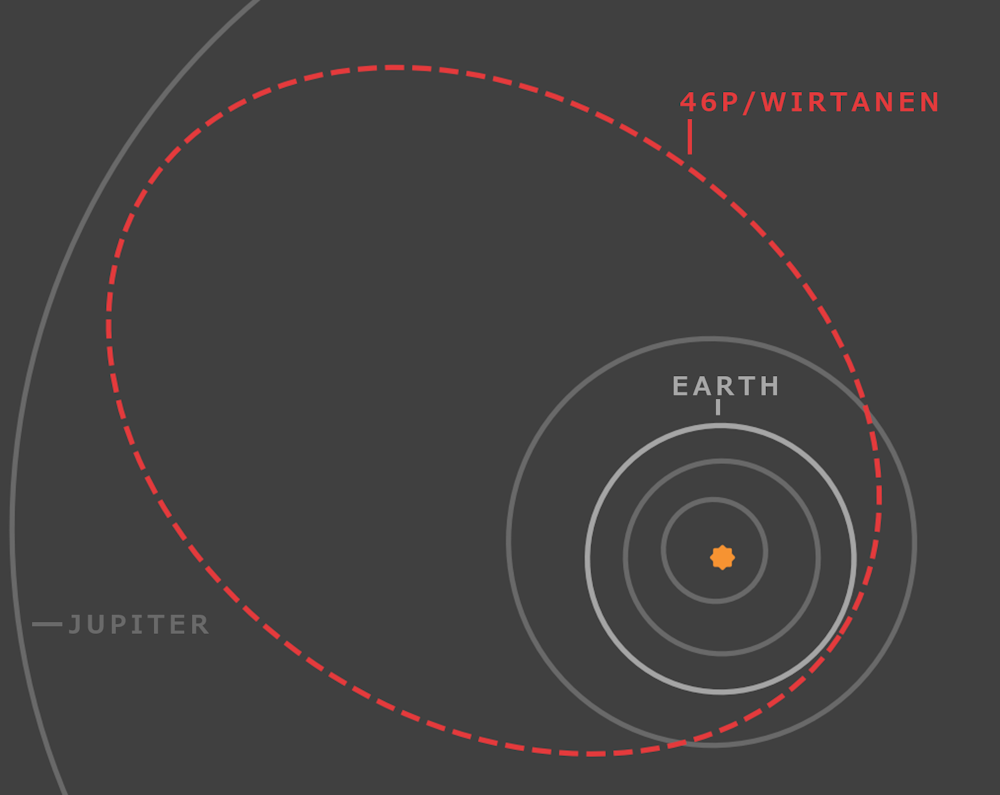 46P/Wirtanen’s home is very different to other comets, residing within the inner-regions of our Solar system.
Jake Clark
46P/Wirtanen’s home is very different to other comets, residing within the inner-regions of our Solar system.
Jake Clark
Having a close-in orbit has its benefits, including a shorter orbit – so 46P/Wirtanen whizzes past Earth every five and a half years. Compare that with Halley’s comet, last seen at close quarters in 1986, and whose next encounter with Earth is scheduled for 2061.
A tale of two tails
Our festive 46P/Wirtanen’s anatomy is no different to any other comet, having a nucleus (the ball of dust and ices), a coma (the fuzzy atmosphere surrounding the nucleus), and the iconic tails residing behind it.
Comets have two distinctively different tails. As comets travel closer towards the Sun, the volatiles (gas, ice with low boiling points) within the comet start to heat up and evaporate, causing these iconic streaming tails to follow behind the comet.
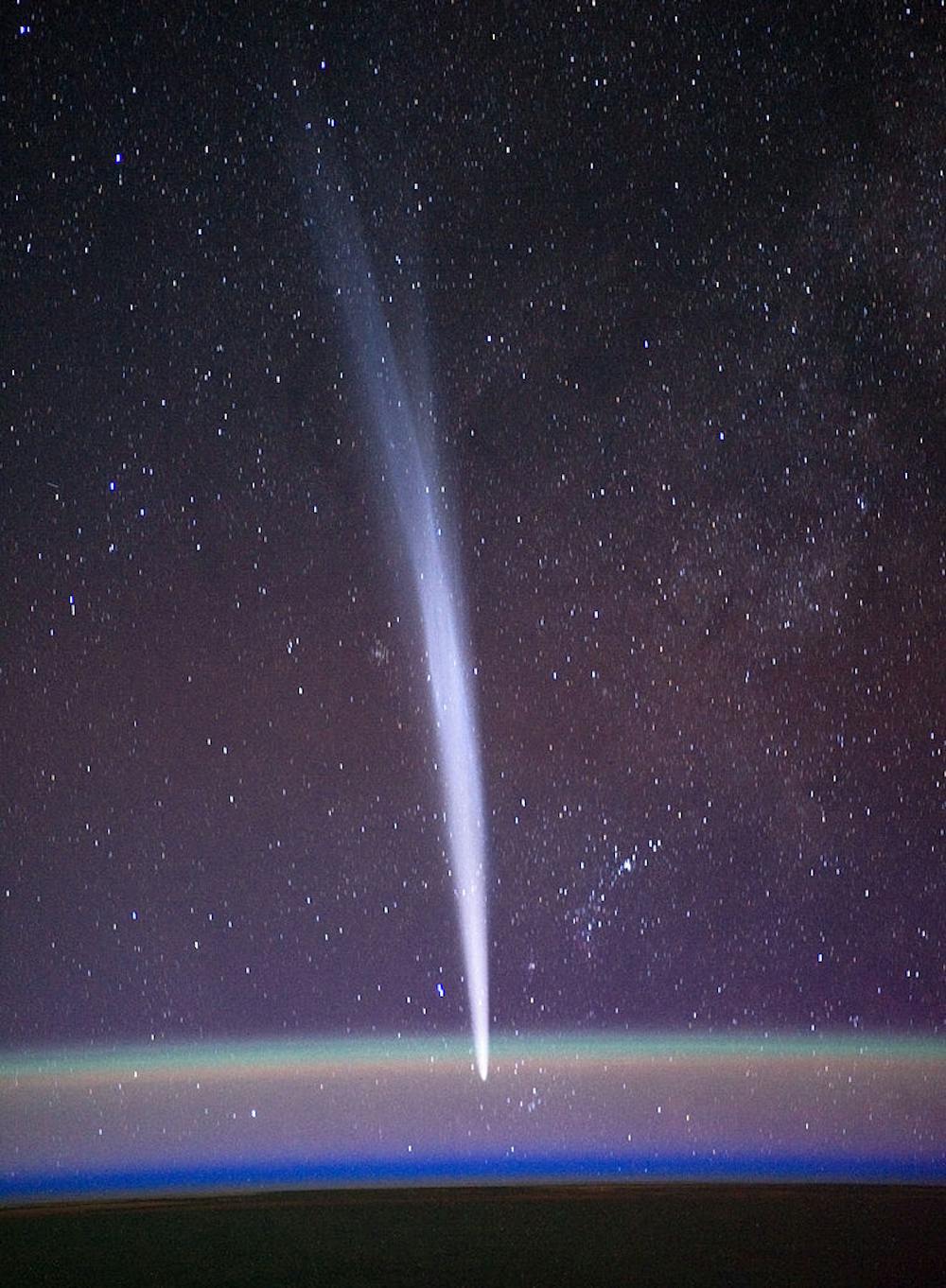 Comet Lovejoy as seen on the International Space Station. The Ion tail is the straighter of the two tails, with the dust tail leaning towards the left in this image.
NASA/Dan Burbank
Comet Lovejoy as seen on the International Space Station. The Ion tail is the straighter of the two tails, with the dust tail leaning towards the left in this image.
NASA/Dan Burbank
The straighter and bluer tail is caused by energised charged particles from the Sun, known as the solar wind, interacting with gas within the comet’s coma. This interaction causes gas to ionise and be swept away from the sheer force of our Sun’s immense magnetic field.
Because these particles are following the Sun’s magnetic field lines, this tail will always point directly away from the Sun.
Dust from the coma and nucleus can be carried away just by the pressure from the Sun’s radiation, causing the fuzzier and more iconic dust tail streaming behind a glowing comet.
Comet 46P/Wirtanen will be no different this weekend as it streams across our night sky.
A close encounter
Comet 46P/Wirtanen is a periodical comet (that’s where the P in its name comes from) that took almost 12 months to confirm its existence after its discovery on January 17, 1948, by American astronomer Carl Wirtanen.
Even though the comet whizzes pass Earth’s orbit every five and a half years, due to the nature of celestial orbits and geometry, its brightness in the night sky during its closest approach will vary from visit to visit.
This weekend is a real treat, with 46P/Wirtanen making its closest and brightest approach to Earth for years, a mere 11 million kilometres away. It won’t come this close again until 2038.
Where and when to look
Even with its small stature, 46P/Wirtanen’s visible coma will extend near to a million kilometres and can be seen from Earth.
Astronomers have optimistically predicted that the comet might even be bright enough to see in an urban backyard, with an expected magnitude between 4 to 3. For reference, Ginan, the fifth-brightest star in the southern cross (the star just off centre) has a magnitude of 4.
This brightness, however, will be dispersed over an expected area three times the size of the full Moon at its closest point to Earth. Time to dust off your binoculars prior to Saturday’s flyby – these will be the perfect tool to observe 46P/Wirtanen.
Rural and regional Australians are in prime position to witness 46P/Wirtanen, having darker, cleaner skies than those living in cities and suburban hubs. If you can, head out to a dark sky, grab your deckchair and enjoy the celestial displays of our cosmic backyard.
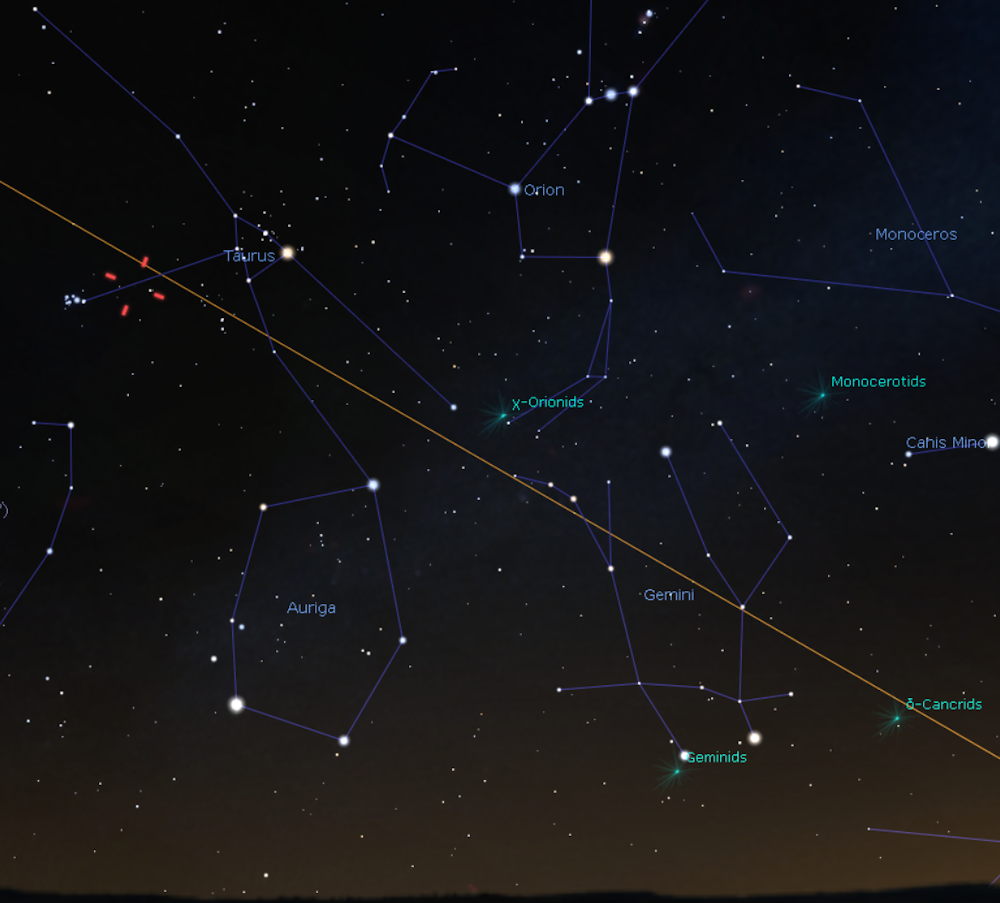 The night sky in regional Queensland at 10pm on December 15. 46P/Wirtanen’s position is shown as the red cross-hairs (above, right) and will be nearing the ecliptic plane between the Plediades star cluster and Aldebaran.
Stellarium Team
The night sky in regional Queensland at 10pm on December 15. 46P/Wirtanen’s position is shown as the red cross-hairs (above, right) and will be nearing the ecliptic plane between the Plediades star cluster and Aldebaran.
Stellarium Team
But, where to look?
Currently 46P/Wirtanen is between the warm giant stars Menkar and the eye of Turaus, Aldebaran – a red giant left of Betelguese. It’ll slowly make its way towards the Pleiades cluster and at its closest approach will be roughly between Pleiades and Aldebaran, nearing the ecliptic.
As a rough guide around Australia, in the late evening (10-11pm) look just east of true north, about 20-35 degrees above the horizon and you’ll find Pleiades (the Seven Sisters) and Aldebaran.
Weekend of cosmic treats
So what of the other celestial event happening in our backyards this weekend? The frail debris from asteroid 3200 Phaethon creates the Geminids meteor shower that can be seen in both the northern and southern hemispheres in early to mid-December each year.
More than 100 meteors an hour can potentially be seen at the showers peak this Friday night and Saturday morning.
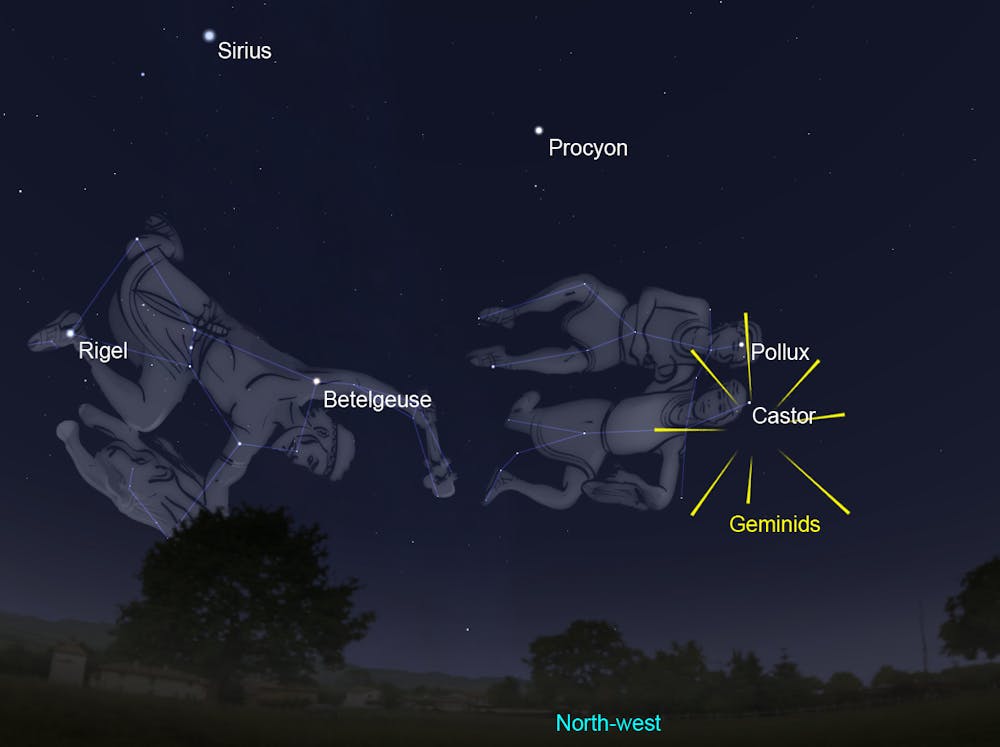 The consistent and spectacular Geminids in the early morning sky (Brisbane 4am).
Museums Victoria/stellarium
The consistent and spectacular Geminids in the early morning sky (Brisbane 4am).
Museums Victoria/stellarium
Coincidentally, you won’t need to stray too far from 46P/Wirtanen’s sky location, with, the Geminids radiant being only 30 degrees away from the Orion constellation.
What a truly spectacular way to finish off 2018.
Authors: Jake Clark, PhD Candidate, University of Southern Queensland
Read more http://theconversation.com/we-have-a-christmas-comet-how-to-spot-2018s-interplanetary-bauble-108597


















