Why artificial submarine curtains won’t save West Antarctica’s retreating glaciers
- Written by Alanna Alevropoulos-Borrill, Postdoctoral Research Fellow, Te Herenga Waka — Victoria University of Wellington
Some researchers have recently proposed the construction of artificial structures – submarine curtains or walls – to stop the warming ocean from getting to the most rapidly melting glaciers in West Antarctica.
If effective, these interventions could save trillions of dollars in avoided coastal impacts.
But such a large-scale operation in one of the most inaccessible places on Earth is estimated to cost US$50 billion–100 billion to build and another US$1 billion a year to maintain. It could also have negative impacts on the rest of the ice sheet and marine life in the Southern Ocean.
Our new study weighs up whether these kinds of experiments are worthwhile.
We explore the conditions required to stop runaway glacial retreat in the Amundsen Sea Embayment, the sector of West Antarctica currently losing most ice. We find that blocking warm water from the embayment may not be enough to prevent ongoing sea-level rise from the region.
Read more: Antarctic tipping points: the irreversible changes to come if we fail to keep warming below 2℃
Investigating the fate of West Antarctica
The future of the Antarctic ice sheet is the greatest uncertainty in projections of global sea-level rise over the coming century. During the past 25 years, the ice sheet has already contributed 7.6mm to global sea-level rise and the rate of mass loss is accelerating.
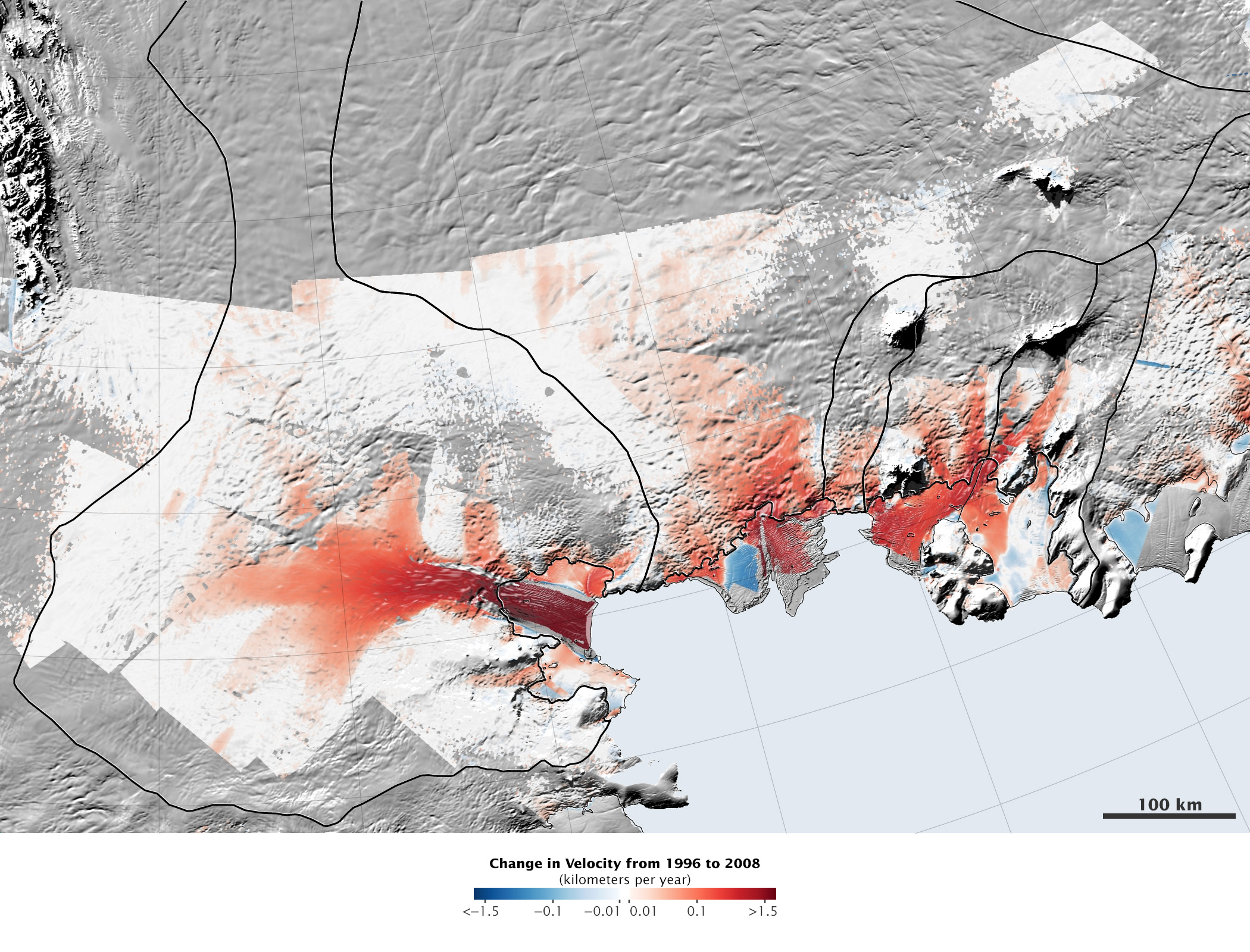
Much of this increase is due to a warm ocean current that floods into deep basins close to parts of West Antarctica. It melts the parts of the ice sheet that flow into the ocean.
This warm water drives some of the highest rates of ice-shelf melting seen on the continent and is causing the ice to thin and retreat rapidly. Recent research suggests this retreat is now unavoidable.
Satellite observations have shown extensive thinning and retreat of glaciers in this region. Some scientists are concerned that this sector has already passed a threshold for irreversible retreat.
Read more: Increasing melting of West Antarctic ice shelves may be unavoidable – new research
The Amundsen Sea Embayment has been identified as the most vulnerable sector of the ice sheet because the glaciers there are resting on bedrock that lies up to two kilometres below sea level. Worse still, that bedrock slopes inland, toward the middle of the continent. This means that as the ice in this region retreats, it exposes increasingly thicker ice to the ocean, causing further melting, thinning and retreat.
We have known for a long time that glaciers resting on bedrock that deepens inland could undergo runaway retreat, ultimately leading to a near total collapse of the entire West Antarctic ice sheet. Collapse of the main outlet glaciers in this area would lead to more than a metre of sea-level rise. The loss of the West Antarctic ice sheet as a whole would raise global sea level by more than three metres – enough to affect major cities around the world catastrophically and displace hundreds of millions of people.
Lowering future sea-level rise
Using a state-of-the-art computer model to simulate the behaviour of the ice, we investigated how the glaciers of the Amundsen Sea Embayment would respond to future scenarios in which we were able to block warm water from reaching the ice sheet, stabilising or even reducing current rates of ice loss.
We explored nearly 200 different future scenarios of melting. In these experiments, we first allowed the floating ice shelves in the region to thin and retreat as they are doing now. Then, we abruptly reduced the amount of melting to see whether or not the ice could recover.
In this ensemble of experiments we explored not just different levels of cooling, but also different initial periods of melting. Together, these simulations tell us whether regrowth of the region would be possible and, if so, how quickly we would need to start reducing melt rates to allow that regrowth to happen.
Our experiments show that lowering the temperature of the ocean by blocking warm water from the embayment would, as expected, reduce the maximum amount of ice lost from the region. This in turn would reduce the contribution to sea-level rise.
However, reducing glacier melt rates only slows down the process. It doesn’t stop the sea level from rising or allow the ice sheet to regrow in a way that replaces what has already been lost.
What we found was that entirely offsetting or reversing the sea-level contribution would need much more than ocean cooling. It would also require nearly two centuries of increased snowfall to build up the mass of ice that has been lost.
These findings present a gloomy image for the future of West Antarctica.
Our results suggest that even if these bold geoengineering proposals work, there will still be ongoing ice loss and global sea-level rise for decades, even centuries, to come. The rate at which this proceeds, however, will most likely depend on the emissions reductions we put in place right now.
Authors: Alanna Alevropoulos-Borrill, Postdoctoral Research Fellow, Te Herenga Waka — Victoria University of Wellington