

Without community support, the green energy transition will fail. Here’s how to get communities on board
- Written by Simon Wright, Senior Research Fellow, Energy & Circularity, Gulbali Institute, Charles Sturt University
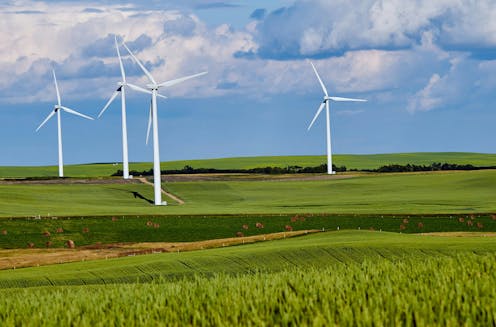
Connecting cheap, clean energy from renewables comes with a hidden cost and challenge: building 5,000 kilometres of new transmission lines this decade, and another 5,000km after that. This sounds like a lot, but 5,000km is only around 10% of the existing grid network, and unlocks more than 32 gigawatts of new clean energy capacity by 2030.
The problem is, communities are often not sold on having to host new transmission lines. As the recent review of community engagement by renewable and transmission companies demonstrates, this is because it wasn’t explained well to these communities as to why it’s needed and how they can benefit.
We already know uncertainty undermines the social license for big projects. And we know public engagement is vital in translating national policies into local impacts.
In my research, I work with RE-Alliance, a community organisation working to help local communities actually benefit from the energy transition. In the course of this research, rural residents often say they would like to host wind turbines on their property. But we have seen those same residents oppose new transmission line projects – without realising the wind farm will not be viable without this infrastructure.
When these projects succeed, it’s because developers engage early and often with communities, showing them why the project matters to society – and to them.
Projects are much more likely to succeed when communities feel the project is theirs or includes them.
Community pushback could scupper the green transition
Community scepticism is not unique to Australia.
More than two-thirds of Americans favour renewables over fossil fuels. But when it comes to actually building them, opposition is common. Around 300 wind, solar and transmission projects are being delayed by local opposition, stalling A$132 billion of investments and 74,000 jobs.
In some respects this is understandable. Communities can bristle if they feel a project is imposed on them – especially if it feels like a cost without benefits.
Developers who engage with communities from the beginning and work to tackle concerns and issues collectively have a better chance of success. Equitable sharing of benefits can help.

Focus on local benefits
Almost 20 new renewable projects are planned in Victoria’s Wimmera Southern Mallee region near the Grampians. Until now, solar farms in this flat, sunny region have been hamstrung by a lack of transmission lines. But some local residents are strongly sceptical of transmission projects, which means some renewable projects can’t proceed.
Even so, progress is being made, due in part to the efforts of regional development organisation, Wimmera Southern Mallee Development, to broker between community and developers. As the organisation’s CEO Chris Souness told me:
Renewable energy will thrive [in this region] if developers and communities collaborate, the interests of the farming communities and rural towns are supported, and the benefits flow to communities.
The region is in need of jobs, more diverse industries, workforce reskilling, and better housing stock. These are all things renewable and transmission projects can help provide.
It’s a similar story in the South West Renewable Energy Zone in New South Wales, one of several laid out by the state government to boost efficiency by grouping big solar and wind projects with existing or new transmission lines.
The zone has led to a renewable gold rush, as developers scout for good locations. But what does it mean for people? The Hay Shire Council last year asked its 3,000 residents what they thought.
The council took the lead on consultation to increase community influence and make clear to renewable developers what the community does and does not want. The alternative was to have many developers running their own consultation efforts.
The consultation revealed some residents felt overwhelmed by the interest from developers. Others worried wind and solar farms could damage the local environment. Would there be enough housing for workers, given the existing housing crisis? And what about the visual impact of large transmission lines? In the consultation document, council staff note:
It is very important that the development of renewable energy projects in Hay Shire happens “with” our community, not “to” our community.
How do we do better when time is so short?
The conundrum we face is we know we need to do better, but we have only a narrow window of time to green the grid.
One avenue is to focus on the long-term prosperity of these projects, both for landowners hosting them and for the broader community. Local leadership here is essential, as are First Nations voices and leadership in clean energy.
For farmers battling increasingly volatile growing and grazing conditions due to climate change, renewables offer new income streams. Typical payments by wind companies are now more than A$40,000 per turbine per year.
Many farmers host dozens of turbines while still farming sheep or cattle. For solar projects, farmers can earn around $1,500 per hectare per year in rent and can keep running sheep under the panels. Landowners willing to host new high voltage transmission lines can get payments from $200,000 to $300,000 a kilometre depending on the state.
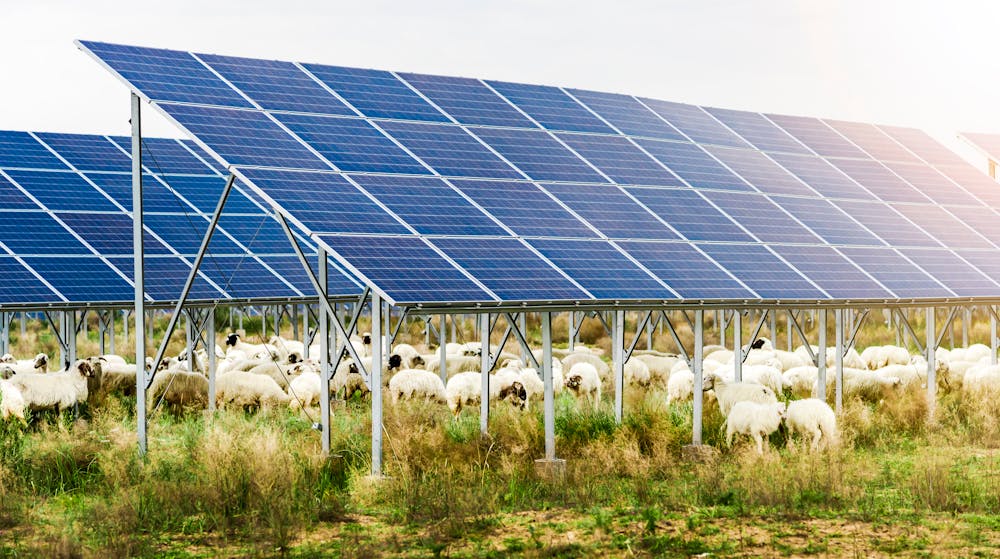 Farmers can often still run sheep on solar farms.
Jenson/Shutterstock
Farmers can often still run sheep on solar farms.
Jenson/Shutterstock
But we will also need national action.
The federal government must find ways of better communicating their plans at local level. Explain why we need to do this, what the benefits are to communities, and why transmission is key.
The government could consider a CSIRO-based research centre focused on environment, technology and social outcomes in the energy transition.
And the government could invest in local energy hubs where people can ask questions, get information, and find out ways of sharing benefits. These hubs could work alongside existing project shopfronts, such as the ENGIE hub in Hay.
As James Joyce wrote, mistakes are the portals of discovery. We need to learn quickly from the early opposition so we can avoid repeating our mistakes.
Authors: Simon Wright, Senior Research Fellow, Energy & Circularity, Gulbali Institute, Charles Sturt University


















