

Beethoven was close to deaf when he wrote his self-proclaimed best work
- Written by Peter Tregear, Principal Fellow and Professor of Music, The University of Melbourne
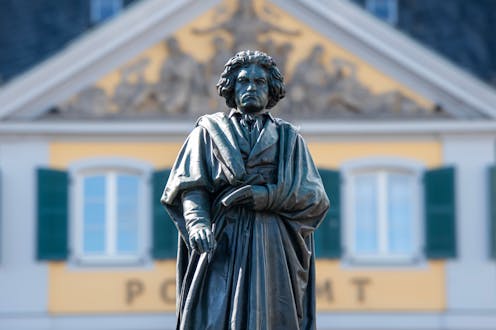
Major anniversaries of works of art present us with an opportunity to engage in cultural stocktaking. We are invited to take a moment to contemplate and celebrate the basis of their lasting significance.
April 7 2024 presents one such opportunity; it is exactly 200 years from the first performance of Ludwig van Beethoven’s Missa Solemnis, or “Solemn Mass”.
Today, the Missa Solemnis is generally considered to be one of the most remarkable works of Christian liturgical (relating to public worship) music ever conceived. It is also a summation of Beethoven’s mature compositional style.
A self-consciously great work
Beethoven’s initial excuse for composing the Missa Solemnis had been a commission in 1819 for a Mass to accompany the enthronement of his friend, patron and composition pupil, Archduke Rudolph, as the archbishop of Olmütz (now Olomouc, Czech Republic). But he became so engrossed in the creative challenge that he ran some three years late in finishing it.
In part, this was because he seemed very aware of its potential to be a work of lasting significance. He later claimed to his publishers it was also his best composition. His favourite (and most famous) portrait shows him in the act of writing it.
A masterpiece you’ve likely never heard
Why, however, is the Missa Solemnis also one of Beethoven’s lesser-recognised and performed works today? One reason is mounting a performance is not for the faint-hearted. At some 90 minutes in length, calling for about 100 highly skilled musicians, it presents a host of logistical and musical challenges.
It also seems, at least at first, to have a potentially uncomfortable relationship with its original liturgical purpose, which was to accompany a full Catholic service of Holy Communion.
However, the period of the Mass’s composition, roughly 1818–1823, was also a period in European history where there was a profound shift away from established religion’s central role in public and private life. This is perhaps reflected in the fact the Missa Solemnis defied, in both its form and content, conventional expectations at the time of what this kind of Mass setting should be.
Perhaps the most famous example is the way Beethoven sets the closing “Dona nobis pacem”, the traditional closing prayer for peace. Heard initially in the liturgically correct place, these words then initiate one of Beethoven’s famous extended codas (or closing passages) to give voice to what he described as a “Bitte um innern und äussern Frieden”, or prayer for inner and outer peace.
Beethoven goes on to highlight, ironically and very dramatically, the disasters of war. And he had good reason to, having experienced first-hand some of the horrors of the Napoleonic wars.
Also, by the time Beethoven composed the Mass he was close to being profoundly deaf. As a result, his music became less concerned with the practicalities (and indeed limits) of performance. He was now realising on paper what he heard in his imagination and seemed to have felt more free to explore the extremes of conventional musical expression.
An overt struggle between form and function
While Beethoven made a detailed study of the Mass settings of earlier masters, such as those by Giovanni Pierluigi da Palestrina, he also knew he could not simply follow their example. He said:
It would be a folly to imitate Palestrina’s language unless its spirit and world of religious thought lives within us.
A century later, German critic Paul Bekker wrote Beethoven instead broke through the walls of musical tradition and liturgical dogma “which divide the church from the world”. Indeed, the Missa Solemnis has been almost exclusively performed as a concert piece, despite Beethoven himself intending for it to be performed as part of an actual Mass service.
But all these aspects can also be considered a part of, and not necessarily in opposition to, the work’s underlying religious sensibility.
The score of the Missa Solemnis embodies much of what we have come to label as a “Late Style”. This category of creative output tends to emerge from an artist towards the end of their life. Late Style works are commonly infused with an awareness of impending death, as well as speculation about the limits of artistic expression itself.
An emblematic example might be the way Beethoven sets the text “Et vitam venturi sæculi. Amen” (“[…] and the life of the world to come, Amen”) from the closing passage of the Mass’s Credo (Creed) movement.
“Et vitam venturi” from the Credo movement of the Missa Solemnis.While Beethoven at first takes up the tradition of setting these words with a concluding flourish of musical counterpoint, he then proceeds to do so to a technically extreme degree.
Not for nothing did British musicologist Sir Donald Tovey later describe this as “the most difficult choral passage ever written”. It sounds deliberately overproduced, as if Beethoven wishes to convey both a mood of affirmation and doubt – perhaps similar to the supplicant in St Mark’s Gospel who declares: “Lord I believe, forgive my unbelief”.
Even what might at first seem to be an outwardly conservative setting, such as the Mass’s opening Kyrie Eleison prayer (“Lord have mercy upon us, Christ have mercy upon us, Lord have mercy upon us”), draws us into such a mode of contemplation. Here, the Mass’s grandiloquent music contains a more urgent, anxious, prayer as the text changes to “Christ have mercy”.
It expresses both tremendous religious yearning, but also battles with that yearning – and ultimately does not find peace with it. As the opening sequence of 1994 film Immortal Beloved imaginatively depicts, this movement was also performed at Beethoven’s funeral in 1827.
The Kyrie from the Missa Solemnis is heard after 52 seconds.An enduring message
This direct engagement with doubt as an inevitable companion to expressions of faith is, I suspect, a key reason why Beethoven’s Missa Solemnis can still speak directly to us across the centuries. Just as Beethoven himself wished: “from the heart to the heart again”.
On Sunday, 200 years to the day, more than 100 musicians will join to commemorate the anniversary of Missa Solemnis with a liturgical performance at St Paul’s Cathedral in Melbourne.
In this way, we hope to bring renewed attention to the powerful amalgam of traditional ritual, musical force and theological questioning that lies at the heart of this great work.
Authors: Peter Tregear, Principal Fellow and Professor of Music, The University of Melbourne

















