

The Southern Ocean has the cleanest air on Earth. We have just discovered why
- Written by Tahereh Alinejadtabrizi, PhD student, Monash University
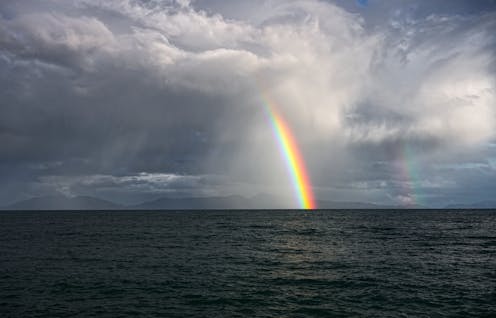
The Southern Ocean is renowned for having the cleanest air on Earth. But the precise reasons why have remained a mystery, until now.
There’s more to it than just a lack of human activity. Yes, there are fewer people down there using industrial chemicals and burning fossil fuels. But there are natural sources of fine particles too, such as salt from sea spray or dust whipped up by the wind.
Regardless of origin, fine solid particles or liquid droplets suspended in air are known as “aerosols”. We consider clean air to have low levels of aerosols, without discriminating between natural or industrial sources.
Our recent research discovered clouds and rain play a crucial role in scrubbing the atmosphere clean.
Understanding the role of clouds and rain
Aerosol levels over the Southern Ocean are influenced by a range of factors. These include the amount of salt spray and seasonal variation in the growth of tiny plant-like organisms called phytoplankton, which are a source of airborne sulphate particles.
Fewer sulphates are produced during winter, which is when the air over the Southern Ocean is most pristine.
But that’s not the full story. The Southern Ocean is also the cloudiest place on Earth. It experiences short-lived, sporadic showers like nowhere else. We wanted to understand the role of clouds and rain in cleaning the air.
The biggest barrier to understanding these processes has always been the lack of high-quality observations of clouds, rainfall and aerosols in this poorly observed region of the world.
Thankfully, a new generation of satellites allows us to study images of clouds in unprecedented detail. We developed a computer program to recognise different cloud patterns over a vast area of the Southern Ocean.
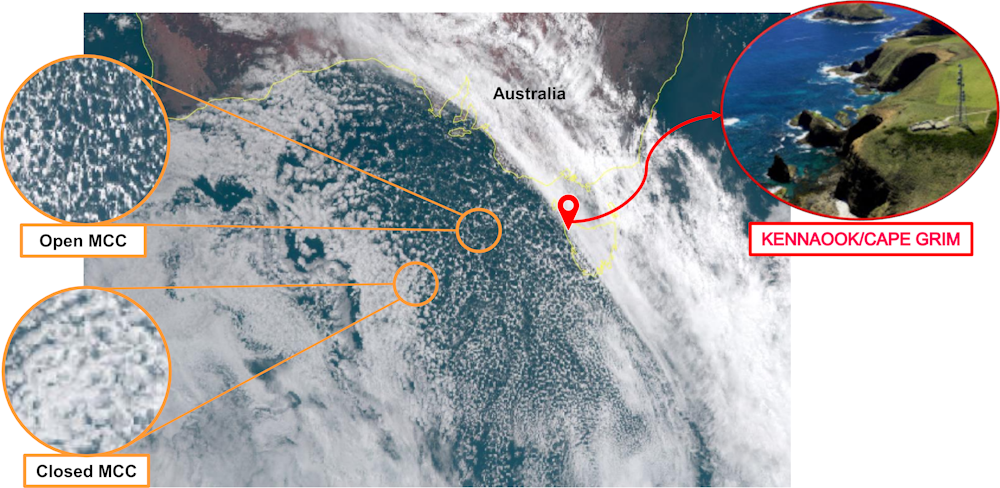
In particular we were on the lookout for distinctive honeycomb-shaped patterns in the cloud field. These honeycomb-like clouds are of great interest because they have a major role in regulating the climate.
When the honeycomb cell is filled with cloud or “closed” it is whiter and brighter, reflecting more sunlight back to space. So these clouds help keep the Earth cool.
Empty or “open” honeycomb cells, on the other hand, let more sunlight in.
These intricacies remain a source of error in modelling the Earth’s climate because they are not being properly included. It’s important to get the balance of open and closed cells right, or the results can be way off.
Whether the honeycomb cells are open or closed also relates to the amount of rainfall they can produce.
The cells are big enough to be seen from space, around 40-60km in diameter. So we can study them using satellite images.
Our research is particularly timely given this month’s launch of a cloud and precipitation experiment at Kennaook/Cape Grim in Tasmania. It aims to get higher resolution data on clouds, rain and sunlight.
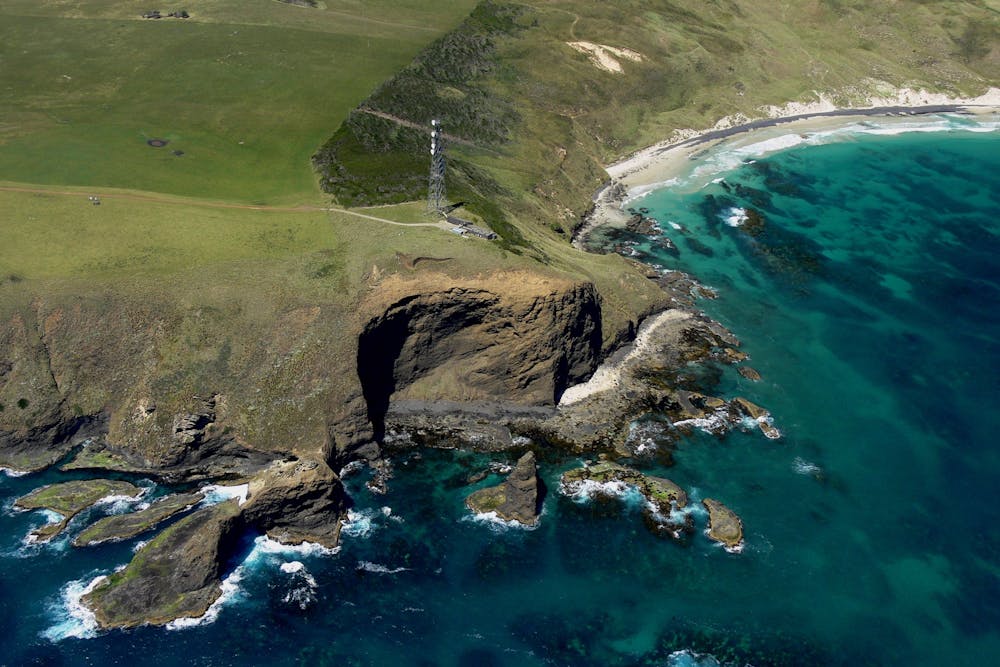 The world-famous atmospheric gas monitoring station at Kennaook/Cape Grim on the north-west tip of Tasmania.
CSIRO
The world-famous atmospheric gas monitoring station at Kennaook/Cape Grim on the north-west tip of Tasmania.
CSIRO
Read more: Forty years of measuring the world's cleanest air reveals human fingerprints on the atmosphere
Scrubbing aerosols out of the sky
We compared the honeycomb cloud patterns with measurements of aerosols from the Kennaook/Cape Grim observatory and also with the Bureau of Meteorology’s rainfall observations from a nearby rain gauge.
Our results showed days with the cleanest air were associated with the presence of open honeycomb cloud. We think this is because these clouds generate sporadic but intense rain showers, which seem to “wash” the aerosol particles out of the air.
It’s somewhat counter-intuitive, but it turns out the open cells contain more moisture and produce more rain than the fluffy white closed cells filled with cloud. We found the open honeycomb clouds produce six times as much rain as the closed ones.
So what looks like less cloudy weather by satellite actually triggers the most effective rain showers for washing the aerosols out. Whereas the filled or closed honeycomb pattern, which looks cloudier, is less effective. That was one of the more surprising aspects of our findings.
We found the empty honeycombs to be far more common during the winter months, when the air is cleanest.
We also wanted to know what makes cloud fields look the way they do. Our analysis suggests large-scale weather systems control the pattern of the cloud field. As unruly storms track across the Southern Ocean, they produce these open and closed cells.
Read more: The Southern Ocean upwelling is a mecca for whales and tuna that's worth celebrating and protecting
Fresh air and better climate models
Our research has added a new piece to the puzzle of why the Southern Ocean has the world’s cleanest air. Rainfall is the key, especially rain from these clear, open honeycomb cell-type clouds. We were first to discover they are truly responsible for cleaning up all the air flowing over the Southern Ocean.
These honeycomb patterns are also found in both the North Atlantic and North Pacific regions during winter. So our work will also help explain how these clouds remove aerosols including dust and pollution in these locations. And our findings will help improve climate models, enabling more accurate predictions.
Rain scrubs the aerosols out of the sky in much the same way as a washing machine acts to clean clothes.
After the cold front comes through, the air is clean. If you’re wintering on the south coast of Australia, you can breathe in the benefits as this fresh air comes in off the Southern Ocean.
We would like to acknowledge the valuable contributions of CSIRO, ANSTO and the Bureau of Meteorology to this research.
Read more: More than 200 scientists from 19 countries want to tell us the Southern Ocean is in trouble
Authors: Tahereh Alinejadtabrizi, PhD student, Monash University

















