

Native cherries are a bit mysterious, and possibly inside-out
- Written by: Gregg Müller, Lecturer in Natural History, La Trobe University
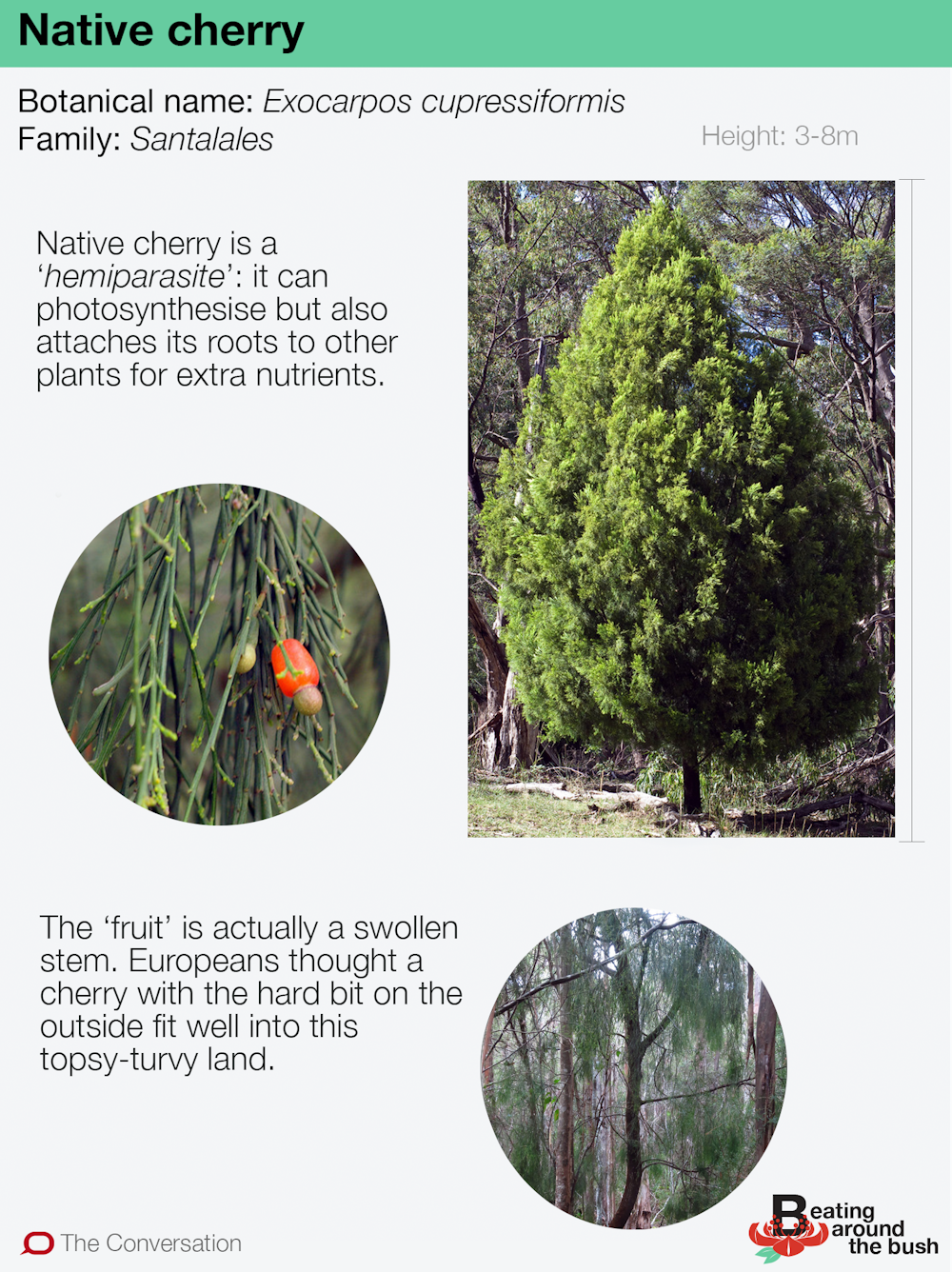
People don’t like parasites. But there’s a local Aussie tree that’s only a little bit parasitic: the native cherry, or cherry ballart.
It’s what we call hemiparasitic. It can photosynthesise, but gains extra nutrients by attaching its roots to host plants.
The native cherry, Exocarpos cupressiformis, might be our most widespread root hemiparasite tree, but we’re not quite sure – root-parasitic shrubs and trees are a bit of a research blank spot. We are not even really sure who all the hosts of cherry ballart are.
Read more: Warty hammer orchids are sexual deceivers
Although other parasites – like mistletoes – have a more direct Christmas association, cherry ballart does have an Australian Yuletide connection: their conifer-like appearance (the species name cupressiformis means “cypress-like”) was noted by homesick European settlers, who chopped them down for Christmas trees.
 The Conversation
On the map
Cherry ballart grows from the Atherton Tablelands in Queensland to southern Tasmania, and across to the Eyre Peninsula in South Australia.
The first European to record it was Jacques-Julien Houtou de Labillardière, the botanist on d'Entrecasteaux’s expedition in search of La Perouse. He formally described the species in 1800, but we have no physical type specimen – the botanical type is his illustration and description. Maybe he lost his specimen, or disposed of it, or thought a picture would do; Jacques seems to have been a bit cavalier with his record-keeping.
Or perhaps it was stolen or misplaced after all his specimens were seized in an overlapping series of defections, wars, defeats and revolution as the expedition tried to return to Europe. The collection was eventually returned after the intercession of English botanist Joseph Banks – but no cherry ballart.
The Conversation
On the map
Cherry ballart grows from the Atherton Tablelands in Queensland to southern Tasmania, and across to the Eyre Peninsula in South Australia.
The first European to record it was Jacques-Julien Houtou de Labillardière, the botanist on d'Entrecasteaux’s expedition in search of La Perouse. He formally described the species in 1800, but we have no physical type specimen – the botanical type is his illustration and description. Maybe he lost his specimen, or disposed of it, or thought a picture would do; Jacques seems to have been a bit cavalier with his record-keeping.
Or perhaps it was stolen or misplaced after all his specimens were seized in an overlapping series of defections, wars, defeats and revolution as the expedition tried to return to Europe. The collection was eventually returned after the intercession of English botanist Joseph Banks – but no cherry ballart.
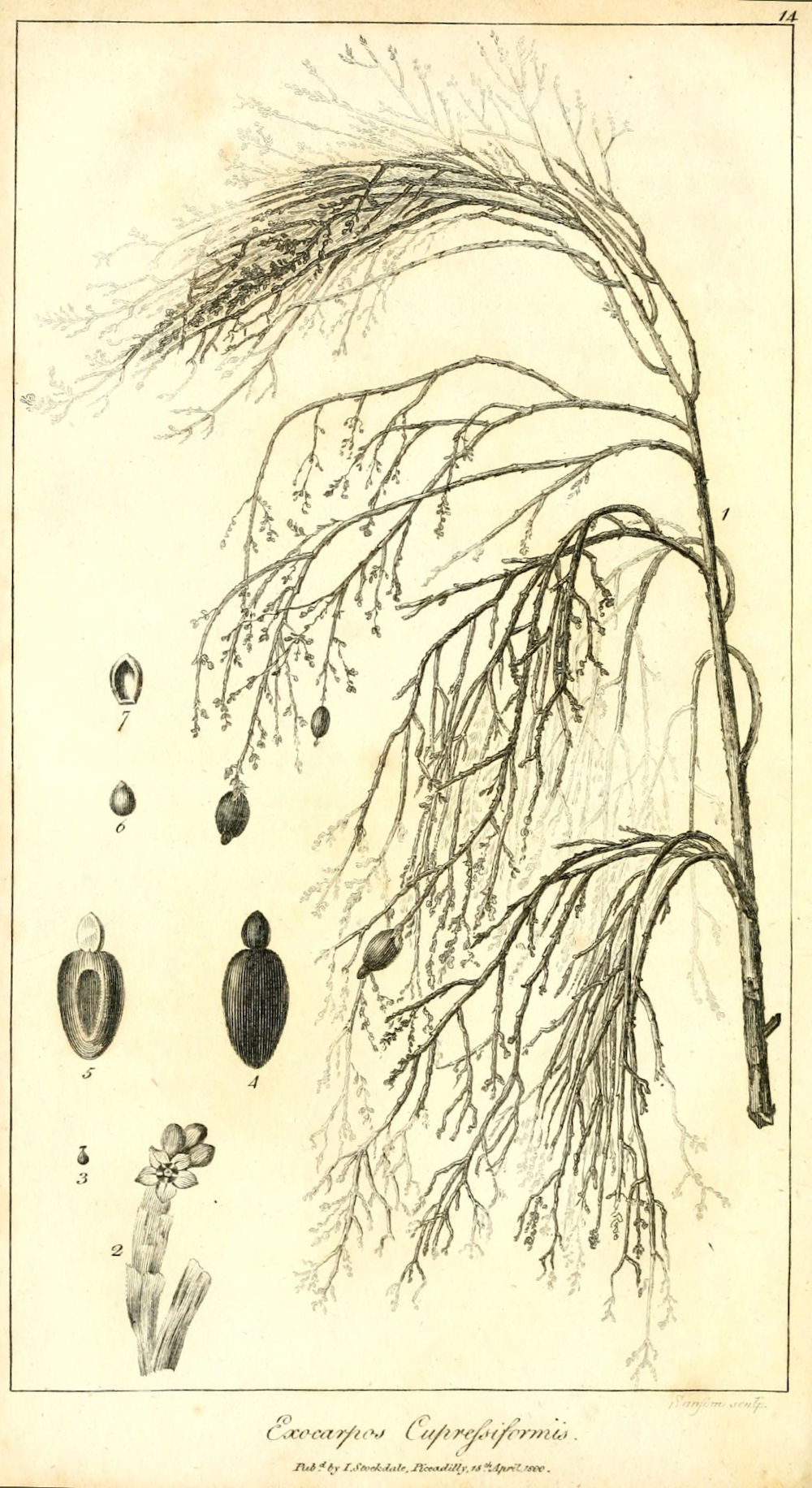 Jacques-Julien Houtou de Labillardière’s description of the native cherry.
Voyage in search of La Pérouse
Its distinctive shape led to native cherry being marked on early Australian orienteering maps, since they are in a cartographic Goldilocks zone: obvious, just numerous enough to make them useful, but not so many as to clutter the map.
That was until Australia held the World Orienteering Championships in the mid-1980s, when the standardisation of Australian orienteering maps for overseas competitors led to the cherry ballart becoming an early victim of internationalisation – at least cartographically speaking.
Its utility also extended to the timber. Among the uses of its “close-grained and handsome wood” are tool handles, gun stocks and map rollers (although the last is probably a niche market these days).
Indigenous Australians ate the fruit, used the wood for spear throwers and reportedly used the sap as a treatment for snakebite. They called it Tchimmi-dillen (Queensland), Palatt or Ballot (Lake Condah, Victoria) and Ballee (Yarra).
Read more:
Leek orchids are beautiful, endangered and we have no idea how to grow them
Grow baby, grow!
Despite producing large quantities of fruit and seed, no one seems to be able to get native cherry to germinate reliably. There are anecdotal reports that feeding the seed to chooks works, but other growers dismiss this approach.
The edible fruit isn’t actually a true fruit: it’s a swollen stem. It’s reported to have the highest sugar level of any native fruit in the forests of southern Victoria and is much tastier than you’d think a stem would be. (It’s also probably an important nutrient supply for some birds, but that’s yet another thing we are yet to prove.)
This odd “fruit” gives rise to the genus name (exo = outside, carpos = fruit,) and was often touted by early European writers as another example of the topsy-turvy nature of Australia – “cherries” with the pit on the outside went along with “duck-billed playtpus”, animals with pouches, trees that shed bark rather than leaves, and Christmas in the middle of summer.
Jacques-Julien Houtou de Labillardière’s description of the native cherry.
Voyage in search of La Pérouse
Its distinctive shape led to native cherry being marked on early Australian orienteering maps, since they are in a cartographic Goldilocks zone: obvious, just numerous enough to make them useful, but not so many as to clutter the map.
That was until Australia held the World Orienteering Championships in the mid-1980s, when the standardisation of Australian orienteering maps for overseas competitors led to the cherry ballart becoming an early victim of internationalisation – at least cartographically speaking.
Its utility also extended to the timber. Among the uses of its “close-grained and handsome wood” are tool handles, gun stocks and map rollers (although the last is probably a niche market these days).
Indigenous Australians ate the fruit, used the wood for spear throwers and reportedly used the sap as a treatment for snakebite. They called it Tchimmi-dillen (Queensland), Palatt or Ballot (Lake Condah, Victoria) and Ballee (Yarra).
Read more:
Leek orchids are beautiful, endangered and we have no idea how to grow them
Grow baby, grow!
Despite producing large quantities of fruit and seed, no one seems to be able to get native cherry to germinate reliably. There are anecdotal reports that feeding the seed to chooks works, but other growers dismiss this approach.
The edible fruit isn’t actually a true fruit: it’s a swollen stem. It’s reported to have the highest sugar level of any native fruit in the forests of southern Victoria and is much tastier than you’d think a stem would be. (It’s also probably an important nutrient supply for some birds, but that’s yet another thing we are yet to prove.)
This odd “fruit” gives rise to the genus name (exo = outside, carpos = fruit,) and was often touted by early European writers as another example of the topsy-turvy nature of Australia – “cherries” with the pit on the outside went along with “duck-billed playtpus”, animals with pouches, trees that shed bark rather than leaves, and Christmas in the middle of summer.
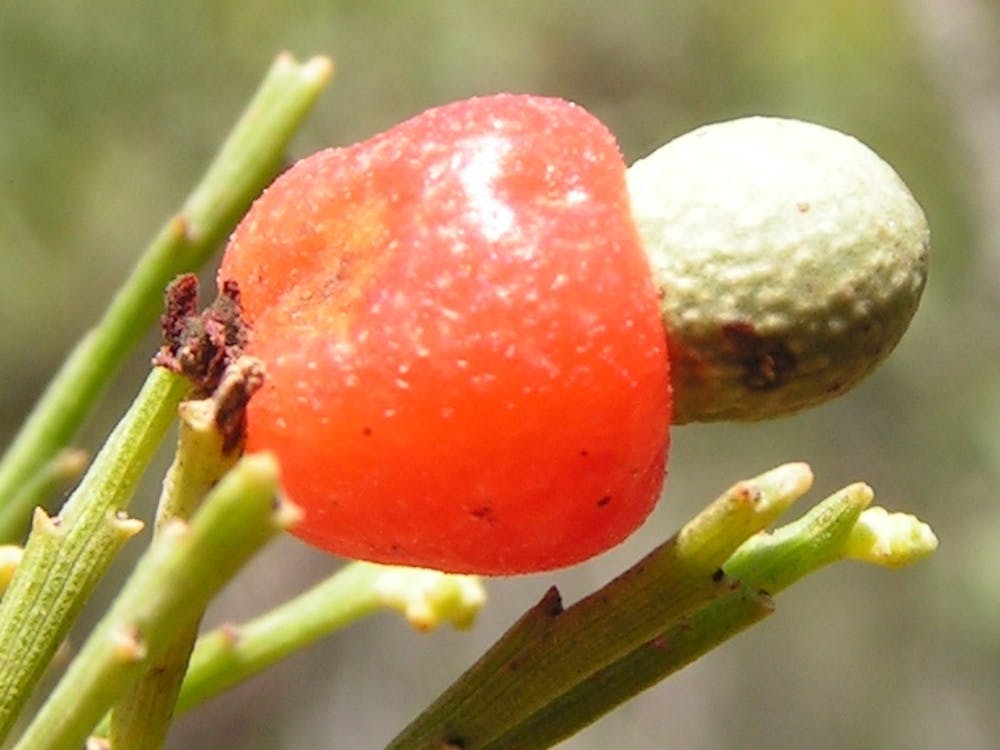 The sweet and delicious fruit of native cherries is actually a swollen stem.
Arthur Chapman/Flickr, CC BY-NC
Despite their oddness, native cherries in the bush are biodiversity hotspots. My camera trap data show they preferentially attract echidnas, possums, foxes, swamp wallabies, white-winged choughs and bronzewing pigeons.
This might be because they modify their immediate environment. My research shows they create moderate micro-climates in their foliage, reduce soil temperatures, increase soil water retention, concentrate nutrients in the soil beneath their canopies, and alter the understorey vegetation. They also kill some of their host trees, creating patches with higher concentrations of dead timber. All these probably have something to do with their animal attraction, but exactly how is a mystery yet to be solved.
Read more:
'The worst kind of pain you can imagine' – what it's like to be stung by a stinging tree
In addition to their attractiveness to vertebrates, native cherries are required hosts for some striking moths and share specialist host duties with mistletoe for some of our most beautiful butterflies (although mistletoes take most of the glory in the scientific literature).
My research into our cherry ballart hopes in part to correct these historical slights. I want to set the record straight on this overlooked widespread and attractive little tree, which has a long indigenous use and was one of the first of our native flora to be described by Europeans.
The sweet and delicious fruit of native cherries is actually a swollen stem.
Arthur Chapman/Flickr, CC BY-NC
Despite their oddness, native cherries in the bush are biodiversity hotspots. My camera trap data show they preferentially attract echidnas, possums, foxes, swamp wallabies, white-winged choughs and bronzewing pigeons.
This might be because they modify their immediate environment. My research shows they create moderate micro-climates in their foliage, reduce soil temperatures, increase soil water retention, concentrate nutrients in the soil beneath their canopies, and alter the understorey vegetation. They also kill some of their host trees, creating patches with higher concentrations of dead timber. All these probably have something to do with their animal attraction, but exactly how is a mystery yet to be solved.
Read more:
'The worst kind of pain you can imagine' – what it's like to be stung by a stinging tree
In addition to their attractiveness to vertebrates, native cherries are required hosts for some striking moths and share specialist host duties with mistletoe for some of our most beautiful butterflies (although mistletoes take most of the glory in the scientific literature).
My research into our cherry ballart hopes in part to correct these historical slights. I want to set the record straight on this overlooked widespread and attractive little tree, which has a long indigenous use and was one of the first of our native flora to be described by Europeans.
 Sign up to Beating Around the Bush, a series that profiles native plants: part gardening column, part dispatches from country, entirely Australian.
Authors: Gregg Müller, Lecturer in Natural History, La Trobe University
Read more http://theconversation.com/native-cherries-are-a-bit-mysterious-and-possibly-inside-out-108760


















