

Why naming all our mozzies is important for fighting disease
- Written by: Bryan Lessard, Postdoctoral Research Fellow, CSIRO
Notorious for spreading diseases like malaria and Zika virus overseas, mosquitoes contribute to thousands of cases of human disease in Australia each year. But only half of Australia’s approximately 400 different species of mosquitoes have been scientifically named and described. So how are scientists able to tell the unnamed species apart?
Climate change means population change
Mosquito populations and our ability to predict disease outbreaks are likely to change in the future. As climates change, disease-carrying mozzies who love the heat may spread further south into populated cities.
As human populations continue to grow in Australia, they will interact with different communities of wild animals that act as disease reservoirs, as well as different mosquito species that may be capable of carrying these diseases. The expansion of agricultural and urban water storages will also create new homes for mosquito larvae to mature, allowing mosquitoes to spread further throughout the country.
Read more: How we kept disease-spreading Asian Tiger mozzies away from the Australian mainland
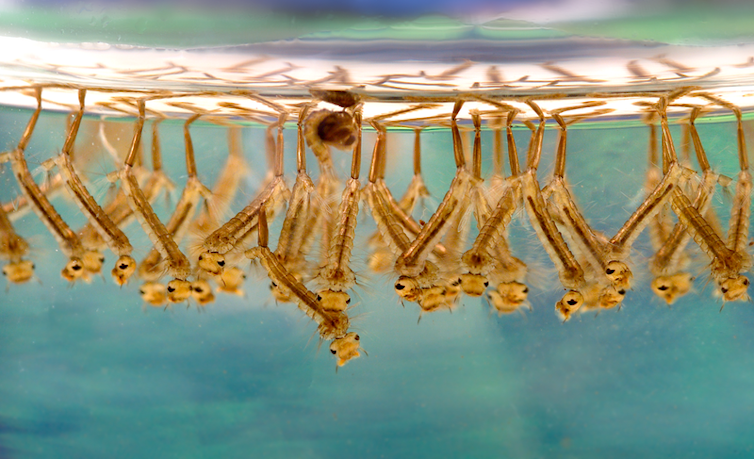 Mosquito larvae need a body of water to mature in.
James Gathany, CDC
Mosquito larvae need a body of water to mature in.
James Gathany, CDC
Agents of disease
Mosquitoes like the native Common Banded Mosquito (Culex annulirostris) are known to spread human diseases such as Ross River virus, Barmah Forest virus, Dengue fever and Murray Valley encephalitis.
It’s not the adult mosquito itself that causes the disease, but the viruses and other microbes that accumulate in the mosquito’s saliva and are injected into the bloodstream of the unsuspecting victim during feeding.
The mosquitoes that bite humans are female, requiring the proteins in blood to ripen their eggs and reach sexual maturity. Male mosquitoes, and females of some species, are completely vegetarian, opting to drink nectar from flowers, and are useful pollinators.
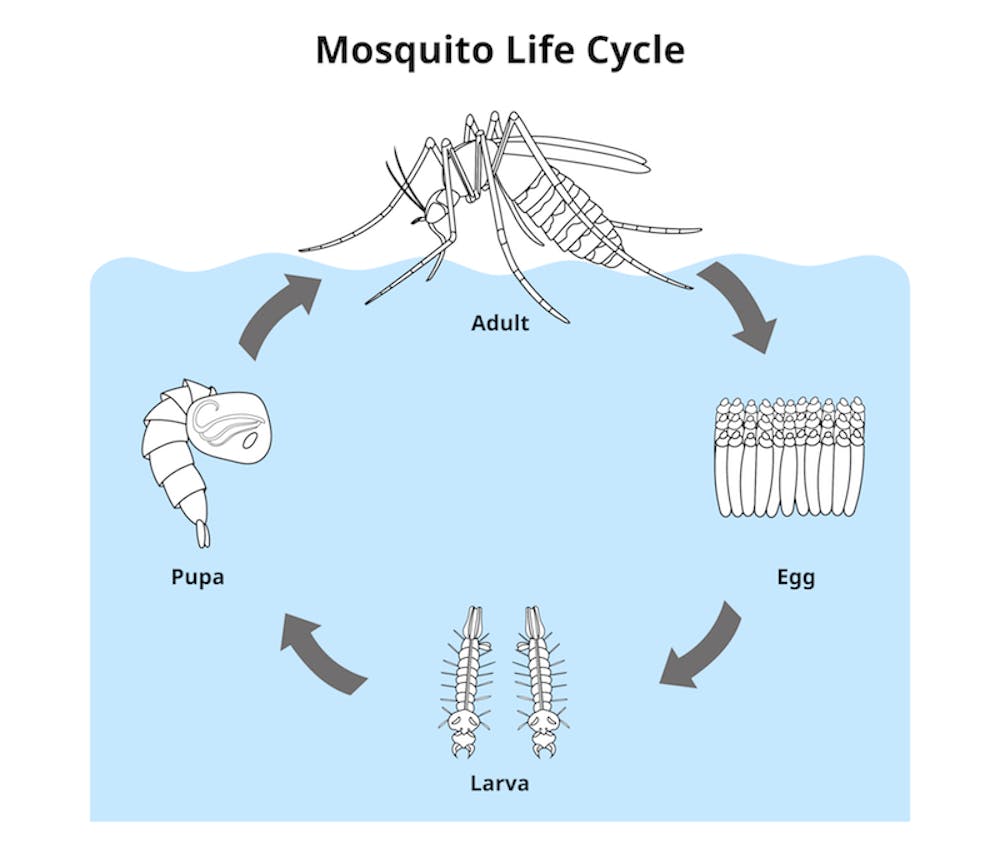 The life cycle of a mosquito.
from www.shutterstock.com
The life cycle of a mosquito.
from www.shutterstock.com
Read more: Common Australian mosquitoes can't spread Zika
The name game
Mosquitoes belong to the fly family Culicidae and are an important part of our biodiversity. There are more than 3,680 known species of mosquitoes in the world. Taxonomists, scientists who classify organisms, have been able to formally name more than 230 species in Australia.
The classification of Australian mosquitoes tapered off in the 1980s with the publication of the last volume of The Culicidae of the Australasian Region and passing of Dr Elizabeth Marks who was the most important contributor to our understanding of Australian mosquitoes.
She left behind 171 unique species with code numbers like “Culex sp No. 32”, but unfortunately these new species were never formally described and remained unnamed after her death. This isn’t uncommon in biodiversity research, as biologists estimate that we’ve only named 25% of life on earth during a time when there is an alarming decline in the taxonomic workforce.
Dr Marks’ unnamed species are still held in Australian entomology collections, like CSIRO’s Australian National Insect Collection, Museum Victoria and the Queensland Museum. Although all the major disease-carrying species of mosquitoes are known in the world, several of Marks’ undescribed Australian species are blood feeding and may have the capacity to transmit diseases.
How do we tell mozzies apart?
Naming, describing and establishing the correct classification of Australia’s mosquitoes is the first step to understanding their role in disease transmission. This is difficult work as adults are small and fragile, and important diagnostic features that are used to tell species apart, like antennae, legs and even tiny scales, are easily lost or damaged.
CSIRO scientists, with support from the Australian Biological Resources Study, Government of Western Australia Department of Health, and University of Queensland, have been tasked with naming Australia’s undescribed mosquitoes. New species will be named and described based on the appearance of the adults and infant larval stages which are commonly intercepted by mozzie surveillance officers. New identification tools will also be created so others can quickly and reliably identify the Australian species.
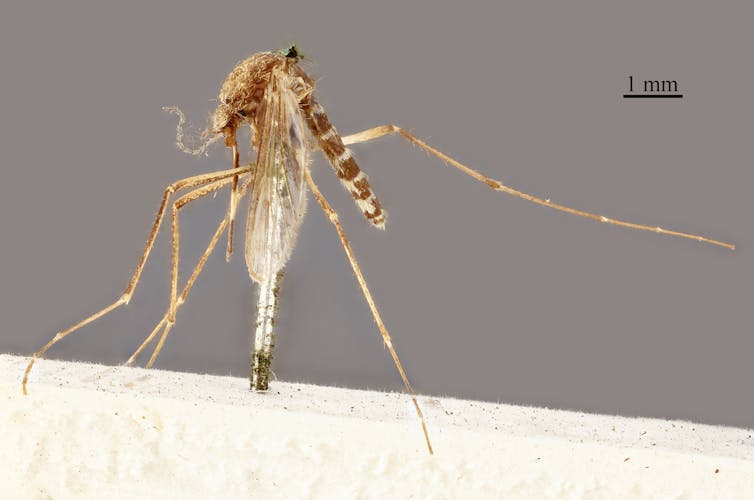 A 100 year old specimen of the native Common Banded Mosquito Culex annulirostris, capable of spreading Murray Valley encephalitis virus, one of 12 million specimens held in CSIRO’s Australian National Insect Collection in Canberra.
CSIRO/Dr Bryan Lessard
A 100 year old specimen of the native Common Banded Mosquito Culex annulirostris, capable of spreading Murray Valley encephalitis virus, one of 12 million specimens held in CSIRO’s Australian National Insect Collection in Canberra.
CSIRO/Dr Bryan Lessard
Read more: How the new mozzie emoji can create buzz to battle mosquito-borne disease
Scientists are now able to extract DNA and sequence the entire mitochondrial genome from very old museum specimens. CSIRO are using these next generation techniques to generate a reliable DNA reference database of Australian mosquitoes to be used by other researchers and mozzie surveillance officers to accurately identify specimens and diagnose new species. CSIRO are also digitising museum specimens to unlock distribution data and establish the geographical boundaries for the Australian species.
By naming and describing new species, we will gain a more complete picture of our mosquito fauna, and its role in disease transmission. This will make us better prepared to manage our mosquitoes and human health in the future as the climate changes and our growing human population moves into new areas of Australia.
Authors: Bryan Lessard, Postdoctoral Research Fellow, CSIRO
Read more http://theconversation.com/why-naming-all-our-mozzies-is-important-for-fighting-disease-92379



















