

how ethical consumption got so selective
- Written by: Michal Carrington, Senior Lecturer in Marketing, University of Melbourne
Are you an organic shopper? Into fairtrade? A greenhouse gas warrior? All about free-range and animal welfare?
Even if you said yes to all the above, the chances are that, when you shop, only a few products that meet these ethical concerns actually make it into your basket.
Generally, we all have the blinkers on when shopping with our ethics. We select specific ethical causes and concerns to integrate into our shopping choices while ignoring others.
In their book The Myth of the Ethical Consumer, management professor Timothy Devinney his co-authors cite the evidence that while consumers might profess a social consciousness in surveys (where there is no cost), they usually fail to live up to this when their behaviour is examined.
Rather than a myth, perhaps a more accurate description would be “one-eyed”.
So why do we exercise ethical favouritism at the cash register, turning a blind eye to all but a select few ethical concerns?
Creatures of habit
Shopping is highly habitual. Think about how you do your own grocery shopping. It is usually at the same stores, buying the same stuff. Chances are you take the same route around the store every time.
Mobilising our ethical concerns into our shopping baskets generally requires breaking old habits and making new ones. This takes conscious effort.
Research is required. You have to the read the fine print on labels. Then you have to assess if the claims made are accurate, and weigh them against other choices. It takes time. To integrate a new ethical concern into our shopping basket may even require a whole new store visit and travel routine.
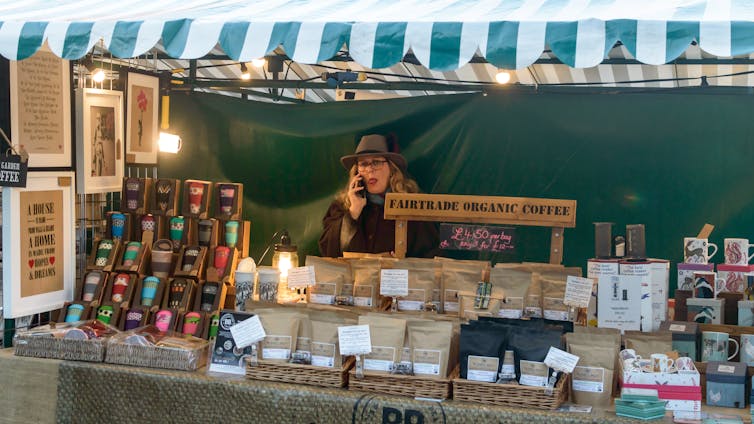 A Fairtrade coffee stall in Gloucester, Britain. Fairtrade certification is one of the few labels guaranteeing fair conditions for producers, but it applies only to a small range of products, such as coffee, chocolate, tea, vanilla, cotton and gold.
Jacek Wojnarowsk/Shutterstock
A Fairtrade coffee stall in Gloucester, Britain. Fairtrade certification is one of the few labels guaranteeing fair conditions for producers, but it applies only to a small range of products, such as coffee, chocolate, tea, vanilla, cotton and gold.
Jacek Wojnarowsk/Shutterstock
Priority principles
All the effort to make new habits and break old habits is generally reserved for the ethical concerns we give the greatest priority.
Prioritisation is an important coping mechanism to maintain our sanity while juggling complexity – and there are few better examples of the increasing complexity of modern life than your average supermarket. Here we are confronted with literally thousands of choices.
Read more: How too much information can stop people from being sustainable consumers
Price, weight and kilojoules are generally the only standardised information provided. A label may carry a logo certifying the product is organic, or fairtrade, or sourced sustainably from a forest or ocean, but very few products meet all those ethical standards simultaneously. If you are concerned about carbon emissions or modern slavery in supply chains, for example, there are no explicit certification schemes.
It is not surprising, then, that with limited time and resources to source and verify the ethical credentials of products, we prioritise our ethical concerns into primary and secondary importance.
Primary ethical concerns resonate with our sense of values strongly enough to mobilise us into action. Primary ethical concerns often make it to the checkout. Secondary concerns rarely do, being traded off against other priorities such as price.
Read more: What comes first: the free-range chicken or the free-range egg?
Weighing the sacrifice
When it comes to any issue effectively downgraded to secondary importance, we are notoriously commitment-phobic.
Part of the reason is because we associate commitment with sacrifice. Whether accurate or not, we have an idea that shopping ethically will usually mean paying more, as well as sacrificing on quality, choice, trendiness and so forth.
Even if there is no or minimal obvious sacrifice, we still harbour suspicions of some cost lurking beneath the surface, and avoid the potential risk. Only for those highest priority concerns to which we feel a strong moral obligation are we willing to commit, take the risk and make a sacrifice.
Guilt avoidance
As we become more aware of questionable ethics in production — such as the epidemic of modern slavery tainting so many of the products and services we consume – the guilt we feel could fast become unbearable.
Research has highlighted the common justification techniques people use to avoid feeling guilty about enjoying the goods produced using modern slavery. These include blaming the slave for their own enslavement (denial of victim), trivialising the experience and impact on the enslaved individual (denial of injury) and regarding the slave as different to ourselves, and therefore worthy of different treatment (dehumanising the slave).
Read more: Modern slave trade: how to count a 'hidden' population of 46 million
These are perhaps the most extreme forms of guilt avoidance. But we are all adept at deploying some degree of psychological justification to neutralise any sense of personal responsibility for contributing to the problem through our consumption choices.
Turning myth into reality
Can the myth of the ethical consumer become a more lived reality?
Yes, I’m positive it can.
To do so, we need more help from all those interests that shape the choices available to consumers. Laws, regulations and decisions by owners and managers all along supply chains play a part in curating and constraining the choices we have as consumers.
Making it easier for us to assess the ethical credentials of products – through in-store information, accredited labelling systems or apps – would help.
And perhaps simply being more aware of the unconscious justifications going on in our heads daily may help to remove the blinkers, nudging us to shop with both eyes open.
Authors: Michal Carrington, Senior Lecturer in Marketing, University of Melbourne


















