

1996-1997 cabinet papers show how Howard and Costello faced a budget black hole
- Written by: Frank Bongiorno, Professor of History, ANU College of Arts and Social Sciences, Australian National University
On the morning of Monday, March 4 1996, the young treasurer in the Howard government, Peter Costello, and his press secretary, Tony Smith – now the speaker of the House of Representatives – took an Ansett flight from Melbourne to Sydney for their first departmental briefing. The treasury secretary, Ted Evans, who had initially asked to see Costello privately, offered his resignation in light of the change of government. Costello assured Evans he wanted him to stay on.
Once the meeting began, Evans had some startling news for his new boss. The budget had an underlying deficit of about A$9 billion. “Costello appeared genuinely shocked”, his biographer, Shaun Carney, has reported. The size of the deficit probably did take him by surprise, even if the existence of a deficit of some kind did not. John Howard recalls that he had wind of it before his March 2 election victory.
A submission released today by the National Archives of Australia in its 1996-1997 cabinet records sets out the nature and scale of the problem that the new government saw as its most serious during its first term. But problem would become opportunity. In his autobiography, Lazarus Rising, Howard would call the 1996 budget “the most important of all budgets” delivered during his almost 12 years in government, as well as “the best and bravest in 25 years”.
Read more: An evening with the treasurer: how governments belt out budget hits and hope someone is listening
Howard is hardly a disinterested party. Nonetheless, there is a persuasive strand of opinion among commentators that the fiscal decisions taken in 1996, while creating political pain for the government and economic pain for voters, were foundational for Howard and Costello.
Some have credited this early decision-making for Australia’s economic resilience in the face of turbulent global winds: the Asian financial crisis, the bursting of the dot-com bubble, even the global financial crisis.
The cabinet submission of March 18 1996 predicted economic growth of 3.75% for 1995-96 and 1996-97, on the back of improved performance from the farm sector as the drought ended. Weak demand was likely cyclical, a “temporary slowdown of the type which often occurs at this stage of the business cycle and that growth should strengthen in subsequent quarters”, as business investment again took off.
Howard’s quip from opposition in 1995 – that the recovering economy was “five minutes of economic sunlight” – was effective politics. But it was not supported by the new government’s own records, which referred to a “generally favourable outlook”.
Compared with the skyrocketing interest rates and then the recession the Hawke and Keating governments faced in the early 1990s (or the recession the Hawke government inherited in 1983), these were happy days.
However, unemployment remained high at well over 8% and was projected to stay there in the following year.
The government was also concerned about the drag on economic performance of continuing budget deficits and rising government debt. This was running down national savings, undermining investment and worsening Australia’s current account deficit – the difference between the value of imports and exports of goods, services and capital.
Costello committed the government to reducing the underlying deficit of 3.5% of gross domestic product to 0.5% over three years, thereby reducing public sector lending, relieving pressure on the current account deficit, and returning the budget to a structural surplus. The government rejected the idea of a single massive cut of A$8 billion in the 1996 budget as running the risk “of knocking the economy off course”. It therefore committed to cuts of A$4 billion in each of the budgets of 1996 and 1997, with an eye to less pain in the 1998 budget leading up to an election.
With defence spending quarantined from the cuts, the August 1996 budget was indeed a tough one. The usual suspects – health, welfare, the public service and tertiary education – bore much of the load. Nonetheless, the government’s own polling suggested most voters thought its measures “tough but fair”, dispensing necessary if bitter medicine.
Howard remarked at the December launch of the latest cabinet records release that the government applied to the budget a “fair go” test, although he would ultimately bear pain for his too-clever distinction between “core” and “non-core” election promises.
Tony Abbott was a young parliamentary secretary in 1996, on his way up but still some way from the real levers of power. By 2013, however, he had his own government and with his treasurer, Joe Hockey, faced the problem of framing his first budget.
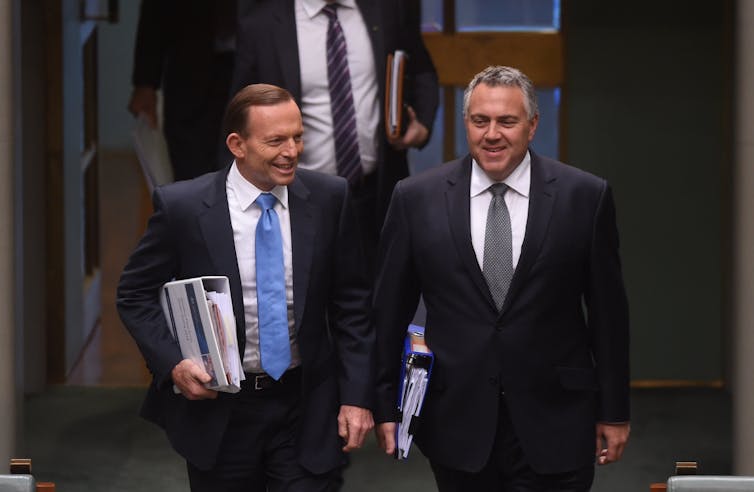 The 1996 effort would have provided a strong clue for Tony Abbott and Joe Hockey to frame their first budget after their 2013 election win.
AAP/Lukas Coch
The 1996 effort would have provided a strong clue for Tony Abbott and Joe Hockey to frame their first budget after their 2013 election win.
AAP/Lukas Coch
The 1996 effort would have been a powerful precedent for a new Coalition government in 2013 and, at a superficial level, the Abbott government did many similar things. As Howard and Costello had done, it established a National Commission of Audit.
Costello had complained of the “Beazley black hole” – the deficit bequeathed by Labor’s finance minister, Kim Beazley. Conveniently for the government, he was also the new opposition leader. The phrase lived on as a way of reminding electors of the Labor Party’s weaknesses in economic management and the Coalition’s achievements and strengths.
In 2014, Abbott and Hockey spoke of a “budget emergency”. But whereas the public seems to have bought the “black hole” image – although described recently by economist Warwick McKibbin as more like a temporary “pothole” – voters appear to have regarded the Abbott government’s “budget emergency” as invented.
One reason for this failure ironically lies in legislative changes that Costello announced at the very time he drew public attention to the black hole. This was the Charter of Budget Honesty, which mandated more rigorous reporting on the national finances, including the alphabet soup of MYEFO (Mid-Year Economic and Fiscal Outlook) and PEEFO (Pre-Election Economic and Fiscal Outlook), as well as five-yearly intergenerational reports.
These initiatives, which a Costello cabinet submission of August 2 1996 said were intended to promote “responsible fiscal management”, made it well nigh impossible to spring the surprise of a large deficit on an unsuspecting public and successor.
Unlike Hawke and Keating in 1983, and Howard and Costello in 1996, Abbott and Hockey could not stoke panic to implement unpopular measures and back out of difficult election commitments. The Charter of Budget Honesty meant they could not claim to have been blind-sided by an unanticipated budget deficit.
Howard and Costello also faced a much more helpful set of parliamentary numbers than their Coalition successor. With a massive 94 seats in a House of 148, they had political capital to burn. While few imagined the government would last almost 12 years, equally few considered it could be defeated after one term.
But it is in the Senate that the differences between 1996 and 2014 become clearer. There, the Howard government held 37 seats in a chamber of 76. After the defection of disgruntled Labor senator Mal Colston in August 1996, the government could get its legislation passed without the support of the Australian Democrats if it had Colston and the other independent senator, Brian Harradine, on side.
By way of contrast, the Abbott government faced a Senate cross bench of considerable complexity and diversity. And, as Howard has remarked, dealing with the Australian Democrats was notably easier for a Coalition government than getting Greens support.
Read more: Grattan on Friday: Budget blues as government reels under the blows
In 1996, Howard and Costello got the politics right. They still paid a political price, but it did not prove fatal. McKibbin argues that the introduction of a GST in 2000 was made easier by the reduction of government outlays and the elimination of the budget deficit in the government’s first term.
By dealing with spending in 1996, the government was able to turn its attention to revenue and taxation in a more favourable fiscal environment for politically difficult reform.
The image remains: as they contemplated their own horror budget, Joe Hockey and Mathias Cormann relaxed with cigars. Trivial in itself, this clumsiness epitomised the Abbott government’s muddled budget politics.
In 2014, after decades of strong economic performance, few believed that the drastic measures the Abbott government proposed in 2014 were either necessary or fair. Hockey declared the “age of entitlement” over, but voters suspected this did not extend to politicians or their friends.
The contentious measures in the 2014 budget – such as the Medicare co-payment and the winding back of unemployment benefits – did not pass Howard’s “fair go” test.
But the tough spending cuts Costello announced in 1996, while hardly provoking an outbreak of national joy, were an early taste of the professionalism and toughness that he and Howard brought to their long years at the helm.
Authors: Frank Bongiorno, Professor of History, ANU College of Arts and Social Sciences, Australian National University


















