

Hop Lin Jong, a Chinese immigrant in the early days of White Australia
- Written by: Antonia Finnane, Professor of Chinese History, University of Melbourne
In a new series, we look at under acknowledged women through the ages.
There are “hidden women” in history who deserve to be known for the same reasons as we know about “great men”. The film Hidden Figures showed us a few of them: African-American women who did the mathematics for the first US space program.
And then there are the rest of us: ordinary people who at first glance look more like products than producers of their times. Hop Lin Jong was one of these, or should I say one of us: a turn-of-the-century immigrant whose arrival in Western Australia in 1901 was remarkable only because she was Chinese. Her life might have passed in obscurity if her daughter Ruby had not been murdered in 1925.
Hop Lin Jong was born in Guangzhou according to immigration records, but arrived in Australia on the S.S. Australind, which plied the Singapore-Fremantle route. Singapore was a hub for human trafficking from China, a multi-million dollar business that linked villages in South China to the world. Hop Lin Jong may have been a victim of this trade.
The year of her birth is uncertain: 1884 in the family genealogy, 1886 in her residential documents. When she disembarked in Fremantle she was somewhere between 15 and 17 years of age. Her surname was Jong or Jung. In Australia she was known as Lin or Lucy, or more formally as Mrs Lee Wood, for on arrival she was wed to James Lee Wood, butcher, merchant and a prominent member of the local Chinese community. The instability of names resulting from poor English rendering is typical for this generation of Chinese migrants.
Lin arrived at the very dawn of the White Australia era, when restrictions directed mainly at preventing Chinese immigration had just been brought into force across the country. How she crossed this colour line is unknown, except that minors were treated differently from adults. Her youth may have been a factor.
Life in early 20th-century Perth
Lin’s wedding photo, published on the Chinese-Australian Historical Images site, shows a well-dressed young woman in a ruffled blouse and tailored skirt. Ruffles must have been all the rage then. A second family photo shows her older daughters, May and Ruby, aged around two and three, dressed identically in ruffled dresses and little boots. She had five children in all, born between 1902 and 1910.
At that time there were few Chinese women in Perth. Census figures for 1901 show 18 women of Chinese nationality in the whole of Western Australia. But the European wives of Chinese men and their children added to the size of the local community. Lin undoubtedly knew Elizabeth Gipp, the wife of Charlie Ah You, and mother of the Gipp boys of Anzac fame. (George, Leslie, and Richard Gipp all served in the First World War.) These women must have supported each other during confinements: this was before the age of hospital births.
The Chinese community of Perth was centered in James St, Northbridge. The Chung Wah (Chinese) Society, established in 1909, had its premises in James St, and Lee Wood’s butcher shop occupied the ground floor of the same building. In 1914, the Lee Woods bought a house in Tiverton St, not far away. Family social and economic life appeared to have operated between the two poles of Tiverton and James Streets. There was a primary school in James St that was attended by the Gipp children. It is possible that the Lee Wood children, too, went there.
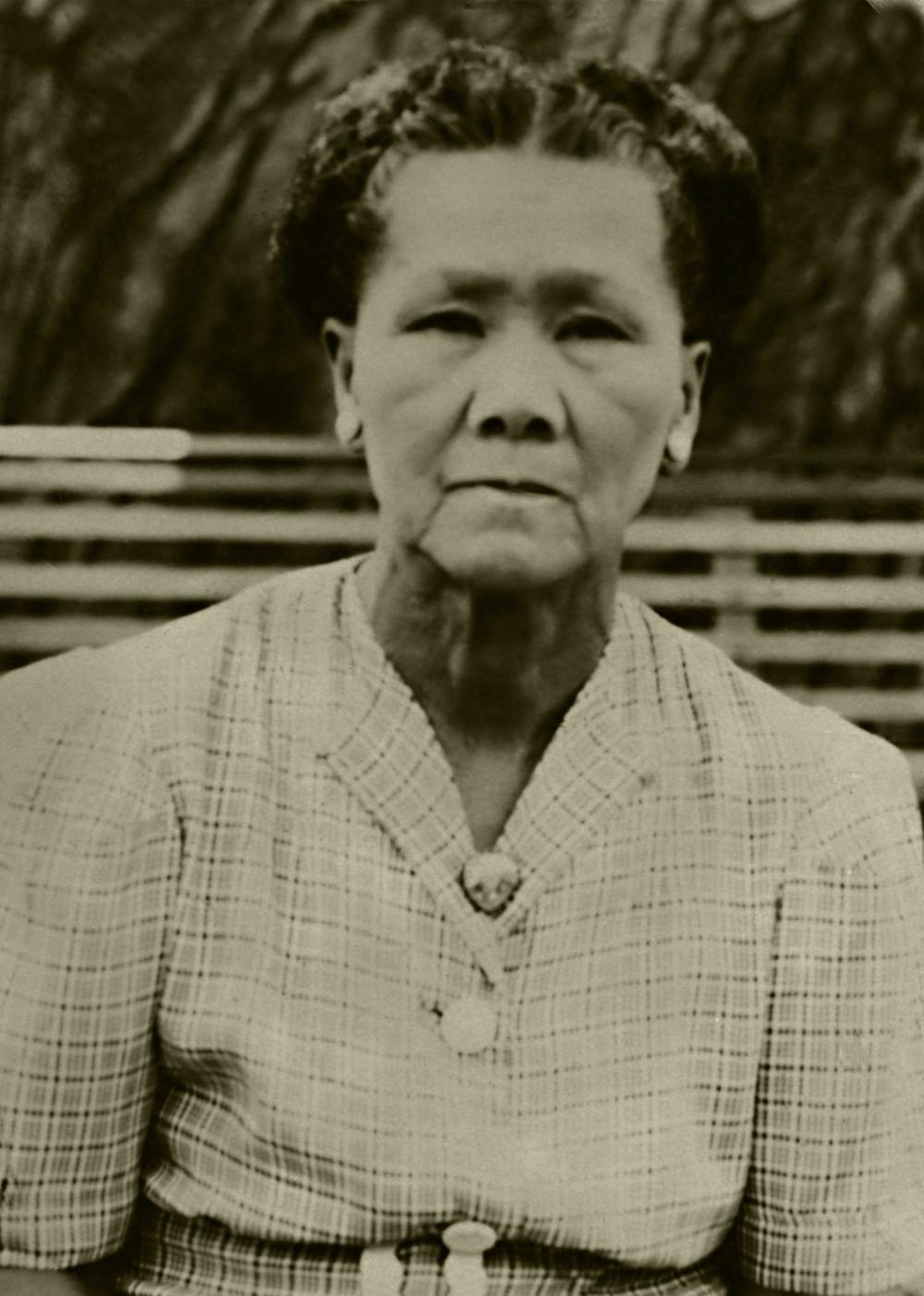 Lin Lee Wood, 1948.
National Archives of Australia
Lin Lee Wood, 1948.
National Archives of Australia
Lin was a seamstress, and took in sewing. She may have passed her skills onto Ruby, who became a dressmaker. She also worked when needed in the butcher shop. The marriage, however, was not happy. By the 1920s, she and Lee Wood were living apart, she in Tiverton St and he at the shop. Yet as an economic and social unit, the family remained intact. There were family photos, and family notices in the local newspaper. Both parents were involved in the marriages of the children: May’s to local merchant Timothy Chiew in 1922, and Ruby’s to recent immigrant Leong Yen in 1924.
Death of a daughter
Ordinary life with its ordinary problems changed forever in the middle of 1925. On the morning of 13 July that year, a Monday, Lin was working in the shop when Ruby called in to leave the house key with her. That night, when her daughter failed to return home, Lin knew immediately that something must have happened. On the Thursday she went to the police. On the next Thursday again, Ruby’s body was pulled from the harbour in Fremantle.
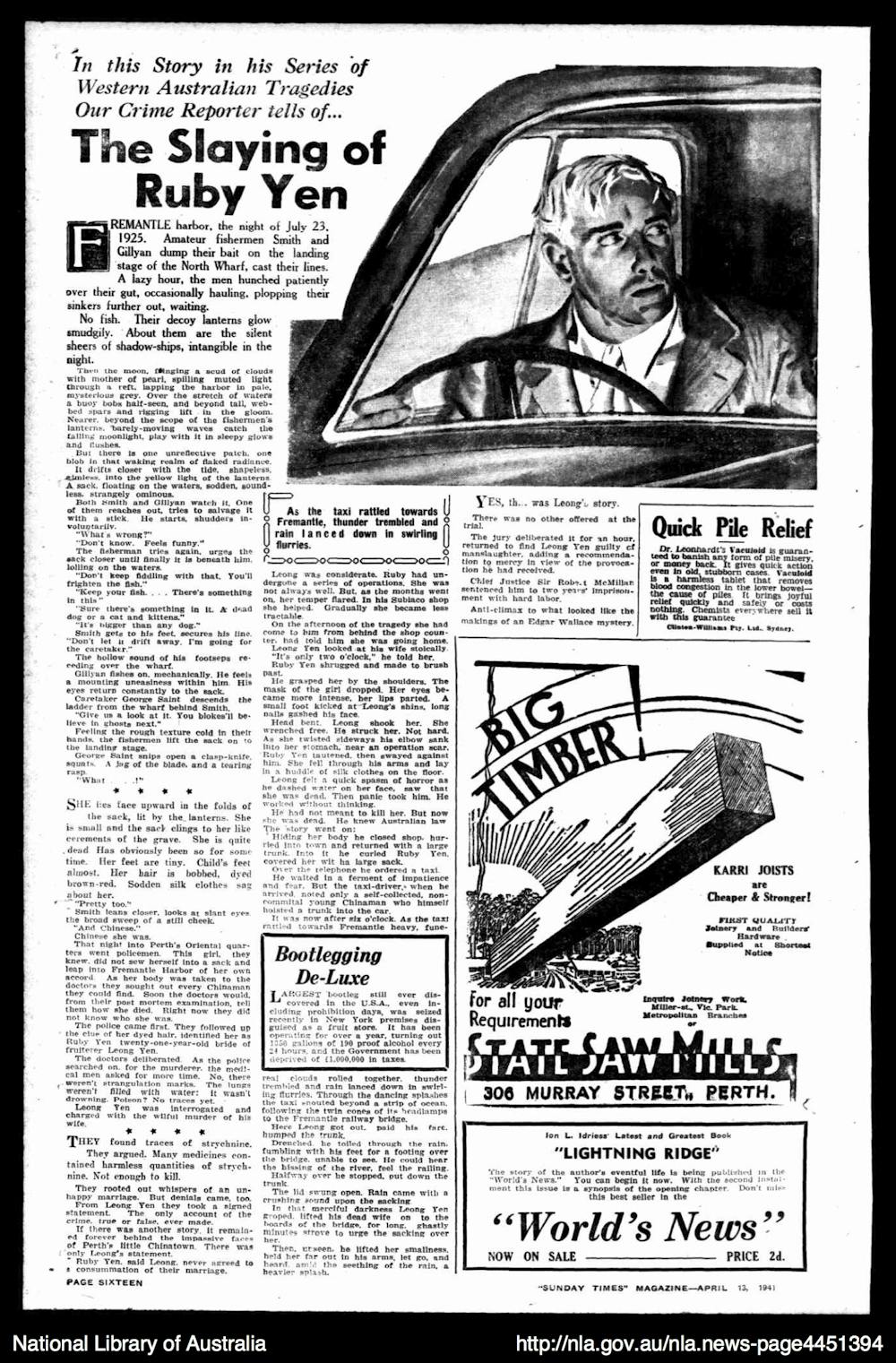 Coverage of Ruby Yen’s murder in the Sunday Times Magazine in 1941.
National Library of Australia
Coverage of Ruby Yen’s murder in the Sunday Times Magazine in 1941.
National Library of Australia
There followed a coronial inquest, the arrest of Leong Yen for the murder of his young wife, and a trial presided over by Chief Justice Robert McMillan. The case meant an unusual degree of public exposure for a Chinese-Australian family. Newspaper reporting was detailed, giving close to verbatim accounts of the evidence. Perth was glued to the events. During the trial, the public gallery was packed, with women making up a large percentage of onlookers.
From the court records we learn that a local Chinese pharmacist, George Way, had served as matchmaker for Ruby’s marriage; that Leong and Ruby had lived with Lin after their wedding in 1924; and that at one stage Lin had thrown him out of the house. We know from the forensic report that the marriage had not been consummated, and from Leong’s evidence that the couple did not share the same bedroom. Perhaps due to these facts, the all-male jury felt sorry for Leong and while finding him guilty of manslaughter, recommended leniency. The judge obliged, with a sentence of two years hard labour. On expiry of the sentence, Leong was deported.
In later decades, the press periodically revisited the case in salacious and sometimes imagined detail (“as the taxi rattled towards Fremantle, thunder rumbled and rain lanced down in swirling flurries”). Quite recently, The West Australian carried a report on the “chilling coincidences” between the current “body-in-a-suitcase trial” centred on the death of Annabel Chen and the trial of Leong Yen more than 90 years ago.
After Ruby
Between the obscurity of life as a Chinese working-class woman in a small Australian city and the glare of publicity surrounding her daughter’s death, Lin is just dimly visible to history. At only five foot high, she was smaller than any of her Australian children. The West Australian reported on her appearance in court, describing “a slight, frail woman, in deep mourning and weeping quietly.” But she was stalwart. According to her grandson Bill Chiew, she “used to work like hell.”
She was barely if at all literate, finding it difficult to sign her immigration papers. Her spoken English, however, was quite good, according to immigration records. In middle age she spent much time minding her grandchildren. Her English may have benefited from time with these second-generation Australians, who could hardly speak Chinese at all; and she may have taken comfort from them.
From the public record we can see that she was swept along in the course of Australian history. With the outbreak of World War II, her youngest son, William (“Boy”), joined the army. In the post-war years, the family enjoyed upward mobility. Granddaughter Irene graduated from university in 1952. And by the time Lin died in 1970, the White Australia Policy had effectively been dismantled. Citizenship had become possible for someone like her.
The last photo of her in the public record is attached to her application for renewal of residential status in 1948. It shows a woman in the ordinary dress of the post-war era, a button-through frock, her hair parted in the middle and done up at the sides. Her birthplace is given as Canton and her nationality as Chinese. By then she had lived in Perth for nearly 50 years. Not surprisingly, she looks Australian and Chinese at the same time.
Authors: Antonia Finnane, Professor of Chinese History, University of Melbourne


















