

Google AI


Modern Australian

Businesses think they're on top of carbon risk, but tourism destinations have barely a clue

  • Written by: Susanne Becken, Professor of Sustainable Tourism and Director, Griffith Institute for Tourism, Griffith University

The directors of most Australian companies are well aware of the impact of carbon emissions, not only on the environment but also on their own firms as emissions-intensive industries get lumbered with taxes and regulations designed to change their behaviour.

Many are getting out of emissions-intensive activities ahead of time.

But, with honourable exceptions, Australia’s tourism industry (and the Australian authorities that support it) is rolling on as if it’s business as usual.

This could be because tourism isn’t a single industry – it is a composite, made up of many industries that together create an experience, none of which take responsibility for the whole thing.

But tourism is a huge contributor to emissions, accounting for 8% of emissions worldwide and climbing as tourism grows faster than the economies it contributes to.

Read more: The carbon footprint of tourism revealed (it's bigger than we thought)

Tourism operators are aiming for even faster growth, most of them apparently oblivious to clear evidence about what their industry is doing and the risks it is buying more heavily into.

If Australian tourist destinations were companies they would be likely to discuss the risks to their operating models from higher taxes, higher oil prices, extra regulation, and changes in consumer preferences.

Aviation is one of the biggest tourism-related emitters, with the regions that depend on air travel heavily exposed.

But at present the destination-specific carbon footprints from aviation are not recorded, making it difficult for destinations to assess the risks.

A recent paper published in Tourism Management has attempted to fill the gap, publishing nine indicators for every airport in the world.

The biggest emitter in terms of departing passengers is Los Angeles International Airport, producing 765 kilo-tonnes of CO₂ in just one month; January 2017.

When taking into account passenger volumes, one of the airports with the highest emissions per traveller is Buenos Aires. The average person departing that airport emits 391 kilograms of CO₂ and travels a distance of 5,651 km.

The analysis used Brisbane as one of four case studies.
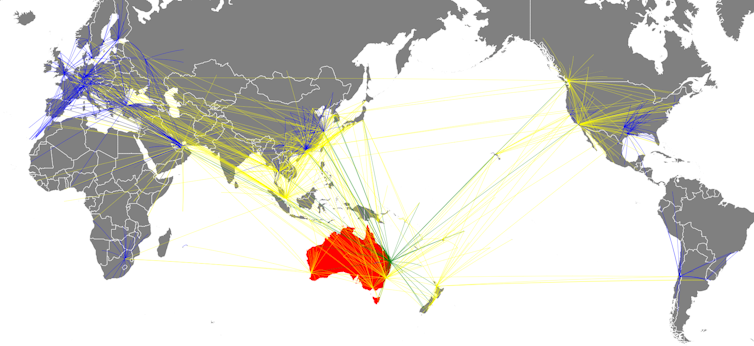
Businesses think they're on top of carbon risk, but tourism destinations have barely a clue Most of the journeys to Brisbane are long.

Brisbane’s share of itineraries under 400 km is very low at 0.7% (compared with destinations such as Copenhagen which has 9.1%). That indicates a relatively low potential to survive carbon risk by pivoting to public transport or electric planes, as Norway is planning to.

The average distance travelled from Brisbane is 2,852 km, a span exceeded by Auckland (4,561 km) but few other places.

As it happens, Brisbane Airport is working hard to minimise its on-the-ground environmental impact, but that’s not where its greatest threats come from.

Read more: Airline emissions and the case for a carbon tax on flight tickets

The indicators suggest that the destinations at most risk are islands, and those “off the beaten track” – the kind of destinations that tourism operators are increasingly keen to develop.

Queensland’s Outback Tourism Infrastructure Fund was established to do exactly that. It would be well advised to shift its focus to products that will survive even under scenarios of extreme decarbonisation.

They could include low-carbon transport systems and infrastructure, and a switch to domestic rather than international tourists.

Experience-based travel, slow travel and staycations are likely to become the future of tourism as holidaymakers continue to enjoy the things that tourism has always delivered, but without travelling as much and without burning as much carbon to do it.

An industry concerned about its future would start transforming now.

Read more: Sustainable shopping: is it possible to fly sustainably?

Authors: Susanne Becken, Professor of Sustainable Tourism and Director, Griffith Institute for Tourism, Griffith University


Read more http://theconversation.com/businesses-think-theyre-on-top-of-carbon-risk-but-tourism-destinations-have-barely-a-clue-105375

Pool and Deck Design: How to Plan the Perfect Outdoor Living Space for Your Sydney Home

For many Australians, the backyard is where life happens. Summer barbecues, weekend swims and long evenings outdoors are all part of the lifestyle, ...

Is Solar Pool Heating Worth It? What Sydney Homeowners Should Know

There's nothing quite like a backyard pool on a hot Sydney day. But once autumn rolls in, many pools sit unused for months because the water is simp...

Planning a Luxury House Move: A Week-by-Week Timeline for Prestige Sydney Homes

Selling or buying a prestige home is a major milestone. Whether it's a waterfront residence in Birchgrove, a grand Federation home in Haberfield or ...

Downsizing or Upgrading Your Caravan? Here's How to Sell It Without the Hassle

Selling a caravan can feel like a major task, especially when you are unsure about its value, paperwork, or how to find a buyer. Whether you are dow...

The Best Overseas Adventure Holidays for Australians Who Love the Outdoors

Australia offers no shortage of incredible outdoor experiences, but sometimes the best way to satisfy your sense of adventure is to head overseas. A...

Cape Town Wine Shuttle: Winelands Tasting & Tours

Embark on an unforgettable journey through the picturesque Cape Winelands, where world-class wines and breathtaking scenery await. Our Cape Town Win...

Metal Fabrication: Choosing Metal Fabrication Melbourne Services for Custom Projects

What Modern Metal Fabrication Involves From individual components to complete structures, metal fabrication brings together processes such as desig...

Why Giant Rats Tail Grass Keeps Coming Back After Spraying

Giant Rats Tail Grass (GRT) is one of the most frustrating pasture weeds for farmers and lifestyle property owners. You spray an infested area, see th...

When Custom Cardboard Boxes Make Sense for Your Business

Custom cardboard boxes can be useful when a standard carton does not fit a product, packing method or presentation requirement particularly well. A ...

Bottle Label Printing: Key Factors for a Professional Finish

Why the Printing Method Matters When businesses need packaging or printed containers developed for a particular application, the right supplier can m...

Virtual Livestock Fencing and GPS Tracking: Improving Visibility Across Cattle Properties

What Virtual Livestock Fencing Means for Modern Cattle Management Managing cattle across extensive properties requires more than knowing where anim...

Sydney Pawnbrokers Explained: How Hocking Your Car Actually Works

Sometimes you need cash, and you need it soon. If you own a car, you may already have a way to get it. That's what people mean when they say they've...

Moving Interstate from the Gold Coast to Brisbane (or Back)? What Removalists Wish You Knew First

Have you talked to anyone who’s done the move? They say the same thing: the drive up the M1 is the easy part. It's everything around it that catches...

Why the Spring School Holidays Are a Great Time to Visit Coffs Harbour

The spring school holidays are a good time to spend a few days on the Coffs Coast. The weather is starting to warm up, there is plenty to do outdoor...

What to Do When an Older Car Is No Longer Worth Keeping in Melbourne

Ever looked at another repair quote and wondered whether your old car is still worth the trouble? It is a common turning point for Melbourne motoris...

Your Baby's First Year: A Local Guide to Feeding, Sleep, and When to Get Extra Support

Ask ten parents in a Brisbane mothers' group how their baby is feeding or sleeping, and expect ten different answers.  Someone's baby sleeps throug...

Kitchen and Laundry Makeover Ideas That Don't Require a Full Renovation

Full kitchen renos are expensive — and most people don't actually need one.  They need the kitchen to stop looking like it's stuck in 2009, or they...

How Technology Is Reshaping the Modern Australian Commercial Kitchen

The commercial kitchen has always been shaped by technology. Refrigeration changed how ingredients could be stored, modern ventilation transformed k...
















