

The economics of 'cash for cane toads' – a textbook example of perverse incentives
- Written by: David Smerdon, Assistant Professor, School of Economics, The University of Queensland
Economics teachers can all thank Pauline Hanson for providing an excellent example to add to their classes.
Indeed, it’s rare that Economics 101 lessons are as readily on display as in the Queensland senator’s “cash for cane toads” proposal.
Both textbook wisdom and historical failures tell us the plan won’t work.
Hanson’s proposal involves paying welfare recipients 10 cents for each toad they collect (alive) and hand over to their local council. The council would then kill the toads humanely in large freezers.
The senator is right to be concerned about the cane toad problem. Introduced in the 1930s as a biological fix to control native beetles eating sugar cane crops, the animals have prospered with devastating impact on native flora and fauna. It’s estimated there are now more than 200 million across Queensland and northern New South Wales.
Read more: We've cracked the cane toad genome, and that could help put the brakes on its invasion
They carry toxins at all stages of their life cycle, including as eggs. Ingesting the toxin is fatal to many Australian species. Their voracious appetites both deplete insect populations such as honey bees and threaten the food sources of other native animals.
The reason Hanson’s idea is fundamentally flawed, both in theory and in practice, has to do with incentives.
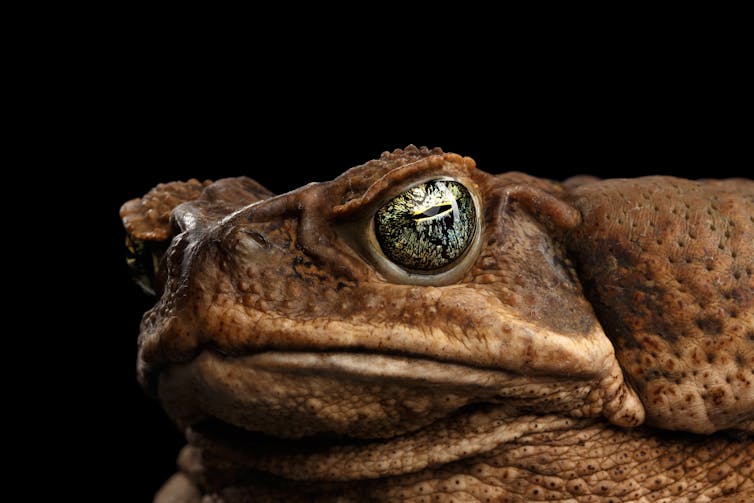 A native of Latin America, the cane toad has adapted well to Australia due to the lack of natural predators. Toads have spread from Queensland as far west as Broome, Western Australia.
www.shutterstock.com
A native of Latin America, the cane toad has adapted well to Australia due to the lack of natural predators. Toads have spread from Queensland as far west as Broome, Western Australia.
www.shutterstock.com
History repeating
Incentives are central to economics. They are ingrained in the laws of demand and supply, and the setting of interest rates and taxes.
Humans react to incentives. The key is setting them just right by accounting for all of the costs involved.
This is the most obvious and least interesting problem with the scheme. In NSW and Queensland, you can earn 10 cents by returning an empty drink container to your local supermarket. That’s a task exponentially easier than catching a cane toad and delivering it alive to your local council chambers.
If it were just a case of the incentives being too low, the solution would be simple: raise the price.
However, this would run into a surprising phenomenon called the Cobra effect. Also known as “perverse incentives”, it describes a situation in which a seemingly well-intentioned proposal actually makes things much worse.
The Cobra effect is named after a curious incident from British Colonial India. Faced with a cobra outbreak, the local government of Delhi enacted a cash-for-cobras scheme, with initial success. But as cobras became harder to find, the locals responded to the incentives in a completely logical way: they started breeding the snakes to claim their bounties. When the scheme was scrapped, breeders released their now-worthless snakes, resulting in the city having more cobras than before the scheme.
A similar case comes from French-run Vietnam.
When the colonial government built a sewerage system under Hanoi early in the 20th century, it inadvertently helped create a rat plague. Its solution was a cash-for-rats scheme - though to save the government having to dispose of hundreds of thousands of rat carcasses, it only required collectors turning in a rat’s tail to claim their bounty.
Crowd displeasers
The consequences this time were not only the creation of pop-up rat-breeding farms, but also hordes of tail-less rats roaming the city streets.
Of course, at its current pittance of 10 cents a toad, Hanson’s proposal is unlikely to lead to lucrative cane-toad farming.
It’s a reasonable claim that the incentives would simply be too low to be effective, leading to no change in the status quo (besides large freezers sitting empty at local council buildings).
Yet even as a toothless policy, a cash-for-cane-toads scheme could produce other unintended consequences.
When people already do something out of their own goodness, like volunteering, putting a price on the activity by offering chump change can actually put them off. Behavioural economists call this “crowding out of intrinsic motivation”. It explains why blood donation rates are no different between countries that pay donors (such as the United States) and those that rely on volunteers (such as Australia).
Read more: For love, not money: kidney exchange encourages social contract
One of the best-known examples in economics involved a day-care in Israel that introduced small fines for parents who were late picking up their children. The result was a doubling of lateness. Before the fine, parents would try to come on time because it was the right thing to do. After the fine, however, that moral value had a price: about three dollars.
Notably, parents continued to come late after the fines were removed. Parents who pay pocket money for chores need only imagine how their own kids would respond if they moved to a “volunteer system”.
Thus economics gives us a third reason to doubt Senator Hanson’s proposal will work: the risk that altruistic citizens who have culled cane toads for free will be discouraged by a price being put on the activity.
Instead of considering the “priceless” value of native ecosystems when spotting an offending creature, people may start weighing up their efforts against 10 cents. This cost-benefit thinking could continue even after the compensation scheme ends.
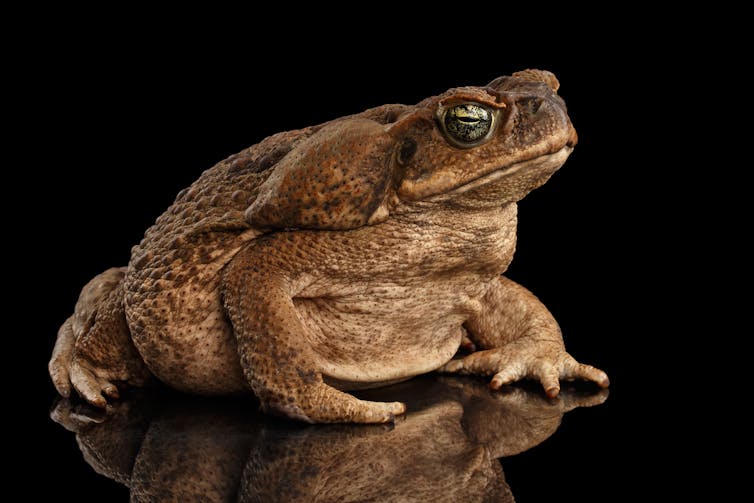 The cane toad is the world’s largest toad. An adult’s body is typically 10-15 cm in length, but some grow at large as 24 cm.
www.shutterstock.com
The cane toad is the world’s largest toad. An adult’s body is typically 10-15 cm in length, but some grow at large as 24 cm.
www.shutterstock.com
That’s the crux of why this payment scheme wouldn’t work. Setting a high price perverts the incentives, while setting a low price crowds out intrinsic motivations. In either case, taxpayer money is wasted and the toad problem is potentially made worse.
The best approach is to leave prices out of it and trust our experts, who are continuing to come up with remarkably innovative ideas to solve the cane toad problem.
Senator Hanson’s proposal was no doubt made with the best of intentions. Unfortunately, in reality the only real beneficiaries would be economics teachers.
Authors: David Smerdon, Assistant Professor, School of Economics, The University of Queensland


















