

La Passion de Simone brings Simone Weil's sufferings to life, but the movements feel static
- Written by: Zoltan Szabo, Cellist and musicologist, University of Sydney
Review: La Passion de Simone, Sydney Festival 2019
It is striking that the cosmopolitan, culturally vibrant city of Sydney, with its covetous interest in a broad spectrum of recent (contemporary is such a loaded term!) literature, theatre, jazz and classical music, rarely offers opera from the last hundred years or so. For goodness’ sake, The Nose, Dmitri Shostakovich’s ground shaking opera from 1928 was premiered less than a year ago in Australia!
It is most commendable, then, that the Sydney Festival in 2019 presented the Australian premiere of La Passion de Simone, a work by prominent Finnish composer, Kaija Saariaho, performed by Sydney Chamber Opera at its customary high standard.
The genre of La Passion de Simone is slightly ambiguous. While according to the Festival’s media sheet it is an opera, the Sydney Morning Herald’s review calls it a cantata-like meditation, yet the composer herself refers to it as an oratorio.
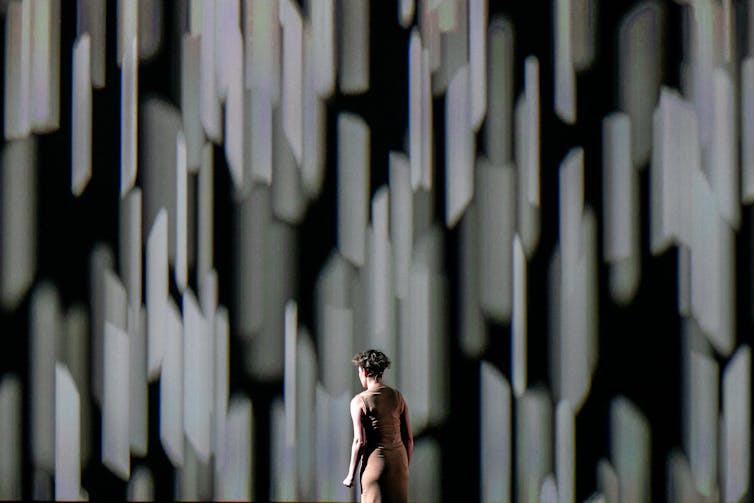 Soprano Jane Sheldon in La Passion de Simone.
Victor Frankowski
Soprano Jane Sheldon in La Passion de Simone.
Victor Frankowski
At any rate, it is a staged composition for soprano, choir and orchestra, perhaps closest to a passion play, as it led the near-capacity audience through the life and sufferings of French philosopher Simone Weil. The Latin verb patior means suffering (hence passion), although more than once, Weil’s passion for social justice is also referred to in the text, adding another valid meaning to the same word.
The composition consists of 15 scenes, a clear reference to the 15 stations of Christ’s suffering on the way to the cross. (If your ecclesiastical memories recall only 14 stations, you are not wrong; it was only in 2000 that Pope St. John Paul II added a 15th station, extending the scenes of suffering and death with the resurrection of Jesus.)
The link between Jesus Christ and Simone Weil is obvious and intentional, if more than a little tenuous. Indeed, both were Jewish and selflessly died a painful death at a very similar age. But a direct parallel of Weil’s life and famously complex philosophical thoughts to the Via Crucis of Jesus – as Lebanese-born Amin Maalouf’s libretto proposes – rings false even if it is an artistically intriguing proposition. After all, among many other interests, Weil worked as a correspondent to La Révolution prolétarienne (or The revolution of the proletariat), a syndicalist magazine in Paris in the 1920s.
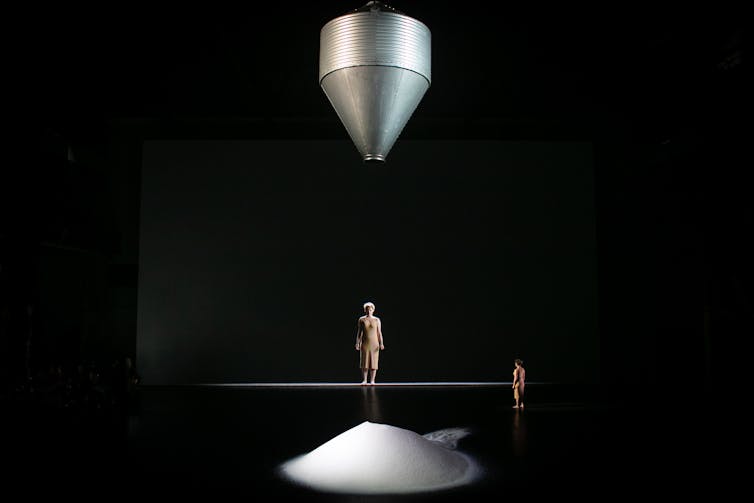 The sparse stage arrangement for La Passion de Simone.
Victor Frankowski
The sparse stage arrangement for La Passion de Simone.
Victor Frankowski
Simone Weil, this modern-day Jeanne d'Arc doggedly following her beliefs, this frail French woman who died of starvation in 1934 to prove exploitation of the poor wrong, was a paradoxical philosopher. She had mystic ideas but also a working knowledge of classical languages such as Sanskrit and Greek. Her Spartan asceticism appealed to many then and later, and she gained a particular influence after her untimely death.
Her life was guided by a crusade for social and political justice, but was by no means without controversies. She fought passionately for the rights of the underprivileged. Her writings are fuelled with catholic zest, yet even a few days before her death, she refused to be baptised. Both André Gide’s description of her as “the patron saint of all outsiders” and Leon Trotsky’s as a “melancholy revolutionary” seem to be fitting, albeit reflecting different aspects of her life.
La Passion de Simone, originally composed for a full choir and orchestra, premiered on this occasion in a chamber version prepared by the composer. In the cavernous space of Bay 17 of Carriageworks, the 19-piece ensemble of Sydney Chamber Opera was placed stage right along with four members of the Song Company (Susannah Lawergren, Jessica O’Donoghue, Owen Elsley, Mark Donnelly), right next to the wall.
On the other side of the stage, adorned only by a large mound of white rice in the centre, stood soprano, Jane Sheldon, with her back to the audience. She never took a single step or showed her face to the audience throughout the 75-minute work.
Director Imara Savage and set & costume designer Elizabeth Gadsby (both having worked with SCO before) used the huge stage effectively by using it very little. The delicate lighting was Alexander Berlage’s work, Bob Scott was responsible for the subtle amplification and sound design.
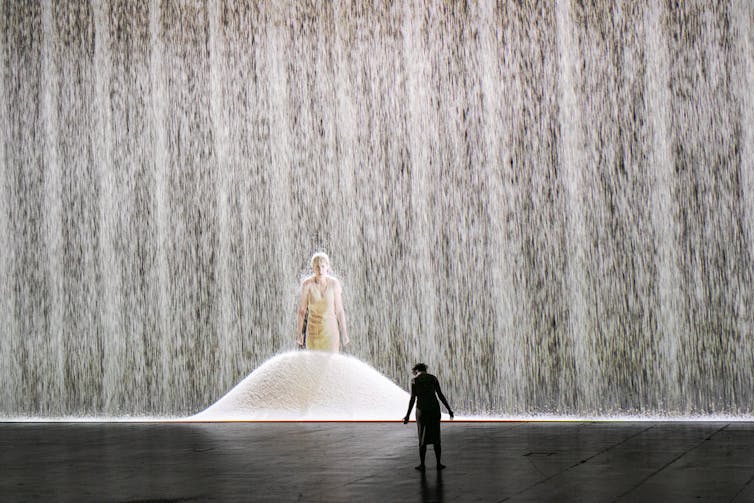 Soprano Jane Sheldon appeared as a projection on a giant wall-to-wall screen, offsetting the sparseness of the stage.
Victor Frankowski
Soprano Jane Sheldon appeared as a projection on a giant wall-to-wall screen, offsetting the sparseness of the stage.
Victor Frankowski
The sparseness of the stage and lack of action on it was splendidly offset by a giant wall-to-wall screen, onto which video artist Mike Daly projected a much-larger-than-life Sheldon, in the same beige costume as the singer on stage. She stood – pained and battered – under a relentless downpour of white rice against a black backdrop for most of the performance. Until the last few minutes, stage-Sheldon’s head and hand movements precisely followed screen-Sheldon’s movements. The metaphor was as simple as it was powerful.
One of the strengths of this minimalist production is that, despite the limited visual or sonic challenges, the audience’s attention is constantly divided at least four ways: between the live and the projected protagonist, the orchestra on stage and the surtitles.
There is always something happening, for example, multiple voices transferring the text of the monodrama from different parts of the stage. Sheldon is presented as the sister of Weil narrating the composition (referring to Weil as “my elder sister, my little sister”) and occasionally as Weil herself. The chorus comments on her life and actions and occasionally an electronically projected stage-whisper cites from Weil’s own writings.
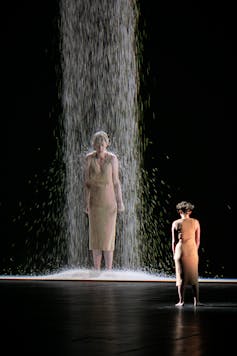 Soprano Jane Sheldon is showered with rice in a wall-to-wall projection in La Passion de Simone.
Victor Frankowski
Soprano Jane Sheldon is showered with rice in a wall-to-wall projection in La Passion de Simone.
Victor Frankowski
Beyond her singing, the expressive possibilities of the protagonist are deliberately limited. Sheldon’s movements deviate only in the last ten minutes or so from her screen-self; her jerky, marionette-like gestures suggest trance-like pain. But it is her singing that radiates memorably throughout the evening. Her understanding of this extensive monodrama is exemplary, both in the technical and musical sense. She uses vibrato sparingly, making it almost ornamental.
Despite no visible contact with the conductor Jack Symonds, the innovative spiritus rector behind the Sydney Chamber Opera, no ensemble or balance problems marred the performance. Symonds’s correct and always reliable conducting made the performance safe and did justice to the strengths of the composition: the well-balanced orchestration, the lush sounds and the lyric atmosphere.
However, even his artistic contribution could not help most of the 15 movements feeling static, due to their almost universally slow tempo and limitations of the compositorial toolkit. After a while, the block chords of the first few movements became mannered, as did the string slides (glissandi), the sustained brass chords or the mostly steady beats of the percussions. Ostensibly having a meditative quality in mind, this work is almost completely bereft of emotional climactic points – which Simone Weil’s life was not.
Authors: Zoltan Szabo, Cellist and musicologist, University of Sydney


















