

We're in the era of overtourism but there is a more sustainable way forward
- Written by: Regina Scheyvens, Professor of Development Studies, Massey University
If you live in a tourist destination, you might dread the holiday invasion. Likewise, disgruntled tourists complain about crowded and polluted beaches, national parks or attractions.
 Graffiti in Oviedo, northern Spain, following a spate of attacks on tourism facilities in Barcelona.
EPA/ALBERTO MORANTE, CC BY-ND
Graffiti in Oviedo, northern Spain, following a spate of attacks on tourism facilities in Barcelona.
EPA/ALBERTO MORANTE, CC BY-ND
Overtourism is now a serious issue in many parts of the world. A good visitor experience may not be a finite resource in the same way as oil, but many popular destinations in Europe are reaching what could be termed “peak tourism”.
Concerns have been raised from Amsterdam to Dubrovnik about noise pollution, crowded parks, pressure on public facilities and rising rents. And in what is depicted as a “global battle” between travellers and locals, anti-tourism street marches have occurred in Barcelona and Venice.
Read more: Anti-tourism attacks in Spain: who is behind them and what do they want?
Unsustainable tourism growth
Tucked away in a seemingly idyllic spot in the South Pacific, New Zealand is not immune to such concerns, which is why Massey University is hosting the world’s first research conference on tourism and the sustainable development goals this month.
Between 2013 and 2018, international tourist arrivals in New Zealand grew by 1.2 million to a total of 3.8 million. During the 12 months to March last year, tourists spent almost $40 billion, and the industry now provides one in every 12 jobs.
Economists see this growth as very positive for the country’s development, but many New Zealanders are ambivalent: 39% have expressed concern over the negative impacts of the growth in international visitors. The pressure on some destinations is particularly intense. For example, the 20,000 permanent residents of the summer and winter playground of Queenstown play host to around three million visitors a year.
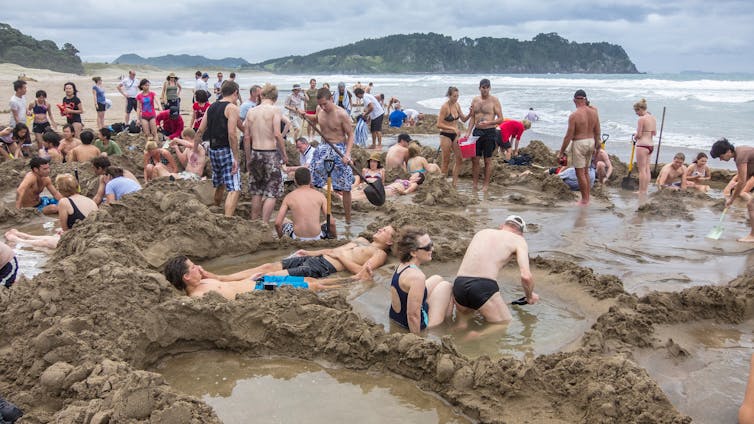 Tourists digging holes in the vulcanic sand of a hot water beach in New Zealand.
from www.shutterstock.com, CC BY-ND
Tourists digging holes in the vulcanic sand of a hot water beach in New Zealand.
from www.shutterstock.com, CC BY-ND
Read more: Rethinking tourism and its contribution to conservation in New Zealand
Meanwhile local government bodies lament the pressure on public infrastructure and demands for waste disposal from freedom campers. Contractors at four Central Otago freedom camping sites have struggled to clear 16 tonnes of rubbish accumulated over the last two months.
A test case for concerns about the promise versus the pitfalls of tourism is the case of cruise tourism in Akaroa Harbour. The battle line lies between some business owners whose livelihoods depend on cruise tourists and local residents who feel their beautiful harbour and quaint town are marred by air and noise pollution and congestion associated with hundreds of tourists dropping in on their town with each cruise.
Read more: Why Australia might be at risk of 'overtourism'
In Australia, the Guinness World Record-certified whitest sand beach in the world - Hyams Beach - has turned away thousands of potential visitors during the Christmas and New Year period. There are only 110 permanent residents and 400 parking spaces, but up to 5000 tourists wanting to visit the beach each day during summer.
These experiences reflect the pressures and tensions tourism brings to many parts of the world, and the need for better ways of regulating tourist activity and capturing the gains from tourism.
A more sustainable way forward
It is clear that most people do not wish to see an end to tourism. But they do want the industry to be far more sustainable. While the term “sustainable tourism” has long been criticised for its lack of clout – and the way it can be seen as merely “sustaining tourism”, there is a way forward. We can look to the United Nations’ 17 sustainable development goals (SDGs), ratified in 2015 by 193 countries and set to guide global development through to 2030.
The SDGs require governments, civil society and business interests to play their parts in creating a more sustainable world. Furthermore, they are multi-faceted, considering social, economic and environmental aspects of sustainability.
Read more: 'Sustainable tourism' is not working – here's how we can change that
The SDGs can help to guide the tourism industry to make more sustainable choices. For example, a strategy by hotels, cruise ships and restaurants to buy as much fresh produce from local farmers as possible would shorten the supply chain and save food miles (thus contributing to SDG 13 on combating climate change). It would also enhance local development (SDG 1 on eliminating poverty).
Tourist resorts in the Pacific could tackle the sexual harrassment from guests that many resort employees experience to show they care about SDG 8 on “decent work for all” and SDG 5 on “empowering all women and girls”.
Tourism trades in luxury products and indulgent experiences, and as such it places a heavy burden on the natural environment and results in waste management issues. SDG 12 on sustainable production and consumption can encourage companies to offer tourists more sustainable products and to reduce wastage of energy, fresh water and food.
Efforts to capture the benefits of tourism while preventing overtourism should pay careful attention to the SDGs.
Authors: Regina Scheyvens, Professor of Development Studies, Massey University


















