

The state of Australia's Indigenous languages – and how we can help people speak them more often
- Written by: Jane Simpson, Chair of Indigenous Linguistics and Deputy Director of the ARC Centre of Excellence for the Dynamics of Language, Australian National University
In 1788 there were between 300 and 700 Indigenous languages spoken across Australia by millions of people, as shown in anthropologist Norman Tindale’s 1974 map. However in the Australian 2016 Census, only around 160 of these languages were reported as being spoken at home.
And of these, only 13 traditional Indigenous languages are still spoken by children. It means that in 60 years’ time only 13 of Australia’s languages will be left, unless something is done now to encourage these children to keep speaking their language, and to encourage children from other language groups to start speaking their heritage languages.
Read more: Why do so few Aussies speak an Australian language?
In the Australian 2016 Census, nearly 650,000 Australians identified as Indigenous. Of these, around 10% (63,754) reported themselves as speaking an Indigenous language at home (they could also be speaking English and/or another Indigenous language). So which languages have the most speakers today?
Even for the 13 traditional Indigenous languages still spoken by children, the total numbers of speakers are tiny. The largest speaker numbers are:
Djambarrpuyngu (one of the large group of Yolŋu languages spoken in Arnhem Land - 4,264 speakers)
Pitjantjatjara (one of the large group of Western Desert languages - 3,054 speakers)
Warlpiri (spoken in Central Australia - 2,276 speakers)
Tiwi (spoken on the Tiwi Islands - 2,020 speakers )
Murrinh-Patha (spoken at Wadeye in the Northern Territory - 1,966 speakers)
Kunwinjku (one of a group of related languages spoken in west Arnhem Land - 1,702 speakers)
13,733 people report that they speak a new Indigenous language. New languages have developed since 1788 from contact between English speakers and Indigenous languages speakers.
These include Kriol spoken in the Katherine region and across the Kimberley, Yumpla Tok spoken in the Torres Strait and Cape York, and Aboriginal English. Others don’t have widely recognised names, and so the Census under-reports these.
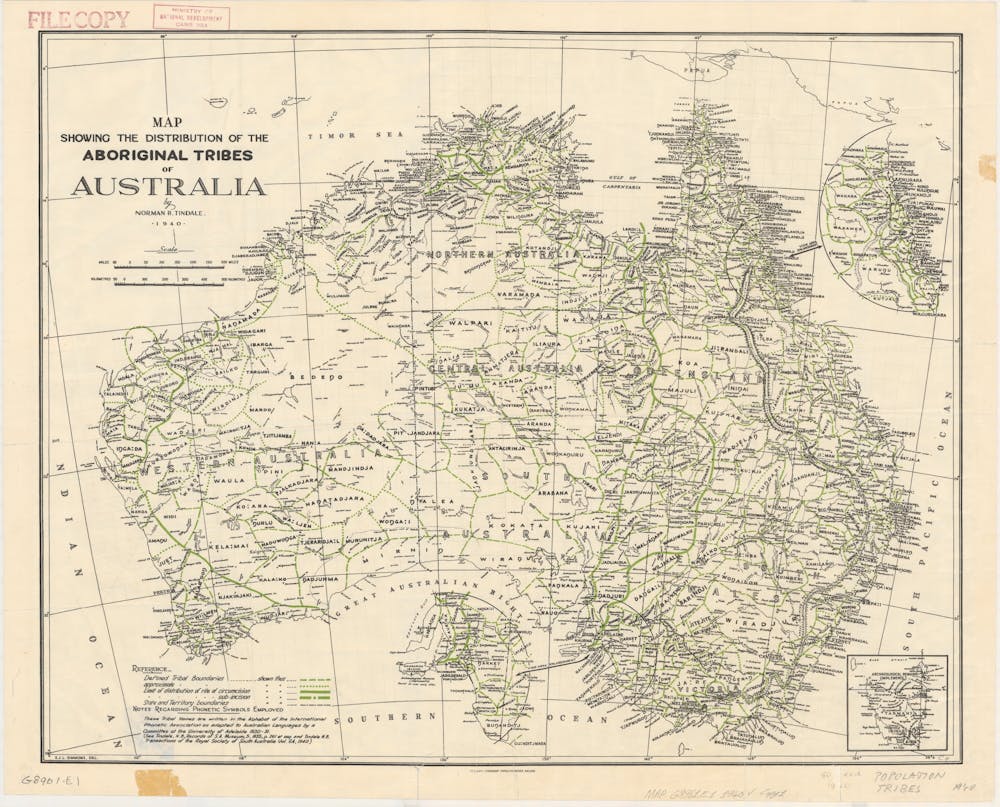 Anthropologist Norman Tindale’s 1974 map of Aboriginal languages.
Held at the South Australia Museum
Anthropologist Norman Tindale’s 1974 map of Aboriginal languages.
Held at the South Australia Museum
Of the 600,000 other Indigenous people, many are actively relearning their ancestral languages. From the 2016 census these include:
However we should be wary of difficulties in counting languages and speakers in the Census. One is drawing boundaries between languages and dialects.
Another is variable names for languages – if Indigenous people don’t have a name for the language they talk (which is common among the world’s smaller languages), or if the Census data analysers don’t recognise that name, then their language will be assigned to “Australian Indigenous languages not further defined” – in the 2016 Census this accounts for 8,625 of the 63,754 people.
Read more: Some Australian Indigenous languages you should know
A third difficulty is that the Census question doesn’t distinguish between people who speak an Indigenous language as their main means of everyday talk, and people who are actively relearning an Indigenous language, and use English for most everyday talk.
The ambiguities and incompleteness in the Census results mean that it is important to find other ways to supplement it. Later this year the Australian government will release its National Indigenous Languages Report which will give a more comprehensive picture.
Read more: Explainer: how Tasmania's Aboriginal people reclaimed a language, palawa kani
Supporting languages
Indigenous people who speak English or a new Indigenous language as their first language often want to learn and reawaken their heritage language from old recordings and documents, and sometimes from elderly speakers.
The Federal government is currently supporting many groups in language reawakening, which can be a transformative activity. In some places it has made Indigenous people and heritage visible through signage, welcomes to country and art events.
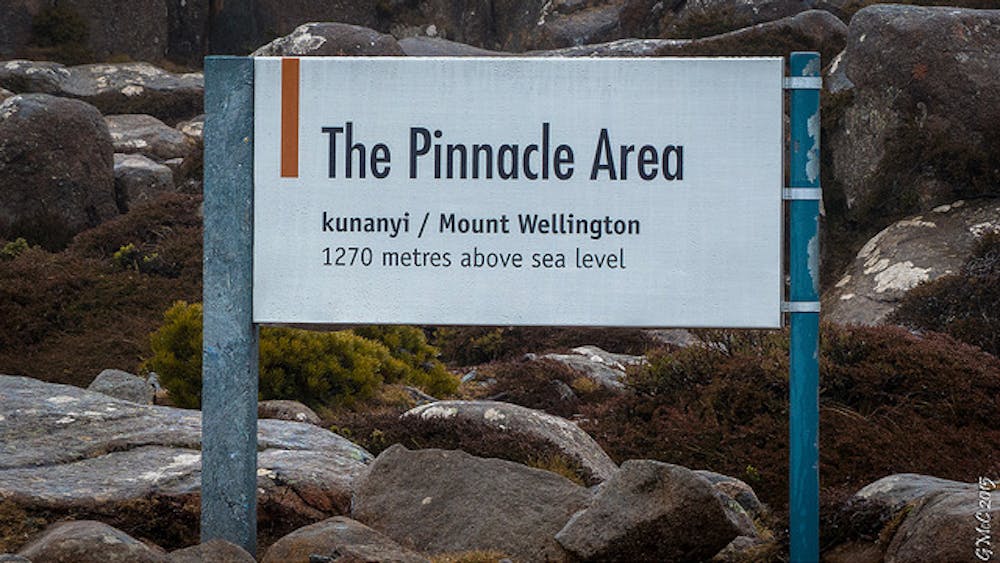 Signage at Hobart’s Mount Wellington using the Tasmanian Aboriginal, palawi kani, name for the mountain, kunanyi.
Flickr/Pursuedbybear, CC BY-NC-SA
Signage at Hobart’s Mount Wellington using the Tasmanian Aboriginal, palawi kani, name for the mountain, kunanyi.
Flickr/Pursuedbybear, CC BY-NC-SA
The demand to learn these languages at school level is increasing, and the supply of teachers with relevant training can’t keep up. There’s only one public teacher education program that addresses this demand: the Master of Indigenous Language Education at the University of Sydney.
Three reawakening languages are now taught at university level: Kaurna (University of Adelaide), Gamilaraay (Australian National University and University of Sydney and Wiradjuri (Charles Sturt University).
Other languages still spoken by children and taught at universities include Yolŋu Matha through Charles Darwin University, and Pitjantjatjara through the University of South Australia.
In 2019 Charles Darwin University and the Australian National University are combining forces with Bininj Kunwok people to teach their language online.
Pressure to speak English
Indigenous people who don’t speak English as a first language face enormous pressure to switch to speaking English only (even though elsewhere in the world multilingualism is common, and affords social and intellectual advantages).
Things that currently make it hard are that:
all government services are delivered in English as the default
interpreters and translations are often not available, or only available for serious court cases and serious medical problems
schools mostly operate in English with inadequate attention to the language needs of the children.
The number of first language speakers of new and traditional language who need language support for access to services is very small - around 60,000. Governments could require at least some of the public servants servicing that area to speak the local language. There are few local Indigenous public servants in remote communities - what if a concerted effort was made to recruit and train more local people?
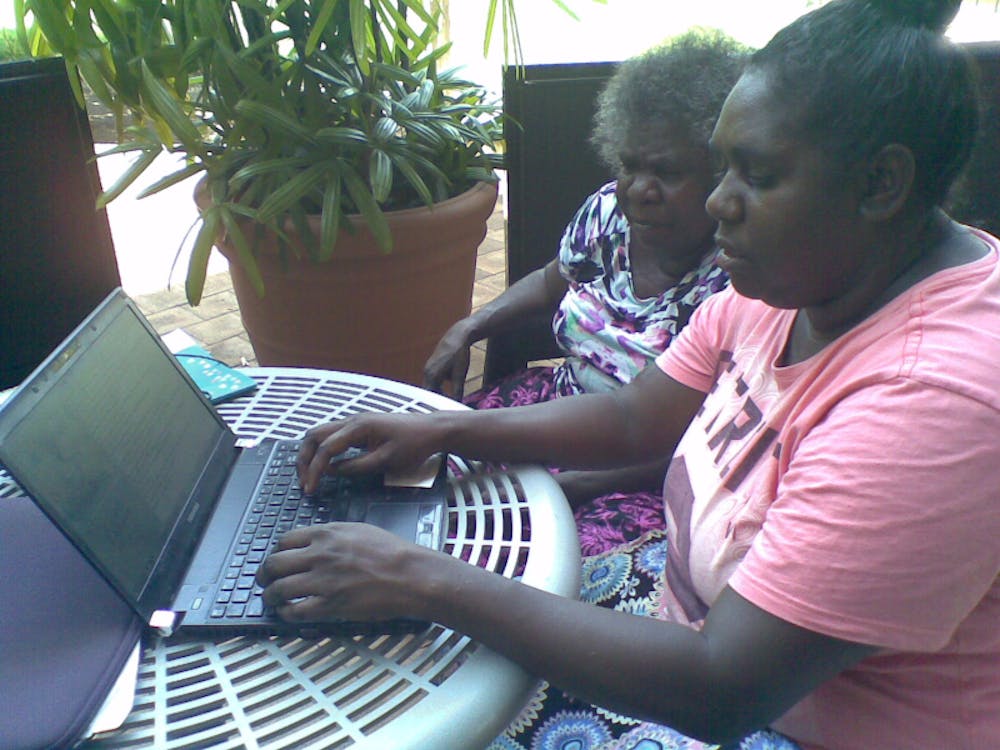 Jill Seraine doing the Bininj Kunwok course.
Provided by Cathy Bow, Author provided
Jill Seraine doing the Bininj Kunwok course.
Provided by Cathy Bow, Author provided
Schooling is another area for support. Governments could say that in communities where the majority of the population speak a language other than English, then the schools should recognise the children’s mother tongue in the initial years of schooling, in order to make the best decisions on how to use languages in their education. Skilled teachers fluent in the local Indigenous language and English are highly valuable in this process. The most cost-effective way of doing this is to make sure local Indigenous people have access to good teacher training.
Having more local Indigenous teachers in remote communities has many other social advantages as well. Properly supporting lessons in Indigenous languages in schools requires rich documentation of the language and society, and so protects cultural heritage. Above all, it shows that the children’s first language is valued by everyone.
A New Year’s Resolution for this International Year of Indigenous Languages: let’s encourage governments to work with Indigenous people to help fulfil hopes for our national languages treasure.
Authors: Jane Simpson, Chair of Indigenous Linguistics and Deputy Director of the ARC Centre of Excellence for the Dynamics of Language, Australian National University


















