

what Mad Max films tell us about filming in the Australian desert
- Written by Melanie Ashe, PhD Candidate, School of Media, Film & Journalism, Monash University
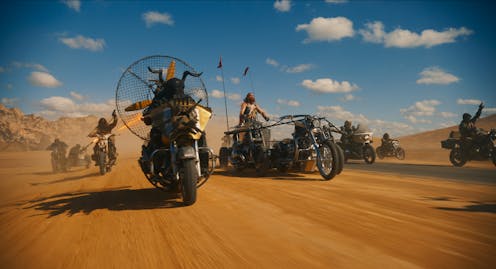
The Mad Max films are set in an arid, barren, post-apocalyptic world known in the movies as “the wasteland”. This is a world of environmental and civil collapse caused by humans. Resources like water are scarce. Clothes, food and transport – such as the film’s famous customised cars – are cobbled together from found and scavenged objects.
The films present a future of mega drought: a possible future scenario for climate change.
The latest film in the franchise, Furiosa, hits cinemas this week. What does the wasteland have to tell us about the role the Australian environment has played in shaping the Mad Max films?
A colonised wasteland
Film scholar Ross Gibson argued the landscape shown on Australian film reflects how white settlers saw the land when they first arrived: hostile, barren and lifeless. Mad Max’s wasteland is a classic example of this, alongside films like Wake in Fright (1971) or Wolf Creek (2005).
This understanding is shaped by problematic attitudes that see the Australian environment as a “wilderness” devoid of life and structure. These attitudes deny the liveliness of the land and deny the fact that Indigenous people have lived on the continent for tens of thousands of years.
The Mad Max wasteland uses this colonial lens in a knowing way. The films state the wasteland was created through resource extraction and conflict. All but one of the Mad Max films were shot in Australia, and they were similarly filmed in places that have been impacted by heavy resource extraction.
By using settings that are visibly degraded by these industries, Mad Max suggests the apocalyptic wasteland is only “barren” and “lifeless” due to recent human impact.

Mad Max 2 (1981) and Furiosa were shot on location in far west New South Wales near Broken Hill. This region is known for its silver, lead and zinc mining history. The spaces around the town were majorly transformed in the 1800s through tree clearing and degradation caused from mining, including major soil erosion.
Rather than a landscape which has always been devoid of structure and people, Furiosa presents a landscape that shows heavy impact through recent industry. The vast expanses of desert horizon that vehicles tear across in the film are bare, but they show a damaged environment caused by humans since colonisation.
Both in the film and in the real world, this is a post-mining landscape.
Greening the desert
Broken Hill is in a semi-arid biosphere known for having a “boom and bust” ecosystem. While this area may look like “the wasteland” after years of drought, the region is also prone to sudden and heavy rainstorms. With the rain arrives a wave of dense, lush desert greenery.
Mad Max: Fury Road (2015) was originally planned to shoot around Broken Hill, but they relocated after the area was “too green” post heavy rainfall in 2011.
“The Mad Max landscape looks like Wales”, director George Miller reported. The production relocated to the sparse and arid environment of Namibia.
But Mad Max 2 was shot in 1981 around Broken Hill under similar circumstances. Following record rainfall, Broken Hill was lush and green, with plants and shrubs clearly seen in behind the scenes footage.
To deal with this issue, the production team used colour grading: where the tones of the film shot are altered to create a different image quality. This gave an onscreen landscape which was more washed out and warm in tone.
During the shooting of Furiosa in 2022, the area was again looking verdant after months of rain. To transform into “the wasteland” while shooting an epic chase scene on location at a local pastoral station, teams removed wide stretches of green desert shrubbery and extra detail in the background was removed with post-production visual effects.
To shoot in Australia, or not?
There is a complex and sometimes fractious relationship between the economic bottom line, on-location film production and the Australian environment.
Given Furiosa and Mad Max 2 came up with creative solutions to film in the unexpectedly green Broken Hill, why did Fury Road relocate away from the region?
These three films demonstrate the environment is easily shaped for film production when convenient and cost effective. Both Mad Max 2 and Furiosa received tax rebates or government funding packages which made filming in Australia attractive, even when the environment needed to be physically changed during production or in post-production.
 The production crew had to remove greenery from the unusually verdant desert.
Jasin Boland/Warner Bros
The production crew had to remove greenery from the unusually verdant desert.
Jasin Boland/Warner Bros
Fury Road, on the other hand, was in pre-production in 2011 when the Australian dollar was almost on parity with the United States dollar, and any grants or tax benefits the film could receive for shooting in Australia would be offset by increased production costs. This means it made sense financially to relocate offshore where the film could be made cheaper.
The future of Australian screen
The wasteland of Mad Max films comment on the tradition of the Australian landscape as “barren”: this stereotype is actually due to recent human development and industry.
Understanding the environmental rhythms of the location behind the wasteland helps to think about how the geophysical world shaped the franchise. While these environments may be impacted by human industry, they are still very much alive. Rain and plant growth have shifted production through changing set and location design processes.
With the boom and bust cycle intensifying due to our changing climate, thinking about how environment shapes film production will be vitally important for the future of Australian screen.
Understanding how Mad Max’s wasteland was produced on screen reveals the underlying realities of climate catastrophe.
Authors: Melanie Ashe, PhD Candidate, School of Media, Film & Journalism, Monash University

















