

how conservation law is failing the black-throated finch
- Written by: April Reside, Researcher, Centre for Biodiversity and Conservation Science, The University of Queensland
Nearly 20 years ago, Australia adopted national environmental legislation that was celebrated widely as a balanced response to Australia’s threatened species crisis. In the same year, Queensland introduced its Vegetation Management Act. Together, these laws were meant to help prevent further extinctions.
But have they worked?
A famous finch
We investigated whether these laws had successfully protected the habitat of the endangered southern black-throated finch.
Our study found that, despite being nominally protected under federal environmental law, habitat for the species has continued to be cleared. Just three out of 775 development applications that potentially impacted the endangered southern black-throated finch were knocked back, according to our new research.
Read more: Queensland coal mines will push threatened finch closer to extinction
Defining exactly what is habitat for the black-throated finch is tricky – we don’t have oodles of data on their habitat use over time, and the extent of their sightings has declined substantially. But Queensland has excellent vegetation mapping, and we recorded all of the vegetation types in which the southern black-throated finch has been seen.
We then mapped the extent of this habitat in three different time periods: historically; at the advent of the environmental laws (2000); and current day.
Clear danger
We found that most of the black-throated finch’s habitat had been cleared before 2000, mainly for agriculture before the mid-1970s. The black-throated finch hasn’t been reliably seen in New South Wales since 1994 and is listed there as “presumed extinct”.
We looked at all the development proposals since 2000 that were referred to the federal government due to their potential impact on threatened species. 775 of these development proposals overlapped areas of potential habitat for the black-throated finch.
Only one of these projects – a housing development near Townsville – was refused approval because it was deemed to have a “clearly unacceptable” impact to the black-throated finch.
In addition to these projects, over half a million hectares of the cleared habitat were not even assessed under federal environmental laws.
We estimate that the species remains in just 12% of its original range. Yet despite this, our study shows that the habitat clearing is still being approved within the little that is left.
So in theory, Australia’s and Queensland’s laws protect endangered species habitat. But in practice, a lot has been lost.
Critical habitat
The highest-profile development proposal to impinge on black-throated finch habitat loss is Adani’s Carmichael coalmine and rail project. Adani has been given approval to clear or otherwise impact more than 16,000 hectares of black-throated finch habitat, a third of which Adani deemed “critical habitat” But there are four other mines in the Galilee Basin that have approved the clearing of more than 29,000 ha in total of black-throated finch habitat.
But it’s not just the mines. In 2018 the federal government approved clearing of black-throated finch habitat for a housing estate and a sugar cane farm, both near Townsville. Several solar farms have also been proposed that would clear black-throated finch habitat around Townsville.
To further complicate matters, the black-throated finch’s habitat is also threatened with degradation by cattle grazing. The finch needs year-round access to certain grass seeds, so where grazing has removed the seeding part of the grasses, made the ground too hard, or caused the proliferation of introduced grasses such as buffel, the habitat suitability can decrease until it is no longer able to support black-throated finches.
So while they are losing their high-quality habitat to development, a lot of their habitat is being degraded elsewhere.
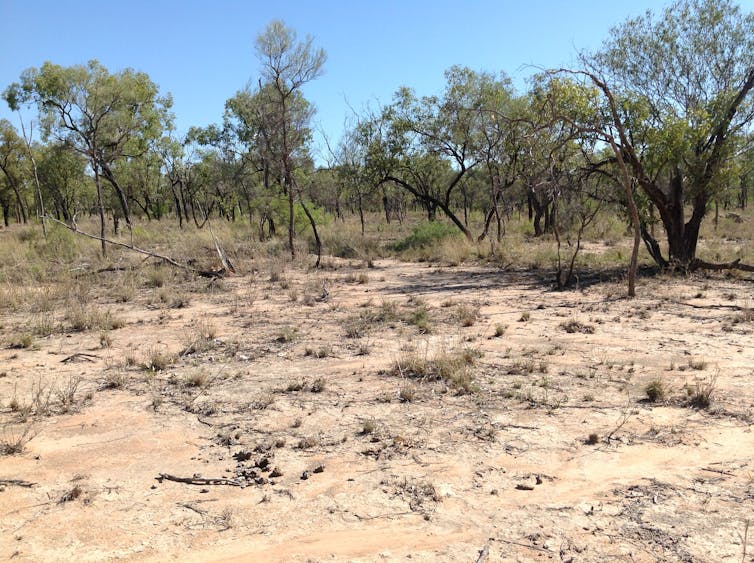 Heavy cattle grazing degrades habitat for the southern black-throated finch by removing edible grass seeds.
April Reside
Heavy cattle grazing degrades habitat for the southern black-throated finch by removing edible grass seeds.
April Reside
The federal government has placed conditions on approved clearing of black-throated finch habitat, often including “offsetting” of any habitat loss. But securing one part of the black-throated finch’s habitat in exchange for losing another still means there is less habitat. This is particularly problematic when the lost habitat is of very high quality, as is the case for Adani’s Carmichael coalmine lease.
Little by little
Our research suggests there is a real danger of the black-throated finch suffering extinction by a thousand cuts – or perhaps 775 cuts, in this case. Each new development approval may have a relatively modest impact in isolation, but the cumulative effect can be devastating. This may explain why a stronger environmental response has not occurred so far.
Read more: Does 'offsetting' work to make up for habitat lost to mining?
So how can we prevent the black-throated finch from going extinct? The finch is endangered because its habitat continues to be lost. So its recovery relies upon halting the ongoing loss of habitat - and ultimately, increasing it. Achieving this would require a political willingness to prioritise endangered species protection.
Australia has already lost hundreds of its unique plants and animals forever. In just the last few years, we have seen more mammals and reptiles disappear to extinction. If we continue on our current path, the southern black-throated finch could be among the next to go.
Authors: April Reside, Researcher, Centre for Biodiversity and Conservation Science, The University of Queensland


















