

Three changes in how we live could derail the dream of the 30-minute city
- Written by: Jennifer Kent, Research Fellow, Urban and Regional Planning, University of Sydney
I live where I want to live and I work where the work is. I don’t understand people that go “this is where I’ll work [and] this is where I’ll buy a house” because it might not be the area they want to live in. – Larry
Sydney’s most recent metropolitan strategy, The Greater Sydney Plan, has the 30-minute city as its key aspiration. The plan recommends that the majority of dwellings be located within a 30-minute public transport trip of a strategic centre or cluster. This is proposed as a solution to the problems with transport, infrastructure and housing affordability that are dominating the headlines and lives of Sydneysiders.
Often the 30-minute city ideal is applied to the journey to work. It’s implied that half-an-hour there and back is around the commute time that is acceptable to most people in most circumstances. A recent survey of residents’ reasons for settling in a new outer suburb of Sydney challenges this assumption. It found other factors were more important than commuting time in deciding where to live.
Read more: 'The 30-minute city': how do we put the political rhetoric into practice?
Proponents of the 30-minute city generally rely, either explicitly or implicitly, on a concept known as the Marchetti Constant. This constant promotes a universal travel time budget of around 60 minutes on average per person per day. The assumption is that although city structure, transport systems and technologies might change, people gradually adjust their lives to their conditions such that the average time they spend travelling stays roughly constant at one hour a day.
In 2014, influential Australian transport planners Peter Newman and John Kenworthy used 2004 data to apply the Marchetti Constant to transport practices in 41 cities around the world. Using average mode travel speeds, the analysis showed mean and median travel times per day were 66 and 65 minutes respectively. Sydney is included in this list.
It is from this kind of analysis that the 30-minute city ideal is born. However, the applicability of Newman and Kenworthy’s analysis to life in Australian cities in 2019 is questionable.
For a start, the analysis is difficult to replicate. It relies on multiple assumptions and masks variability and nuance in its use of averages.
More importantly, elements of life and employment in cities have changed since the Marchetti finding (1980) and Newman and Kenworthy’s most recent data collection (in 2004).
So what has changed?
First, global labour markets have become more flexible. The workforce in 2004 was less dominated by fixed-term contracts and casual positions. The gig economy, based on short-term contract work, freelancing and self-employment, was relatively nascent.
These changes to ways of working mean people can no longer expect their place of employment to remain stable over time. It therefore doesn’t make sense to base decisions on where to live on proximity to the place where we work. Factors such as lifestyle take precedence over minimising travel time when considering where to live.
Second, back in 2004 the housing market was more accessible. More suburbs had median house prices that were affordable for more people. Again, this made the idea of households following employment possible. People not only had the inclination but also the financial ability to live close to where they worked and minimise travel time.
Third, the way we use time while commuting has changed. Technology has started to free time spent travelling from complete redundancy. In 2019 we can legally drive a car while participating in teleconferences, listening to audiobooks and podcasts and/or chatting to family and friends online.
These three basic shifts – working conditions, housing affordability and the freeing up of commute time – highlight that it’s time to question the idea of a universal travel time budget of 60 minutes per day. While the 30-minute city may be desirable to most, our willingness to travel, the need to travel and the way we experience travel are being recast.
Read more: A 20-minute city sounds good, but becoming one is a huge challenge
What matters to suburban residents?
Some of these factors were confirmed by a recent survey of 300 people who had recently relocated to the greenfield suburb of Oran Park. The survey asked the newly settled residents why they chose Oran Park, which is about 60 kilometres southwest of the Sydney CBD. It was not surprising they didn’t choose to live in Oran Park to minimise the time they spent travelling.
They were more motivated by the affordability of a new house in a family-friendly and attractive urban neighbourhood. Being close to employment and public transport access were less important. Residents’ treatment of these elements of access as less significant was balanced by most respondents ranking the ability to drive everywhere as an appealing feature of Oran Park.
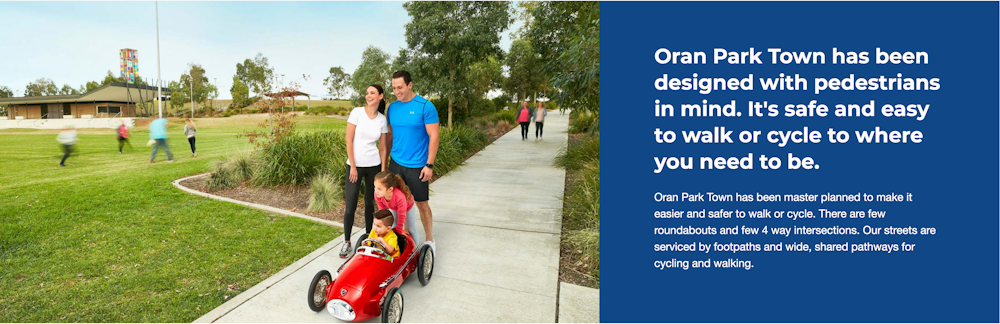 Why Oran Park? The developers know residents buy into the lifestyle of a detached family home with paths for walking, schools for learning and parks for playing.
www.oranparktown.com.au
Why Oran Park? The developers know residents buy into the lifestyle of a detached family home with paths for walking, schools for learning and parks for playing.
www.oranparktown.com.au
Read more: 'Children belong in the suburbs': with more families in apartments, such attitudes are changing
This confirms existing research suggesting location relative to employment is not a particularly strong influence on housing choice. It also confirms research demonstrating how attachments to private car use are alive and well in subsets of Australian culture.
Proponents of jobs-housing balance within a city’s sub-regions, including those who dream of a 30-minute city, rarely consider these factors.
Where does this leave those seeking to plan for the growth of a city such as Sydney? This study suggests a population so desperate to buy into the lifestyle of a detached family home with paths for walking, schools for learning and parks for playing that they will wear an increased commute time.
This willingness – a cultural inclination to sacrifice for home ownership – is lived out in both greenfield estates and infill developments across Australia’s rapidly growing cities. Decreasing housing affordability and increased uncertainty in employment – including where that employment will be located – reinforce this. This is a mix with unanticipated potential to derail the 30-minute city ideal.
Authors: Jennifer Kent, Research Fellow, Urban and Regional Planning, University of Sydney


















