

Breast cancer screening in Australia may change. Here’s what we know so far
- Written by Brooke Nickel, NHMRC Emerging Leader Research Fellow, University of Sydney
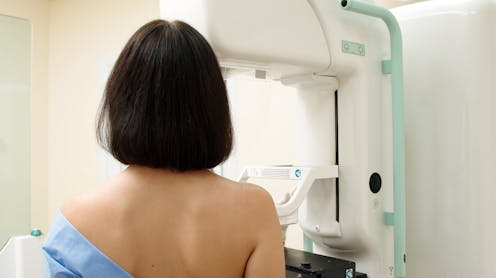
The way women are screened for breast cancer in Australia may change.
There’s international debate on the age women should be invited for screening. But an even larger change being considered worldwide is whether to screen women at high and low risk of breast cancer differently.
But what such a “risk-based” approach to screening might look like in Australia is not yet clear.
Here’s why researchers and public health officials are floating a change to breast cancer screening in Australia, and what any changes might mean.
Why breast cancer screening may need to change
Mass screening (known as population-based screening) for breast cancer was introduced in Australia and many other developed countries in the 1980s and 90s.
This was based on robust research that found early detection and treatment of cancers before there were symptoms prevented some women from dying from breast cancer.
These programs offer regular breast cancer screening to women within a specific age group. For example, in Australia, women aged 40-74 years can have free mammograms (x-rays of the breasts) every two years. The BreastScreen program sends invitations for screening to those aged 50-74.
However, evidence has been mounting that mammography screening could be inadvertently causing harm for some women.
For some, screening causes a false alarm that may cause anxiety, and unnecessary tests and procedures. Even though these tests rule out cancer, these women may remain anxious and perceive something is wrong for many years.
A more insidious harm is overdiagnosis, where screening detects a non-growing or slow-growing lesion that looks like “cancer” under the microscope, but would not have progressed or caused harm if it had been left alone. This means some women are having unnecessary surgery, radiotherapy and hormone therapy that will not benefit them, but may harm.
Although trials have shown screening reduces the risk of dying from breast cancer, questions are being raised about how much it saves lives overall. That is, it’s uncertain how much the reduced risk of dying from breast cancer translates into improvements in a woman’s overall survival.

How about better targeting women?
One idea is to target screening to those most likely to benefit. Under such a “risk-based” approach, a women’s personal risk of breast cancer is estimated. This may be based on her age and many other factors that may include breast density, family history of breast cancer, body-mass index, genetics, age she started and stopped her periods, and the number of children she’s had.
Women who are at higher risk would be recommended to start screening at a younger age and to screen more frequently or to use different, more sensitive, imaging tests. Women at lower risk would be recommended to start later and to screen less often.
The idea of this more “precise” approach to screening is to direct efforts and resources towards the smaller number of women most likely to benefit from screening via the early detection of cancer.
At the same time, this approach would reduce the risk of harm from false positives (detection of an anomaly but no cancer is present) and overdiagnosis (detection of a non-growing or slow-growing cancer) for the larger number of women who are unlikely to benefit.
On face value this sounds like a good idea, and could be a favourable change for breast cancer screening.
But there’s much we don’t know
However, it’s uncertain how this would play out in practice. For one thing, someone’s future risk of a cancer diagnosis includes the risk of detecting both overdiagnosed cancers as well as potentially lethal ones. This is proving to be a problem in risk-based screening for prostate cancer, another cancer prone to overdiagnosis.
Ideally, we’d want to predict someone’s risk of potentially lethal cancers as these are the ones we want to catch early.
It is also still uncertain how many women found to be at low risk will accept a recommendation for less screening.
These uncertainties mean we need robust evidence the benefits outweigh the harms for Australian women before we make changes to the breast cancer screening program.
There are several international randomised controlled trials (the gold standard for research) under way to evaluate the effectiveness of risk-based screening compared to current practice. So it may be prudent to wait for their findings before making changes to policy or practice.
Even if such trials did give us robust evidence, there are still a number of issues to address before implementing a risk-based approach.
One key issue is having enough staff to run the program, including people with the skills and time to discuss with women any concerns they have about their calculated risk.
How about breast density?
Women with dense breasts are at higher risk of breast cancer. So notifying women about their breast density has been proposed as a “first step” on the pathway to risk-based screening. However, this ignores the many other factors that determine a woman’s risk of breast cancer.
Legislation in the United States and changes in some Australian states mean some women are already being notified about their breast density. The idea is to enhance their knowledge about their breast cancer risk so they can make informed decisions about future screening.
But this has happened before we know what the best options are for such women. An ongoing Australian trial is investigating the effects that breast density notification has on individual women and the health system.
What next?
Robust evidence and careful planning are needed before risk-based screening or other changes are made to Australia’s breast cancer screening program.
Where changes are made, there needs to be early evaluation of both the benefits and harms. Programs also need independent, regular re-evaluation in the longer term.
Authors: Brooke Nickel, NHMRC Emerging Leader Research Fellow, University of Sydney

















