

A struggling people languishing across barren lands? No, evidence shows life in ancient Saudi Arabia was complex and thriving
- Written by Jane McMahon, Research Associate, Discipline of Archaeology, University of Sydney
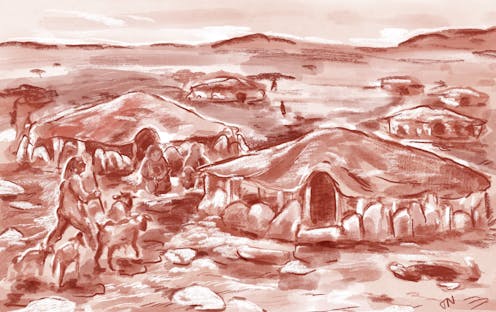
To date, little has been known about people living in north-western Saudi Arabia during the Neolithic – the period traditionally defined by the shift to humans controlling food production and settling into communities with agriculture and domesticated animals.
The piecemeal evidence available hinted traditional ideas – of small struggling groups constantly on the move across the barren lands – needed to be revisited.
Now, an Australian-led team has released new research on monumental buildings we call “standing stone circles”. The findings are helping to rewrite what we know about the people who lived on this land between 6,500 and 8,000 years ago.
Our evidence reveals what they ate, what tools they used and even the jewellery they wore. It leads us to think these people weren’t struggling so much after all, but rather had found complex and strategic ways to thrive on the land for millennia.
The project
Over the past five years, our team of researchers has studied 431 standing stone circles in the AlUla and Khaybar regions of north-west Saudi Arabia, as part of an ongoing project sponsored by the Royal Commission for AlUla. Of the 431 structures, 52 have been surveyed in detail and 11 excavated.
Our latest findings come from a selection of buildings found on the Harrat ‘Uwayrid – a volcanic plateau formed over millennia. The dense clusters of standing stone circles on the harrat show us how complex these mobile pastoralist communities actually were. We also recovered remnants left behind by the people who lived in these buildings for more than 1,000 years.

We used a range of modern and traditional techniques to tackle the practical limitations of working in such a remote and rugged landscape. Aerial survey by helicopter helped us identify examples of the dwellings across 40,000 square kilometres of basalt and sandy desert. Drones were also used to make plans of the sites, some almost three hectares in size.
More than just a house
Our’s is the first published evidence for domestic architecture from this period. These buildings are substantial, between 4 and 8 metres wide. They are formed by two concentric rows of large stones placed end-to-end in a circle.
 The shelter foundations were formed by massive basalt blocks weighing up to a tonne each.
RCU/University of Western Australia/University of Sydney.
The shelter foundations were formed by massive basalt blocks weighing up to a tonne each.
RCU/University of Western Australia/University of Sydney.
We theorise the space created between the two rows of stone acted as a foundation for timber posts wedged between the rows to support the dwelling’s roof. Another slab in the centre supported a central timber post lashed to it.
Based on the tools and animal remains we’ve found, we think the occupants probably threw animal skins across the top of the structure to enclose it, forming a roof of sorts.
These structures – which we think of more as shelters than “houses” – were used for any and all activities. Inside, we found evidence of stone tool-making, cooking and eating, as well as lost and broken tools used for processing animal hides.
A diverse palate
Our analysis of the animal bones found inside the structures shows these people mostly ate domesticated species, such as goats, sheep and a smaller number of cattle. They supplemented this with wild species such as gazelles and birds.
This means they could respond to changes in their environment with flexibility – giving them resilience at a time when climate change would have been affecting the availability of water and vegetation.
This adaptability also extended to their use of plants. They left behind many grindstones – slabs of basalt worn flat by the grinding of wild grasses and local plants.
 Grindstones and mullers were used for crushing pigment and plants.
RCU/University of Western Australia/University of Sydney.
Grindstones and mullers were used for crushing pigment and plants.
RCU/University of Western Australia/University of Sydney.
Nomadic or mobile?
We assume these people didn’t stay in one place, since they lived in buildings that could be partially dismantled and moved. Goats and sheep also need fresh pastures and water to survive.
That said, these people spent enough time at each site to justify the time and effort required to source and manipulate basalt blocks weighing up to one tonne each. This suggests they returned to these locations time and again for hundreds of years, if not more than 1,200 years.
They left behind materials collected from near and far. While the local basalt was sufficient for everyday tools, the best materials made from chert (a tough sedimentary rock) were brought up to the Harrat Uwayrid to make fine arrowheads, drills and scrapers.
 A selection of small chert artefacts including arrowheads and a scraper.
RCU/University of Western Australia/University of Sydney.
A selection of small chert artefacts including arrowheads and a scraper.
RCU/University of Western Australia/University of Sydney.
They also collected red stone to be crushed into pigment. It may have been used for rock art, or perhaps for painting bodies and hides.
Small shells were brought from the Red Sea (some 120 kilometres away) to make beads. Other objects we found included bracelets and pendants carved and polished from exotic stone.
 We found remnants of hanging ornaments and bracelets (right).
RCU/University of Western Australia/University of Sydney.
We found remnants of hanging ornaments and bracelets (right).
RCU/University of Western Australia/University of Sydney.
Trading in the Levant
It seems likely these people formed a culturally distinct group who interacted with their neighbours in the Levant to the north, a region which includes modern-day Jordan, Palestine and Syria, among others.
Our findings suggest they imported their animals and stone tool technologies. Some of the tools resemble those found at earlier sites across Jordan, which suggests they either traded or learned how to make them from further north.
Domesticated goats and sheep would have also been sourced from further afield, as there were no wild versions of these animals in the area. Everything they brought was incorporated usefully into their way of life, to suit the lands they already knew so well.
Our work is just beginning to fill in the gaps of what life was like in north-western Arabia, helping reintroduce it – and its people – into the picture of the wider region.
Authors: Jane McMahon, Research Associate, Discipline of Archaeology, University of Sydney

















