

Modern Australian
The Times

marine habitats are being squeezed

  • Written by Mark John Costello, Professor in Marine Biology, Nord University
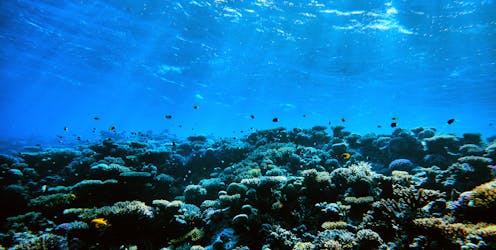
marine habitats are being squeezed

In the deepest parts of the ocean, below 4,000 metres, the combination of high pressure and low temperature creates conditions that dissolve calcium carbonate, the material marine animals use to make their shells.

This zone is known as the carbonate compensation depth – and it is expanding.

This contrasts with the widely discussed ocean acidification of surface waters due to the ocean absorbing carbon dioxide from the burning of fossil fuels.

But the two are linked: because of rising concentrations of carbon dioxide in the ocean, its pH is decreasing (becoming more acidic), and the deep-sea area in which calcium carbonate dissolves is growing, from the seafloor up.

The transition zone within which calcium carbonate increasingly becomes chemically unstable and begins to dissolve is called the lysocline. Because the ocean seabed is relatively flat, even a rise of the lysocline by a few metres can rapidly lead to large under-saturated (acidic) areas.

Our research showed this zone has already risen by nearly 100 metres since pre-industrial times and will likely rise further by several hundreds of metres this century.

Millions of square kilometres of ocean floor will potentially undergo a rapid transition whereby calcareous sediment will become chemically unstable and dissolve.

Expanding boundaries

The upper limit of the lysocline transition zone is known as the calcite saturation depth, above which seabed sediments are rich in calcium carbonate and ocean water is supersaturated with it. The calcite compensation depth is its lower limit, below which seabed sediments contain little or no carbonate minerals.

Conceptual diagram showing two seafloor areas A and B exposed by the rising lysocline.
The carbonate content of seafloor sediments decreases within the lysocline, reaching zero below the carbonate compensation depth (CCD). Above the lysocline is the calcite saturation depth (CSD), with seabed sediments rich in calcium carbonate. Author provided, CC BY-SA

The area below the calcite compensation depth varies greatly between different sectors of the oceans. It already occupies about 41% of the global ocean. Since the industrial revolution, this zone has risen for all parts of the ocean, varying from almost no rise in the western Indian Ocean to more than 300 metres in the northwest Atlantic.

If the calcite compensation depth rises by a further 300 metres, the area of seafloor below it will increase by 10% to occupy 51% of the global ocean.

These maps show the changes in area of ocean exposed to corrosive bottom waters in 17 different regions. The pre-industrial CCD is dark blue and areas above the lysocline are light blue. Map A shows the present day and map B shows a lysocline rise of 300 metres.
These maps show the changes in area of ocean exposed to corrosive bottom waters in 17 different regions. The pre-industrial CCD is dark blue and areas above the lysocline are light blue. Map A shows the present day and map B shows a lysocline rise of 300 metres. Author provided, CC BY-SA

Distinct habitats

For the first time, a recent study showed the calcite compensation depth is a biological boundary with distinct habitats above and below it. In the northeast Pacific, the most abundant seabed organisms above the calcite compensation depth are soft corals, brittle stars, mussels, sea snails, chitons and bryozoans, all of which have calcified shells or skeletons.

However, below the calcite compensation depth, sea anemones, sea cucumbers and octopus are more abundant. This under-saturated (more acidic) habitat already limits life in 141 million square kilometres of the ocean and could expand by another 35 million square kilometres if the calcite compensation depth were to rise by 300 metres.

In addition to the expansion of the calcite compensation depth, parts of the ocean in low latitudes are losing species because the water is getting too warm and oxygen levels are declining, both also due to climate change.

Thus, the most liveable habitat space for marine species is shrinking from the bottom (rising calcite compensation depth) and the top (warming).

Island nations most affected

The exclusive economic zones of some countries will be more affected than others. Generally, oceanic and island nations lose more, while countries with large continental shelves lose proportionately less.

Bermuda’s EEZ is predicted to be the most affected by a 300-metre rise of the calcite compensation depth above the present level, with 68% of that country’s seabed becoming submerged below the lysocline. In contrast, only 6% of the US EEZ and 0.39% of the Russian EEZ are predicted to be impacted.

From a global perspective, it is remarkable that already 41% of the deep sea is effectively acidic, that half may be by the end of the century, and that the first study showing its effects of marine life was only published in the past year.

Authors: Mark John Costello, Professor in Marine Biology, Nord University

Read more https://theconversation.com/as-ocean-surfaces-acidify-a-deep-sea-acidic-zone-is-expanding-marine-habitats-are-being-squeezed-215672

Vista Cruises Enters "Two-Flagship Era" as Vista Aurora Completes Inaugural Voyage

Vista Aurora Sets Sail along the Yangtze. (Photo courtesy of the company)YICHANG, China — August 5, 2026 — Vista Aurora, a high-end interprovinc...

A Digital Preparation Checklist For International Medical Conferences

An international medical conference compresses many responsibilities into a few days. A delegate may need to present research, move between venues, ...

The Growing Popularity of Lab Grown Diamonds in Sydney and Hong Kong

The diamond industry has changed significantly in recent years as more buyers seek ethical, affordable, and sustainable alternatives to mined diamon...

Modern AI SEO Agency vs Traditional SEO: What’s the Difference

Search engine optimisation has changed dramatically over the past few years. Search engines have become smarter, user behaviour has evolved, and bus...

Caravan Travel for Modern Australian Getaways: Plan a Comfortable Holiday

A family road trip is one of the best ways to explore Australia together. And, travelling by caravan gives you the freedom to take your time, stop a...

Mini Excavator and Trailer Package for Sale: What I Buy as One Deal in 2026

The first client who asked me for a mini excavator and trailer package for sale wasn’t trying to save a few hundred dollars on shipping. They we...

Make Dad a Guest in His Own Home This Father’s Day

Father’s Day can accidentally turn Dad into the unpaid event manager of his own celebration. He lights the barbecue, finds extra chairs, checks wh...

Where to Enjoy Your Off-Road Caravan on the Gold Coast

With a caravan, you can travel anywhere and everywhere without battling the rush of the peak holiday season or last-minute reservations. While the r...

How Osteopathy Supports Recovery from Sciatica and Nerve Pain

Sciatica isn't just annoying. It's genuinely painful. It sits deep in your glute and shoots straight down the back of your leg. It turns something as...

The Winter Jewellery Edit: Five Pieces You'll Wear All Season

As wardrobes shift to cosy knits, tailored coats and rich seasonal textures, jewellery becomes the finishing touch that pulls every winter outfit to...

7 Signs It's Time to Upgrade Your Piston Air Compressor

If you run a workshop, panel shop, or fabrication business anywhere around Perth, you already know what heat and dust do to equipment over a few sum...

How Long Do Bathroom Renovations Melbourne Take? Step-by-Step Process Explained

Planning a bathroom renovation is exciting, but one of the biggest questions homeowners ask is, "How long will it take?" While every project is uniq...

Why Your Skin Breaks Out: The Science of Acne Explained

Acne is the most common skin condition in the world. An estimated 85% of people experience it at some point between the ages of 12 and 24, and a gro...

10 Swimwear Trends Australian Women Are Wearing This Summer

Every Australian summer brings a fresh wave of swimwear trends, but some styles have much greater staying power than others. While fashion constantly ...

Why Regular Skills Updates Are Essential for Licensed Security Officers

A guard at a Brisbane shopping centre gets a call about a shoplifter who's turned aggressive.  They’ve done the job for six years. But their de-...

10 Benefits of Choosing Professional Tutoring Penrith Services

Every student has unique learning strengths, challenges, and academic goals. While classroom teaching provides essential knowledge and structure, so...

Sunshine Coast Baby Classes Prove Big Hit Among First-Time Mums

There's a movement gaining traction on the Sunshine Coast, providing a village of support, socialisation and relief for first-time mothers and babie...

Father's Day Gift Ideas for Men Who Are Hard to Buy For

Some dads are easy to buy for. Others do not want anything, already have everything, or give you the classic "don't worry about me" answer every yea...
















